



Luliconazole
Based on 1 publication(s) in Google Scholar
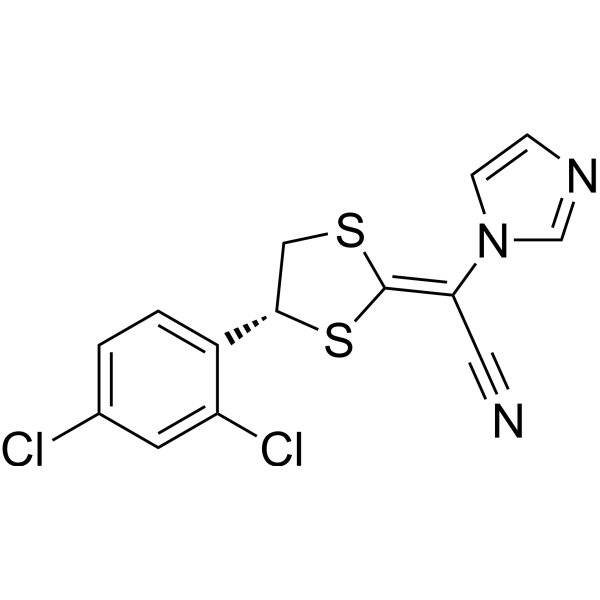
Luliconazole (NND 502) is a topical antifungal imidazole antibiotic with broad-spectrum and potent antifungal activity. Luliconazole can be used for the research of skin infection, including dermatophytosis, tinea corporis, tinea pedis et al.
For research use only. We do not sell to patients.
- Purity: 99.95%
- CAS No.: 187164-19-8
- Formula: C14H9Cl2N3S2
- Molecular Weight:354.28
-
Storage:Powder -20°C, 3 years , 4°C, 2 years ; In solvent -80°C, 2 years , -20°C, 1 year

To place orders, for customer services and technical support, please contact: MedChemExpress USA
Tel: 609-228-6898 E-mail: [email protected] [email protected]


-
 Biological Activity
-
Chemical Information
-
Solvent & Solubility
- Purity & Documentation
- References
-
 Help & FAQs
-

Antifungal Compound Library
HY-L048
-
Anti-COVID-19 Compound Library
HY-L052
-
NMPA-Approved Drug Library
HY-L053
-
FDA Approved & Pharmacopeial Drug Library
HY-L066
-
Antibiotics Library
HY-L067
-
Human Metabolite Library
HY-L123
-
Off-patent Drug Library
HY-L141
-
Bioactive Compound Library Max
HY-L181
-
MCE Bioactive Compound Library
HY-L001V
-
Drug Repurposing Compound Library Plus
HY-L035P
-
FDA-Approved Drug Library Plus
HY-L022P
-
FDA-Approved Drug Library Mini
HY-L022M
-
Bioactive Compound Library
HY-L001
-
High-Throughput Bioactive Compound Library
HY-L205
-
Mass Spectrometry Human Metabolite Library
HY-L215
-
Anti-Infection Compound Library
HY-L002
-
FDA-Approved Drug Library
HY-L022
-
Drug Repurposing Compound Library
HY-L035


Publications Citing Use of MedChemExpress (MCE) Luliconazole
MoreAll Antibiotic Isoforms
More

Biological Activity
The MICs of LLCZ against the organism measured by a standardized microdilution method using RPMI 1640 medium, were 0.002 μg/ml for T. mentagrophytes TIMM1189 and 0.002 μg/ml for TIMM2789[1].The minimum inhibitory concentrations (MIC) of luliconazole against Trichophyton spp. (T. rubrum, T. mentagrophytes and T. tonsurans) and Candida albicans are measured by the standardized broth microdilution method[1].Luliconazole demonstrates great potency against Trichophyton spp. (MIC range: 0.00012-0.002 μg/ml) than the reference agents, with T. rubrum being the most susceptible to it (MIC range: 0.00012-0.00024 μg/ml). Luliconazole is against T. mentagrophytes with MIC values ranging 0.00012-0.002 μg/ml. Luliconazole is also highly active against Candida albicans (MIC range: 0.031-0.13 μg/ml). Further, the MIC of luliconazole against Malassezia restricta is very low (MIC range: 0.004-0.016 μg/ml)[1].
MedChemExpress (MCE) has not independently confirmed the accuracy of these methods. They are for reference only.
MedChemExpress (MCE) has not independently confirmed the accuracy of these methods. They are for reference only.
-
Animal Model:Male specific-pathogen-free (SPF) Hartley guinea pig models of tinea corporis and tinea pedis[2]
-
Dosage:0.02%-1%
-
Administration:Appliance on skin; 0.02%-1%; 7-14 days
-
Result:Was sufficiently potent for short-term treatment for dermatophytosis in vivo.
| NCT Number | Sponsor | Condition | Start Date |
Phase

|
|---|---|---|---|---|
| NCT01329991 | Plexxikon| | 2011-05 | PHASE1 |


Chemical Information
-
CAS No. 187164-19-8
-
Appearance Solid
-
Molecular Weight 354.28
-
Formula C14H9Cl2N3S2
-
Color White to yellow
-
SMILES
ClC1=CC(Cl)=CC=C1[C@@H]2CS/C(S2)=C(C#N)\N3C=CN=C3
-
Synonyms
NND 502
-
Shipping
Room temperature in continental US; may vary elsewhere.
-
Storage
Powder -20°C 3 years 4°C 2 years In solvent -80°C 2 years -20°C 1 year


Publications (1)
-
Journal Impact Factor
-
Most Recent
-
Toxicol Appl Pharmacol
In silico and in vitro assessment of drugs potentially causing adverse effects by inhibiting CYP17A1. [Abstract]2024 May:486:116945. PMID: 38688424


Solvent & Solubility
DMSO : 50 mg/mL (141.13 mM; Need ultrasonic; Hygroscopic DMSO has a significant impact on the solubility of product, please use newly opened DMSO)
Please refer to the solubility information to select the appropriate solvent. Once prepared, please aliquot and store the solution to prevent product inactivation from repeated freeze-thaw cycles.
Storage method and period of stock solution: -80°C, 2 years; -20°C, 1 year. When stored at -80°C, please use it within 2 years. When stored at -20°C, please use it within 1 year.
Please refer to the solubility information to select the appropriate solvent. Once prepared, please aliquot and store the solution to prevent product inactivation from repeated freeze-thaw cycles.
Storage method and period of stock solution: -80°C, 2 years; -20°C, 1 year. When stored at -80°C, please use it within 2 years. When stored at -20°C, please use it within 1 year.
Concentration (start) × Volume (start) = Concentration (final) × Volume (final)
Select the appropriate dissolution method based on your experimental animal and administration route.
- For the following dissolution methods, please ensure to first prepare a clear stock solution using an In Vitro approach and then sequentially add co-solvents:
- To ensure reliable experimental results, the clarified stock solution can be appropriately stored based on storage conditions. As for the working solution for In Vivo experiments, it is recommended to prepare freshly and use it on the same day.
- The percentages shown for the solvents indicate their volumetric ratio in the final prepared solution. If precipitation or phase separation occurs during preparation, heat and/or sonication can be used to aid dissolution.
Add each solvent one by one: 10% DMSO 40% PEG300 5% Tween-80 45% Saline
Solubility: ≥ 2.5 mg/mL (7.06 mM); Clear solution
This protocol yields a clear solution of ≥ 2.5 mg/mL (saturation unknown).
Taking 1 mL working solution as an example, add 100 μL DMSO stock solution (25.0 mg/mL) to 400 μL PEG300, and mix evenly; then add 50 μL Tween-80 and mix evenly; then add 450 μL Saline to adjust the volume to 1 mL.
Preparation of Saline: Dissolve 0.9 g sodium chloride in ddH₂O and dilute to 100 mL to obtain a clear Saline solution.
Add each solvent one by one: 10% DMSO 90% (20% SBE-β-CD in Saline)
Solubility: ≥ 2.5 mg/mL (7.06 mM); Clear solution
This protocol yields a clear solution of ≥ 2.5 mg/mL (saturation unknown).
Taking 1 mL working solution as an example, add 100 μL DMSO stock solution (25.0 mg/mL) to 900 μL 20% SBE-β-CD in Saline, and mix evenly.
Preparation of 20% SBE-β-CD in Saline (4°C, storage for one week): 2 g SBE-β-CD powder is dissolved in 10 mL Saline, completely dissolve until clear.
Please enter the basic information of animal experiments:
-
-
-
-
Recommended: Prepare an additional quantity of animals to account for potential losses during experiments.
Please enter your animal formula composition:
-
%DMSO +
Recommended: Keep the proportion of DMSO in working solution below 2% if your animal is weak.
-
%+
-
+%Tween-80 + +
-
%Saline +
The co-solvents required include: DMSO, . All of co-solvents are available by MedChemExpress (MCE). , Tween 80. All of co-solvents are available by MedChemExpress (MCE).
Working solution concentration: 0.22 mg/mL
Method for preparing stock solution: mg drug dissolved in μL DMSO. Stock solution concentration: mg/mL.
1. Take μL DMSO stock solution;
2. Add μL .
μL , mix evenly;
3. Then add μL Tween 80, mix evenly;
4. Then add μL
Please ensure that the stock solution in the first step is dissolved to a clear state, and add co-solvents in sequence. You can use ultrasonic heating (ultrasonic cleaner, recommended frequency 20-40 kHz), vortexing, etc. to assist dissolution.


Purity & Documentation
-
Data Sheet (277 KB)
-
SDS (393 KB)
- English - EN (393 KB)
- Français - FR (393 KB)
- Deutsch - DE (393 KB)
- Norwegian - NO (393 KB)
- Español - ES (393 KB)
- Swedish - SV (393 KB)
- Italian - IT (393 KB)
- Korean - KR (393 KB)
- Portuguese - PT (393 KB)
-
Handling Instructions (2659 KB)
References
[1]. Hiroyasu Koga, et al. Short-term therapy with luliconazole, a novel topical antifungal imidazole, in guinea pig models of tinea corporis and tinea pedis. Antimicrob Agents Chemother. 2012 Jun;56(6):3138-43. [Content Brief]
[2]. Hiroyasu Koga, et al. In vitro antifungal activities of luliconazole, a new topical imidazole. Med Mycol. 2009;47(6):640-7. [Content Brief]


Complete Stock Solution Preparation Table
Please refer to the solubility information to select the appropriate solvent. Once prepared, please aliquot and store the solution to prevent product inactivation from repeated freeze-thaw cycles.
Storage method and period of stock solution: -80°C, 2 years; -20°C, 1 year. When stored at -80°C, please use it within 2 years. When stored at -20°C, please use it within 1 year.
| Optional Solvent | Concentration Solvent Mass | 1 mg | 5 mg | 10 mg | 25 mg |
|---|---|---|---|---|---|
| DMSO | 1 mM | 2.8226 mL | 14.1131 mL | 28.2263 mL | 70.5657 mL |
| 5 mM | 0.5645 mL | 2.8226 mL | 5.6453 mL | 14.1131 mL | |
| 10 mM | 0.2823 mL | 1.4113 mL | 2.8226 mL | 7.0566 mL | |
| 15 mM | 0.1882 mL | 0.9409 mL | 1.8818 mL | 4.7044 mL | |
| 20 mM | 0.1411 mL | 0.7057 mL | 1.4113 mL | 3.5283 mL | |
| 25 mM | 0.1129 mL | 0.5645 mL | 1.1291 mL | 2.8226 mL | |
| 30 mM | 0.0941 mL | 0.4704 mL | 0.9409 mL | 2.3522 mL | |
| 40 mM | 0.0706 mL | 0.3528 mL | 0.7057 mL | 1.7641 mL | |
| 50 mM | 0.0565 mL | 0.2823 mL | 0.5645 mL | 1.4113 mL | |
| 60 mM | 0.0470 mL | 0.2352 mL | 0.4704 mL | 1.1761 mL | |
| 80 mM | 0.0353 mL | 0.1764 mL | 0.3528 mL | 0.8821 mL | |
| 100 mM | 0.0282 mL | 0.1411 mL | 0.2823 mL | 0.7057 mL |


Luliconazole Related Classifications
HY-14283 Related Classifications
 Powered by Bioz