



Ponsegromab
Based on 4 publication(s) in Google Scholar
Ponsegromab is a Growth differentiation factor 15 (GDF15) inhibitor with human, cynomolgus monkey, and mouse target IC50 values of 0.123 nM, 0.053 nM, and 0.102 nM, respectively. Ponsegromab acts as a chemosensitizer, increases intracellular reactive oxygen species, reduces glutathione levels. Ponsegromab can be used for the research of oxaliplatin-resistant colorectal cancer.
Para uso exclusivo en investigación. No vendemos a pacientes.
- Pureza : 99.60%
- No. CAS: 2368950-15-4
- Peso molecular:145.5 kDa
-
Almacenamiento:
Please store the product under the recommended conditions in the Certificate of Analysis.


To place orders, for customer services and technical support, please contact: MedChemExpress USA
Tel: 609-228-6898 E-mail: [email protected] [email protected]


-
 Actividad biológica
-
Chemical Information
- Protocolo
- Pureza y Documentación
- Referencias
-
 Help & FAQs


-
HY-P99001
Human IgG1 kappa, Isotype ControlIgG1κ Isotype Control -

HY-P99100
VisugromabGDF-15 Neutralizing Antibody -

HY-P99355
BimagrumabAnti-ACVR2B Antibody -

HY-P9903
NivolumabPD-1 Inhibitor -

HY-138298
Trastuzumab deruxtecan (solution)HER2 ADC -
HY-P99590
SotaterceptACVR2A-IgG Fc Fusion Protein -
HY-15392
Chroman 1ROCK2 Inhibitor -
HY-10219
RapamycinmTOR Inhibitor -

HY-P99494
CarotuximabAnti-Endoglin mAb -

HY-114118
SemaglutideGLP-1R Agonist -

HY-P9902
PembrolizumabPD-1 Inhibitor -
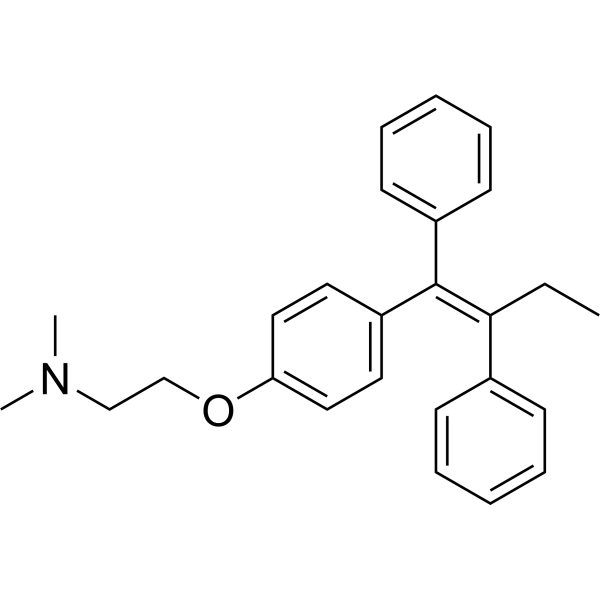
HY-13757A
TamoxifenEstrogen Receptor Modulator
Publications Citing Use of MedChemExpress (MCE) Ponsegromab
More

Actividad biológica
Descripciòn
Isotype
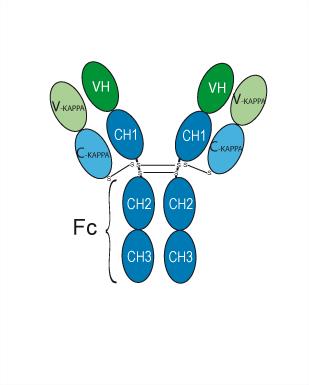
Human IgG1 (L234A/L235A) kappa
Recommend Isotype Controls
Species Reactivity
Human
IC50 & Target
|
GDF15 |
In Vitro
Ponsegromab (log concentrations from -4 to 2 nM; 1 h at 37 °C) potently inhibits the binding of human, cynomolgus monkey, and mouse GDF15 to GFRAL in cell-free ELISA assays with IC50 values of 0.123 nM, 0.053 nM, and 0.102 nM, respectively[1].
Ponsegromab (log concentrations from -4 to 1 nM; 17 h at 37 °C with 5% CO2) potently inhibits GDF15-GFRAL-RET-mediated ELK1 reporter activity in HEK293 cells with an IC50 of 0.037 nM[1].
Ponsegromab (log concentrations from -4 to 2 nM) potently inhibits GDF15-GFRAL-RET-mediated ERK1/2 phosphorylation in HEK293 cells with an IC50 of 0.051 nM[1].
Ponsegromab (log concentrations from -3 to 2 nM) potently inhibits GDF15-GFRAL-RET-mediated AKT phosphorylation in HEK293 cells with an IC50 of 0.171 nM[1].
Ponsegromab (10 µg/mL; 48 h) sensitizes LoVo-OxR and HCT-116-OxR oxaliplatin-resistant colorectal cancer cells to oxaliplatin, reducing oxaliplatin IC50 values to 8.176 μM and 7.818 μM, respectively[2].
Ponsegromab (10 µg/mL; 48 h) increases apoptosis in oxaliplatin-treated LoVo-OxR and HCT-116-OxR oxaliplatin-resistant colorectal cancer cells[2].
Ponsegromab (10 µg/mL; 48 h) modulates apoptosis-related protein expression in oxaliplatin-treated LoVo-OxR and HCT-116-OxR oxaliplatin-resistant colorectal cancer cells, reducing Bcl-2 and increasing cleaved caspase-3 levels[2].
Ponsegromab (10 µg/mL; 48 h) increases oxaliplatin-induced intracellular ROS levels in LoVo-OxR and HCT-116-OxR oxaliplatin-resistant colorectal cancer cells[2].
Ponsegromab (10 µg/mL; 48 h) reduces GSH levels and GSSG/GSH ratio in oxaliplatin-treated LoVo-OxR and HCT-116-OxR oxaliplatin-resistant colorectal cancer cells[2].
Ponsegromab (10 µg/mL; 48 h) reduces protein levels of Nrf2, NQO1, and HO-1 in LoVo-OxR and HCT-116-OxR oxaliplatin-resistant colorectal cancer cells[2].
Ponsegromab (10 µg/mL; 48 h) increases Nrf2 polyubiquitination and reduces Nrf2 interaction with β-TrCP in LoVo-OxR and HCT-116-OxR oxaliplatin-resistant colorectal cancer cells[2].
Ponsegromab (10 µg/mL; 48 h) increases the rate of Nrf2 protein degradation in HCT-116-OxR oxaliplatin-resistant colorectal cancer cells[2].
Ponsegromab (10 µg/mL; 2 h) reduces Nrf2 protein levels via the ubiquitin-proteasome pathway in LoVo-OxR and HCT-116-OxR oxaliplatin-resistant colorectal cancer cells, as MG132 treatment restores Nrf2 expression[2].
MedChemExpress (MCE) has not independently confirmed the accuracy of these methods. They are for reference only.
-
Cell Line:LoVo-OxR, HCT-116-OxR (oxaliplatin-resistant human colorectal cancer cell lines)
-
Concentration:10 µg/mL (in combination with oxaliplatin at 0, 2, 4, 8, 16, 32 μM)
-
Incubation Time:48 h
-
Result:Reduced the half-maximal inhibitory concentration (IC50) of oxaliplatin in LoVo-OxR cells from 14.290 μM to 8.176 μM, and in HCT-116-OxR cells from 19.650 μM to 7.818 μM, sensitizing the resistant cell lines to oxaliplatin treatment.
-
Cell Line:LoVo-OxR, HCT-116-OxR (oxaliplatin-resistant human colorectal cancer cell lines)
-
Concentration:10 µg/mL (in combination with 14.29 μM oxaliplatin for LoVo-OxR, 19.65 μM oxaliplatin for HCT-116-OxR)
-
Incubation Time:48 h
-
Result:Increased the proportion of apoptotic cells in oxaliplatin-treated LoVo-OxR and HCT-116-OxR cells, compared to oxaliplatin treatment alone.
-
Cell Line:LoVo-OxR, HCT-116-OxR (oxaliplatin-resistant human colorectal cancer cell lines)
-
Concentration:10 µg/mL (in combination with 14.29 μM oxaliplatin for LoVo-OxR, 19.65 μM oxaliplatin for HCT-116-OxR)
-
Incubation Time:48 h
-
Result:Reduced anti-apoptotic Bcl-2 protein levels and increased pro-apoptotic cleaved caspase-3 protein levels in oxaliplatin-treated LoVo-OxR and HCT-116-OxR cells.
-
Cell Line:LoVo-OxR, HCT-116-OxR (oxaliplatin-resistant human colorectal cancer cell lines)
-
Concentration:10 µg/mL
-
Incubation Time:48 h
-
Result:Reduced protein levels of Nrf2, as well as its downstream antioxidant target genes NQO1 and HO-1, in LoVo-OxR and HCT-116-OxR cells.\nIncreased polyubiquitination of Nrf2 and impaired the interaction between Nrf2 and β-TrCP (a ubiquitin ligase adapter) in LoVo-OxR and HCT-116-OxR cells.
-
Cell Line:HCT-116-OxR (oxaliplatin-resistant human colorectal cancer cell line)
-
Concentration:10 µg/mL
-
Incubation Time:48 h (prior to cycloheximide chase over 60 min)
-
Result:Increased the rate of Nrf2 protein degradation in HCT-116-OxR cells, reducing the half-life of Nrf2 protein compared to untreated control cells.
-
Cell Line:LoVo-OxR, HCT-116-OxR (oxaliplatin-resistant human colorectal cancer cell lines)
-
Concentration:10 µg/mL (in combination with 10 μM MG132)
-
Incubation Time:2 h
-
Result:Reduced Nrf2 protein levels in LoVo-OxR and HCT-116-OxR cells, and this inhibitory effect was reversed by MG132 treatment, restoring Nrf2 expression.
In Vivo
Ponsegromab (10 mg/kg; i.p.; once every 3 days; until study endpoint) restores body weight, increases ambulatory activity, partially normalizes respiratory exchange ratio, and increases heat production in HT-1080 tumor-bearing NCG mice with cancer cachexia[1].
Ponsegromab (10 mg/kg; i.p.; twice weekly; until study endpoint) partially reverses body weight loss in Renca tumor-bearing BALB/c mice with cancer cachexia[1].
Ponsegromab (10 mg/kg; i.p.; twice weekly; until study endpoint) partially reverses body weight loss in MC38-hGDF15 tumor-bearing C57BL/6 mice with cancer cachexia[1].
Ponsegromab (10 mg/kg; i.p.; once every 3 days; day 6 to day 21) maintains body weight, achieves 100% survival, restores gastrocnemius muscle weight, and partially restores epididymal fat weight in cisplatin-treated C57BL/6 mice with chemotherapy-induced cachexia[1].
MedChemExpress (MCE) has not independently confirmed the accuracy of these methods. They are for reference only.
-
Animal Model:NCG mice (6-week-old male; cancer cachexia model via subcutaneous HT-1080 human fibrosarcoma cell inoculation)[1]
-
Dosage:10 mg/kg
-
Administration:i.p.; twice weekly; until study endpoint
-
Result:Increased gastrocnemius muscle weight; significantly increased epididymal fat weight compared to vehicle control.
-
Animal Model:NCG mice (6-week-old male; cancer cachexia model via subcutaneous HT-1080 human fibrosarcoma cell inoculation)[1]
-
Dosage:10 mg/kg
-
Administration:i.p.; once every 3 days; until study endpoint
-
Result:Restored lost body weight in cachectic mice; increased ambulatory activity compared to vehicle control; partially restored respiratory exchange ratio towards non-tumor bearing levels; increased heat production compared to vehicle control.
-
Animal Model:BALB/c mice (6-week-old male; cancer cachexia model via subcutaneous Renca murine kidney tumor cell inoculation)[1]
-
Dosage:10 mg/kg
-
Administration:i.p.; twice weekly; until study endpoint
-
Result:Led to partial recovery of body weight in cachectic mice, though body weight did not return to non-tumor bearing levels.
-
Animal Model:C57BL/6 mice (6-week-old male; cancer cachexia model via subcutaneous MC38-hGDF15 murine colon cancer cell inoculation overexpressing human GDF15)[1]
-
Dosage:10 mg/kg
-
Administration:i.p.; twice weekly; until study endpoint
-
Result:Led to partial recovery of body weight in cachectic mice, though body weight did not return to non-tumor bearing levels.
-
Animal Model:C57BL/6 mice (6-week-old male; chemotherapy-induced cachexia model via cisplatin injection)[1]
-
Dosage:10 mg/kg
-
Administration:i.p.; once every 3 days; day 6 to day 21
-
Result:Maintained body weight in cachectic mice (preventing continued weight loss seen in vehicle and isotype control groups), with endpoint body weight similar to normal untreated mice; achieved 100% survival to study endpoint; restored gastrocnemius muscle weight to normal levels; partially restored epididymal fat weight compared to vehicle control.
Ensayo clínico
| NCT Number | Sponsor | Condition | Start Date |
Phase

|
|---|---|---|---|---|
| NCT01329991 | Plexxikon| | 2011-05 | PHASE1 |
Gene ID
Accession
Conjugated
Unconjugated
Reconsititution
The product can be reconstituted/diluted with sterile PBS or saline.
Format
-
Human IgG1 kappa
Aplicación
ELISA, FACS, Functional assay
Verified Bioactivity
-
 Immobilized GDF-15 Protein, Human (P.pastoris, His, HY-P75170) can bind Ponsegromab. The EC50 for this effect is 9.7 ng/mL.
 -
 Flow Cytometry analysis of HepG2 cells with Ponsegromab (HY-P99241, red). Cells were fixed with 4% paraformaldehyde and permeabilised with 90% methanol. Then cells were stained with the primary antibody at 1/200 dilution for an hour at 4℃. Goat Anti-Human IgG H&L (AF488) (HY-P83776) was used as the secondary antibody at 1/1,000 dilution for 30 minutes at 4℃. Human IgG1 kappa (HY-P99001, blue) was used as the isotype control, cells without incubation with primary antibody were used as the unlabeled control (black).


Chemical Information
-
No. CAS 2368950-15-4
-
Appearance Liquid
-
Peso molecular 145.5 kDa
-
Color Colorless to light yellow
-
SMILES
[Ponsegromab]
-
Synonyms
PF-06946860
-
Envío
Shipping with dry ice.
-
Formulation
Please refer to the lot-specific COA for specific buffer information.
-
Almacenamiento
Please store the product under the recommended conditions in the Certificate of Analysis.


Publications (4)
-
Journal Impact Factor
-
Most Recent
-
-
-
-
bioRxiv
2024 Jun 17:2024.06.14.598891. PMID: 38948776


Pureza y Documentación
-
Ficha de datos (293 KB)
-
SDS (251 KB)
- English - EN (251 KB)
- Français - FR (251 KB)
- Deutsch - DE (251 KB)
- Norwegian - NO (251 KB)
- Español - ES (251 KB)
- Swedish - SV (251 KB)
- Italian - IT (251 KB)
- Korean - KR (251 KB)
- Portuguese - PT (251 KB)
-
Inhibitory Antibodies User Guide (603 KB)
Referencias
[1]. Huang Y, et al. GB18-06, a nanobody targeting GDF15, effectively alleviates weight loss and restores physical function in cachexia models. MAbs. 2024;16(1):2416453. [Content Brief]
[2]. Lin H, et al. GDF15 induces chemoresistance to oxaliplatin by forming a reciprocal feedback loop with Nrf2 to maintain redox homeostasis in colorectal cancer. Cell Oncol (Dordr). 2024;47(4):1149-1165. [Content Brief]

Calculators
Concentration (start) × Volume (start) = Concentration (final) × Volume (final)


Ponsegromab Related Classifications
HY-P99241 Related Classifications
 Powered by Bioz