



Histone H3 (1-34)

Based on 1 Customer Validation
Histone H3 (1-34) is a peptide derived from human histone isotype 3.1. Histones are the main protein components of eukaryotic chromatin. Histone variants and histone modifications modulate chromatin structure, ensuring the precise operation of cellular processes associated with genomic DNA.
For research use only. We do not sell to patients.
- Purity : 98.49%
- Formula: C144H260N54O44
- Molecular Weight:3452.00
-
Storage:
Sealed storage, away from moisture and light, under nitrogen.
Powder -80°C, 2 years , -20°C, 1 year* In solvent : -80°C, 6 months; -20°C, 1 month (sealed storage, away from moisture and light, under nitrogen)

To place orders, for customer services and technical support, please contact: MedChemExpress USA
Tel: 609-228-6898 E-mail: [email protected] [email protected]


-
 Biological Activity
-
Chemical Information
- Protocols
- Purity & Documentation
- References
-
 Help & FAQs


All Histone Methyltransferase Isoforms
More

Biological Activity
Description


Chemical Information
-
Appearance Solid
-
Molecular Weight 3452.00
-
Formula C144H260N54O44
-
Color White to off-white
-
Sequence
Ala-Arg-Thr-Lys-Gln-Thr-Ala-Arg-Lys-Ser-Thr-Gly-Gly-Lys-Ala-Pro-Arg-Lys-Gln-Leu-Ala-Thr-Lys-Ala-Ala-Arg-Lys-Ser-Ala-Pro-Ala-Thr-Gly-Gly
-
Sequence Shortening
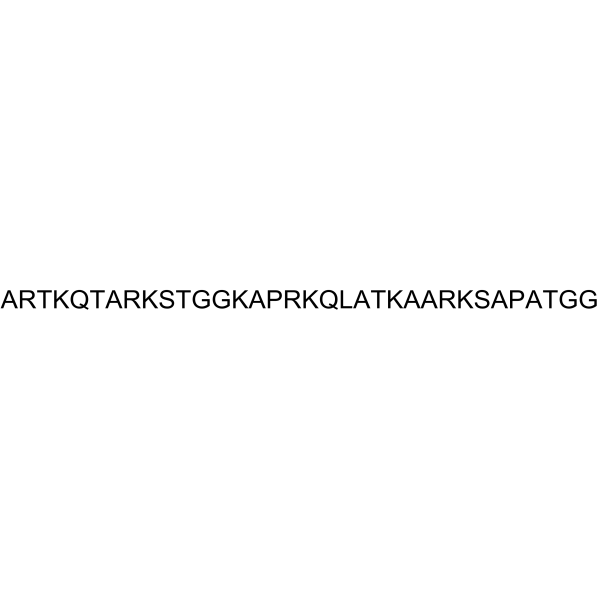
ARTKQTARKSTGGKAPRKQLATKAARKSAPATGG
-
Shipping
Room temperature in continental US; may vary elsewhere.
-
Storage
Sealed storage, away from moisture and light, under nitrogen
Powder -80°C 2 years -20°C 1 year * In solvent : -80°C, 6 months; -20°C, 1 month (sealed storage, away from moisture and light, under nitrogen)

Protocols
-
Protocol for Southern Blot
Southern blot is a DNA hybridization assay used to detect a defined DNA sequence within restriction-digested or otherwise fragmented genomic DNA. The method separates DNA fragments by agarose gel electrophoresis, transfers the size-resolved DNA pattern onto a solid support, denatures the DNA to permit base pairing, and detects fragments that hybridize with a complementary labeled probe; the readout is a band, smear, or fragment-size distribution corresponding to the target sequence and its restriction-fragment context. The assay reflects sequence presence, restriction fragment length, gene copy pattern, structural rearrangement, insertion or deletion affecting restriction sites, and some repeat-length or terminal restriction fragment applications when the experimental design links the probe to those genomic features. Classic applications include Southern blot-based telomere terminal restriction fragment analysis and minisatellite-based DNA fingerprinting, which illustrate how the same


Purity & Documentation
-
Data Sheet (259 KB)
-
SDS (252 KB)
- English - EN (252 KB)
- Français - FR (252 KB)
- Deutsch - DE (252 KB)
- Norwegian - NO (252 KB)
- Español - ES (252 KB)
- Swedish - SV (252 KB)
- Italian - IT (252 KB)
- Korean - KR (252 KB)
- Portuguese - PT (252 KB)
-
Handling Instructions (2659 KB)
References
[1]. Hake SB, Allis CD. Histone H3 variants and their potential role in indexing mammalian genomes: the "H3 barcode hypothesis". Proc Natl Acad Sci U S A. 2006;103(17):6428-6435. [Content Brief]
[2]. Xiong C, et al. Histone Variant H3.3: A versatile H3 variant in health and in disease. Sci China Life Sci. 2016;59(3):245-256. [Content Brief]
[3]. Mulder KW, et al. Regulation of histone H3K4 tri-methylation and PAF complex recruitment by the Ccr4-Not complex. Nucleic Acids Res. 2007;35(7):2428-2439. [Content Brief]

Calculators
Concentration (start) × Volume (start) = Concentration (final) × Volume (final)


Histone H3 (1-34) Related Classifications
HY-P2258 Related Classifications
 Powered by Bioz