



IBG3
Based on 1 publication(s) in Google Scholar
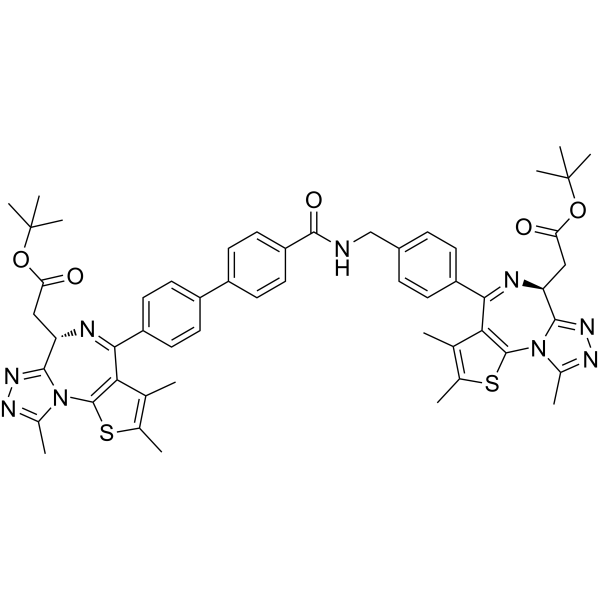
IBG3 is a bivalent molecular glue degrader targeting BRD2 and BRD4, with DC50 values of 8.6 pM and 6.7 pM, respectively. IBG3 exhibits selectivity for BRD2 and BRD4 over BRD3. By recruiting the DCAF16 E3 ligase and binding in cis to the tandem bromodomains of BRD2 and BRD4, IBG3 enhances BRD-DCAF16 binding affinity and promotes ubiquitination and proteasomal degradation, without degrading isolated bromodomains. Although IBG3 lacks degradation selectivity between PSMA-positive and PSMA-negative prostate cancer cells and demonstrates lower in vivo antitumor potency compared to the PSMA-targeting conjugate IBG-P3, it serves as a useful tool for prostate cancer research.
For research use only. We do not sell to patients.
- Purity : 98.53%
- Formula: C54H57N9O5S2
- Molecular Weight:976.22
-
Storage:Powder -20°C, 3 years , 4°C, 2 years ; In solvent -80°C, 6 months , -20°C, 1 month

To place orders, for customer services and technical support, please contact: MedChemExpress USA
Tel: 609-228-6898 E-mail: [email protected] [email protected]


-
 Biological Activity
-
Chemical Information
-
Solvent & Solubility
- Purity & Documentation
- References
-
 Help & FAQs


Publications Citing Use of MedChemExpress (MCE) IBG3
More

Biological Activity
Description
IC50 & Target
[1]|
BRD2 8.6 pM (DC50) |
BRD4 6.7 pM (DC50) |
Cellular Effect
|
Cell Line

|
Type | Value | Description | References |
|---|---|---|---|---|
| HEK293 | DC50 |
8.6 pM
|
Degradation of BRD2 in HEK293 HiBiT knock-in cells expressing BRD2-HiBiT quantified via HiBiT lytic detection system after 5 h incubation.
Degradation of BRD2 in HEK293 HiBiT knock-in cells expressing BRD2-HiBiT quantified via HiBiT lytic detection system after 5 h incubation.
|
38383787 |
In Vitro
IBG3 (0.1 nM; 6 h) potently degrades BRD4Tandem in KBM7 reporter cells with a DC50 of 6.7 pM, showing selectivity for BRD2 and BRD4 over BRD3 and requiring intact tandem bromodomains for activity[2].
IBG3 (increasing concentrations; 5 h) potently degrades BRD2 in HEK293 HiBiT knock-in cells with a DC50 of 8.6 pM, while also degrading BRD4 and sparing BRD3[2].
IBG3 (increasing concentrations; 30 min) promotes formation of the BRD4Tandem-DCAF16 ternary complex in vitro with an EC50 of 32 nM[2].
IBG3 (1:1.1 molar ratio of BRD4Tandem to IBG3; 30 min) enhances the affinity of DCAF16-DDB1(ΔBPB)-DDA1 for BRD4Tandem in vitro, with a measured Kd of 177 nM and endothermic binding thermodynamics[2].
IBG3 (0.1 nM; 6 h)-mediated BRD4 degradation in KBM7 reporter cells is dependent on the CRL4-DCAF16 complex[2].
IBG3 (0.001-10 nM; 24 h) potently induces BRD4 degradation in both PSMA-negative PC3 and PSMA-overexpressing PC3-PIP cells, with complete degradation achieved at 10 nM in PC3 cells and 0.01 nM in PC3-PIP cells, and no inherent cell-type selectivity[4].
MedChemExpress (MCE) has not independently confirmed the accuracy of these methods. They are for reference only.
-
Cell Line:human prostate adenocarcinoma PC3 (PSMA-negative), PC3-PIP (PSMA-overexpressing)
-
Concentration:0.001, 0.01, 0.1, 1, 10 nM
-
Incubation Time:24 h
-
Result:Induced complete BRD4 degradation in PC3-PIP cells at concentrations as low as 0.01 nM.
Induced complete BRD4 degradation in PC3 cells at a concentration of 10 nM.
Showed no significant difference in BRD4 degradation activity between PC3 and PC3-PIP cells.
In Vivo
IBG3 (0.0004 mg/kg; i.p.; daily; 12 days) induces 29.7% tumor growth inhibition in endogenously PSMA-positive LNCaP prostate cancer xenografts[4].
IBG3 (0.004 mg/kg; i.p.; daily; 5 days) shows detectable selectivity for PSMA-positive over PSMA-negative prostate cancer co-xenografts, inducing 46.4% tumor growth inhibition in PC3-PIP tumors and 16.7% inhibition in PC3 tumors[4].
MedChemExpress (MCE) has not independently confirmed the accuracy of these methods. They are for reference only.
-
Animal Model:NSG (male, 8-10 weeks old, subcutaneous xenograft of PC3-PIP cells)[4]
-
Dosage:0.004 mg/kg
-
Administration:i.p.; daily; 5 days
-
Result:Achieved 46.4% tumor growth inhibition in PC3-PIP xenografts.
-
Animal Model:NSG (male, 8-10 weeks old, subcutaneous xenograft of LNCaP cells)[4]
-
Dosage:0.0004 mg/kg
-
Administration:i.p.; daily; 12 days
-
Result:Achieved 29.7% tumor growth inhibition in LNCaP xenografts.
-
Animal Model:NSG (male, 8-10 weeks old, subcutaneous co-xenograft of PC3 cells and PC3-PIP cells)[4]
-
Dosage:0.004 mg/kg
-
Administration:i.p.; daily; 5 days
-
Result:Achieved 46.4% tumor growth inhibition in PSMA-positive PC3-PIP tumors.
Achieved 16.7% tumor growth inhibition in PSMA-negative PC3 tumors.


Chemical Information
-
Appearance Solid
-
Molecular Weight 976.22
-
Formula C54H57N9O5S2
-
Color Off-white to light yellow
-
SMILES
O=C(NCC1=CC=C(C2=N[C@@H](CC(OC(C)(C)C)=O)C3=NN=C(C)N3C4=C2C(C)=C(C)S4)C=C1)C5=CC=C(C6=CC=C(C7=N[C@@H](CC(OC(C)(C)C)=O)C8=NN=C(C)N8C9=C7C(C)=C(C)S9)C=C6)C=C5
-
Shipping
Room temperature in continental US; may vary elsewhere.
-
Storage
Powder -20°C 3 years 4°C 2 years In solvent -80°C 6 months -20°C 1 month


Publications (1)
-
Journal Impact Factor
-
Most Recent
-
Structure
CAND1 and CAND2 drive CUL4 substrate receptor exchange with largely comparable biochemical efficiency, unlike their relative effects on CUL1. [Abstract]2026 Mar 20:S0969-2126(26)00056-0. PMID: 41864201


Solvent & Solubility
In Vitro:
DMSO : 100 mg/mL (102.44 mM; Need ultrasonic; Hygroscopic DMSO has a significant impact on the solubility of product, please use newly opened DMSO)
Please refer to the solubility information to select the appropriate solvent. Once prepared, please aliquot and store the solution to prevent product inactivation from repeated freeze-thaw cycles.
Storage method and period of stock solution: -80°C, 6 months; -20°C, 1 month. When stored at -80°C, please use it within 6 months. When stored at -20°C, please use it within 1 month.
Please refer to the solubility information to select the appropriate solvent. Once prepared, please aliquot and store the solution to prevent product inactivation from repeated freeze-thaw cycles.
Storage method and period of stock solution: -80°C, 6 months; -20°C, 1 month. When stored at -80°C, please use it within 6 months. When stored at -20°C, please use it within 1 month.
Concentration (start) × Volume (start) = Concentration (final) × Volume (final)


Purity & Documentation
-
Data Sheet (297 KB)
-
SDS (252 KB)
- English - EN (252 KB)
- Français - FR (252 KB)
- Deutsch - DE (252 KB)
- Norwegian - NO (252 KB)
- Español - ES (252 KB)
- Swedish - SV (252 KB)
- Italian - IT (252 KB)
- Korean - KR (252 KB)
- Portuguese - PT (252 KB)
-
Handling Instructions (2659 KB)
References


Complete Stock Solution Preparation Table
Please refer to the solubility information to select the appropriate solvent. Once prepared, please aliquot and store the solution to prevent product inactivation from repeated freeze-thaw cycles.
Storage method and period of stock solution: -80°C, 6 months; -20°C, 1 month. When stored at -80°C, please use it within 6 months. When stored at -20°C, please use it within 1 month.
| Optional Solvent | Concentration Solvent Mass | 1 mg | 5 mg | 10 mg | 25 mg |
|---|---|---|---|---|---|
| DMSO | 1 mM | 1.0244 mL | 5.1218 mL | 10.2436 mL | 25.6090 mL |
| 5 mM | 0.2049 mL | 1.0244 mL | 2.0487 mL | 5.1218 mL | |
| 10 mM | 0.1024 mL | 0.5122 mL | 1.0244 mL | 2.5609 mL | |
| 15 mM | 0.0683 mL | 0.3415 mL | 0.6829 mL | 1.7073 mL | |
| 20 mM | 0.0512 mL | 0.2561 mL | 0.5122 mL | 1.2804 mL | |
| 25 mM | 0.0410 mL | 0.2049 mL | 0.4097 mL | 1.0244 mL | |
| 30 mM | 0.0341 mL | 0.1707 mL | 0.3415 mL | 0.8536 mL | |
| 40 mM | 0.0256 mL | 0.1280 mL | 0.2561 mL | 0.6402 mL | |
| 50 mM | 0.0205 mL | 0.1024 mL | 0.2049 mL | 0.5122 mL | |
| 60 mM | 0.0171 mL | 0.0854 mL | 0.1707 mL | 0.4268 mL | |
| 80 mM | 0.0128 mL | 0.0640 mL | 0.1280 mL | 0.3201 mL | |
| 100 mM | 0.0102 mL | 0.0512 mL | 0.1024 mL | 0.2561 mL |


IBG3 Related Classifications
HY-160528 Related Classifications
 Powered by Bioz