



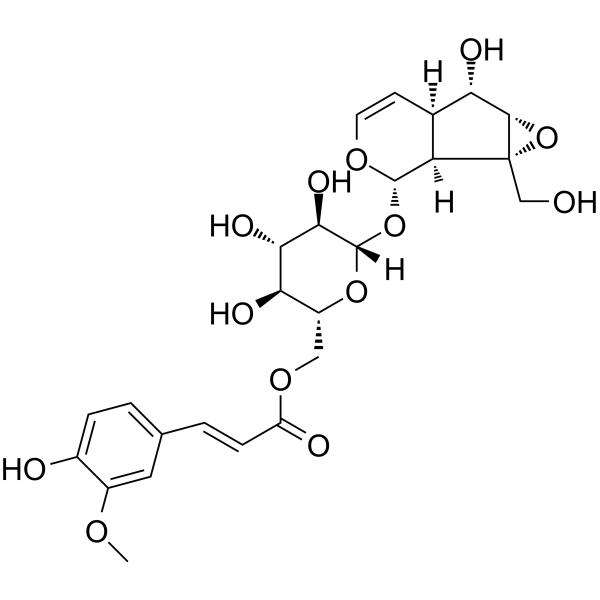
Picroside III
Based on 1 publication(s) in Google Scholar
Picroside III is an orally active iridoid glycoside isolated from Picrorhiza scrophulariiflora, possessing antitumor, antiviral, and intestinal epithelial barrier-protective activities. Picroside III promotes monocytic lineage differentiation and apoptosis in AML cells by inducing mitochondrial reactive oxygen species (mtROS) accumulation. Picroside III activates AMPK phosphorylation in intestinal epithelial cells, upregulates the tight junction proteins ZO-1, occludin, and claudin-3, and downregulates claudin-2 expression, thereby promoting mucosal wound healing and restoring intestinal epithelial barrier integrity. Picroside III inhibits SARS-CoV-2 pseudovirus entry and HCoV-OC43 infection. Picroside III can be used in research on acute myeloid leukemia, ulcerative colitis, and COVID-19.
연구목적의 판매만을 진행합니다. 환자를 대상으로 한 판매는 하지 않습니다.
- Purity : 99.59%
- CAS No.: 64461-95-6
- 화학식: C25H30O13
- 분자량:538.50
-
보관:
4°C, sealed storage, away from moisture and light
* In solvent : -80°C, 6 months; -20°C, 1 month (sealed storage, away from moisture and light)

To place orders, for customer services and technical support, please contact: MedChemExpress USA
Tel: 609-228-6898 E-mail: [email protected] [email protected]


-
 Biological Activity
-
Chemical Information
-
용액&용해도
- Protocol
- 순도&문서
- References
-
 Help & FAQs




Biological Activity
제품 설명
IC50 & Target
[2]|
AMPK |
Cellular Effect
|
Cell Line

|
Type | Value | Description | References |
|---|---|---|---|---|
| U-937 | IC50 |
214.4 μM
|
Cytotoxicity against human U937 AML cells assessed as reduction in viability incubated 72 hrs by MTS assay.
Cytotoxicity against human U937 AML cells assessed as reduction in viability incubated 72 hrs by MTS assay.
|
39941121 |
In Vitro
Picroside III (10-20 μM; 24 h) inhibits viral nucleocapsid protein (NP) mRNA expression in a dose-dependent manner in HRT-18 cells infected with live HCoV-OC43 virus, with an inhibition rate exceeding 50% at 20 μM[3].
Picroside III (5-20 μM; 24 h) significantly reduces FITC-dextran permeability in a dose-dependent manner, promotes monolayer wound healing, upregulates the expression of tight junction proteins ZO-1, claudin-3, and occludin, downregulates the expression of claudin-2, and promotes AMPK phosphorylation activation in TNF-α (HY-P7058)-induced injured Caco-2 cell monolayers[2].
Picroside III (12.5-100 μM; 48 h) shows no obvious cytotoxicity in HEK-293T cells within the 12.5-50 μM range[3].
Picroside III (10-160 μM; 24 h) is confirmed to be safe and non-toxic at 10 μM in A549 cells[3].
MedChemExpress (MCE) has not independently confirmed the accuracy of these methods. They are for reference only.
-
Cell Line:human U937 AML cells
-
Concentration:160 μM
-
Incubation Time:72 h
-
Result:Increased CD11b expression and CD14 expression in U937 cells.
FSC and SSC profiles were altered, consistent with morphological differentiation.
-
Cell Line:human U937 AML cells
-
Concentration:120, 160, 200, 240, 280 μM
-
Incubation Time:72 h
-
Result:Caused a dose-dependent decrease in relative cell viability.
The IC50 in U937 cells was 214.4 μM.
-
Cell Line:human U937 AML cells
-
Concentration:160, 240 μM
-
Incubation Time:24, 48, 72, 96 h
-
Result:Inhibited U937 cell proliferation in a dose-dependent manner, with lower viable cell numbers at 160 and 240 μM than in the untreated group over 96 h.
-
Cell Line:human U937 AML cells
-
Concentration:160, 240 μM
-
Incubation Time:72 h
-
Result:Increased the cell death rate and apoptosis rate in U937 cells at 160 and 240 μM compared with control.
-
Cell Line:Caco-2 cell monolayers
-
Concentration:TNF-α 100 ng/mL (stimulation); 5, 10, and 20 μM (Picroside III)
-
Incubation Time:24 h
-
Result:TNF-α decreased the percentage of wound closure of Caco-2 monolayers.
Reversed this decrease and increased wound closure compared with TNF-α alone at 5, 10, and 20 μM.
-
Cell Line:HRT-18 cells
-
Concentration:10 and 20 µM
-
Incubation Time:24 h (infection/incubation)
-
Result:Exhibited dose-dependent inhibition of HCoV-OC43 infection; over 50% inhibition of viral NP mRNA was observed at 20 µM.
In Vivo
MedChemExpress (MCE) has not independently confirmed the accuracy of these methods. They are for reference only.
-
Animal Model:C57BL/6 (male, 6-8 weeks, 20-22 g)[2]
-
Dosage:15 mg/kg; 30 mg/kg
-
Administration:i.g.; once daily; 11 consecutive days from day 0
-
Result:Reduced DSS-induced body weight loss and DAI score increases at 15 and 30 mg/kg.
Rescued DSS-induced colon shortening and reduced colon tissue damage and histological scores.
Suppressed the DSS-induced increase in colonic TNF-α mRNA.
In colon tissues, increased ZO-1, occludin, and claudin-3 mRNA expression and ZO-1 and occludin protein expression, and decreased claudin-2 mRNA and protein expression.
Increased p-AMPK/AMPK in the colon tissues of colitis mice.
- Research Protocol for Infectious Diseases
- Western Blot
- RNA extraction experimental
- Annexin V plus membrane-impermeant dye apoptosis staining
- ROS/oxidative-stress fluorescent staining
- Cell migration
- Kinase activity and phosphorylation assays
- Detection of Apoptosis
- TUNEL staining for apoptotic DNA fragmentation
- DSS-Induced Colitis
- TNBS-Induced Colitis
- Transepithelial/transendothelial electrical resistance assay
- Apoptosis Solutions
- Protocol for Kinase activity and phosphorylation assays
- iPSC cell differentiation
- Cell-Exclusion Zone Migration Assay


Product Details
-
Structure Classification


Chemical Information
-
CAS No. 64461-95-6
-
Appearance Solid
-
분자량 538.50
-
화학식 C25H30O13
-
Color White to off-white
-
SMILES
OC[C@]12[C@@H](O2)[C@@H](O)[C@@]3([H])[C@]1([H])[C@H](O[C@@]4([H])[C@H](O)[C@@H](O)[C@H](O)[C@@H](COC(/C=C/C5=CC=C(O)C(OC)=C5)=O)O4)OC=C3
-
선적
Room temperature in continental US; may vary elsewhere.
-
보관
4°C, sealed storage, away from moisture and light
* In solvent : -80°C, 6 months; -20°C, 1 month (sealed storage, away from moisture and light)


Publications (1)
-
Journal Impact Factor
-
Most Recent
-
Int J Mol Sci
Therapeutic Potential of Adina rubella Hance Stem and Picroside III as a Differentiation Inducer in AML Cells via Mitochondrial ROS Accumulation. [Abstract]2025 Feb 5;26(3):1350. PMID: 39941121


용액&용해도
In Vitro:
DMSO : 50 mg/mL (92.85 mM; Need ultrasonic; Hygroscopic DMSO has a significant impact on the solubility of product, please use newly opened DMSO)
Please refer to the solubility information to select the appropriate solvent. Once prepared, please aliquot and store the solution to prevent product inactivation from repeated freeze-thaw cycles.
Storage method and period of stock solution: -80°C, 6 months; -20°C, 1 month (sealed storage, away from moisture and light). When stored at -80°C, please use it within 6 months. When stored at -20°C, please use it within 1 month.
Concentration (start) × Volume (start) = Concentration (final) × Volume (final)
In Vivo:
Select the appropriate dissolution method based on your experimental animal and administration route.
- For the following dissolution methods, please ensure to first prepare a clear stock solution using an In Vitro approach and then sequentially add co-solvents:
- To ensure reliable experimental results, the clarified stock solution can be appropriately stored based on storage conditions. As for the working solution for In Vivo experiments, it is recommended to prepare freshly and use it on the same day.
- The percentages shown for the solvents indicate their volumetric ratio in the final prepared solution. If precipitation or phase separation occurs during preparation, heat and/or sonication can be used to aid dissolution.
Add each solvent one by one: 10% DMSO 40% PEG300 5% Tween-80 45% Saline
Solubility: ≥ 1.25 mg/mL (2.32 mM); Clear solution
This protocol yields a clear solution of ≥ 1.25 mg/mL (saturation unknown).
Taking 1 mL working solution as an example, add 100 μL DMSO stock solution (12.5 mg/mL) to 400 μL PEG300, and mix evenly; then add 50 μL Tween-80 and mix evenly; then add 450 μL Saline to adjust the volume to 1 mL.
Preparation of Saline: Dissolve 0.9 g sodium chloride in ddH₂O and dilute to 100 mL to obtain a clear Saline solution.
Add each solvent one by one: 10% DMSO 90% (20% SBE-β-CD in Saline)
Solubility: ≥ 1.25 mg/mL (2.32 mM); Clear solution
This protocol yields a clear solution of ≥ 1.25 mg/mL (saturation unknown).
Taking 1 mL working solution as an example, add 100 μL DMSO stock solution (12.5 mg/mL) to 900 μL 20% SBE-β-CD in Saline, and mix evenly.
Preparation of 20% SBE-β-CD in Saline (4°C, storage for one week): 2 g SBE-β-CD powder is dissolved in 10 mL Saline, completely dissolve until clear.
In Vivo Dissolution Calculator
Please enter the basic information of animal experiments:
-
-
-
-
Recommended: Prepare an additional quantity of animals to account for potential losses during experiments.
Please enter your animal formula composition:
-
%DMSO +
Recommended: Keep the proportion of DMSO in working solution below 2% if your animal is weak.
-
%+
-
+%Tween-80 + +
-
%Saline +
The co-solvents required include: DMSO, . All of co-solvents are available by MedChemExpress (MCE). , Tween 80. All of co-solvents are available by MedChemExpress (MCE).
Working solution concentration: 0.22 mg/mL
Method for preparing stock solution: mg drug dissolved in μL DMSO. Stock solution concentration: mg/mL. * In solvent : -80°C, 6 months; -20°C, 1 month (sealed storage, away from moisture and light)
1. Take μL DMSO stock solution;
2. Add μL .
μL , mix evenly;
3. Then add μL Tween 80, mix evenly;
4. Then add μL
Please ensure that the stock solution in the first step is dissolved to a clear state, and add co-solvents in sequence. You can use ultrasonic heating (ultrasonic cleaner, recommended frequency 20-40 kHz), vortexing, etc. to assist dissolution.
순도&문서


References

Complete Stock Solution Preparation Table
Please refer to the solubility information to select the appropriate solvent. Once prepared, please aliquot and store the solution to prevent product inactivation from repeated freeze-thaw cycles.
Storage method and period of stock solution: -80°C, 6 months; -20°C, 1 month (sealed storage, away from moisture and light). When stored at -80°C, please use it within 6 months. When stored at -20°C, please use it within 1 month.
| Optional Solvent | Concentration Solvent Mass | 1 mg | 5 mg | 10 mg | 25 mg |
|---|---|---|---|---|---|
| DMSO | 1 mM | 1.8570 mL | 9.2851 mL | 18.5701 mL | 46.4253 mL |
| 5 mM | 0.3714 mL | 1.8570 mL | 3.7140 mL | 9.2851 mL | |
| 10 mM | 0.1857 mL | 0.9285 mL | 1.8570 mL | 4.6425 mL | |
| 15 mM | 0.1238 mL | 0.6190 mL | 1.2380 mL | 3.0950 mL | |
| 20 mM | 0.0929 mL | 0.4643 mL | 0.9285 mL | 2.3213 mL | |
| 25 mM | 0.0743 mL | 0.3714 mL | 0.7428 mL | 1.8570 mL | |
| 30 mM | 0.0619 mL | 0.3095 mL | 0.6190 mL | 1.5475 mL | |
| 40 mM | 0.0464 mL | 0.2321 mL | 0.4643 mL | 1.1606 mL | |
| 50 mM | 0.0371 mL | 0.1857 mL | 0.3714 mL | 0.9285 mL | |
| 60 mM | 0.0310 mL | 0.1548 mL | 0.3095 mL | 0.7738 mL | |
| 80 mM | 0.0232 mL | 0.1161 mL | 0.2321 mL | 0.5803 mL |


Picroside III Related Classifications
HY-N0409 Related Classifications
 Powered by Bioz
Keywords