



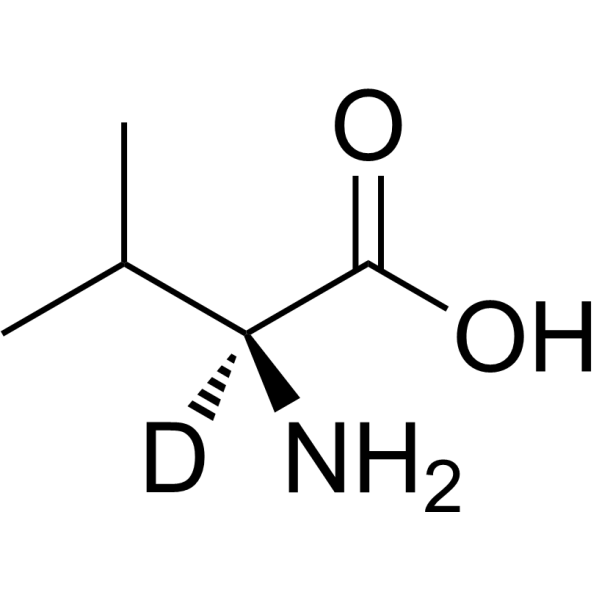
L-Valine-d1

Based on 1 Customer Validation
L-Valine-d1 ((S)-Valine-d1) is the deuterium labeled L-Valine (HY-N0717). L-Valine ((S)-Valine) is a nonlinear semiorganic material. L-Valine causes lipid peroxidation and accumulation of malondialdehyde (MDA), exhibits inhibitory activity against cyanobacteria. L-Valine inhibits multidrug-resistant bacteria through activation of PI3K/Akt signaling pathway and inhibition of arginase.
Nos produits utilisent uniquement pour la recherche. Nous ne vendons pas aux patients.
- Pureté : 98.0%
- CAS No.: 77257-03-5
- Formule: C5H10DNO2
- Masse moléculaire:118.15
-
Stockage:Powder -20°C, 3 years ; In solvent -80°C, 6 months , -20°C, 1 month

To place orders, for customer services and technical support, please contact: MedChemExpress USA
Tel: 609-228-6898 E-mail: [email protected] [email protected]


-
 Activité biologique
-
Chemical Information
-
Solvant et solubilité
- Protocole
- Pureté et documentation
- Références
-
 Help & FAQs




Activité biologique
Description
In Vitro
Stable heavy isotopes of hydrogen, carbon, and other elements have been incorporated into drug molecules, largely as tracers for quantitation during the drug development process. Deuteration has gained attention because of its potential to affect the pharmacokinetic and metabolic profiles of drugs[1].
MedChemExpress (MCE) has not independently confirmed the accuracy of these methods. They are for reference only.
Application
1. This compound can be used as a tracer
2. This compound can be used as an internal standard for quantitative analysis by NMR, GC-MS, or LC-MS.


Chemical Information
-
CAS No. 77257-03-5
-
Unlabeled CAS 72-18-4
-
Appearance Solid
-
Masse moléculaire 118.15
-
Formule C5H10DNO2
-
Color White to off-white
-
SMILES
CC(C)[C@@](N)([2H])C(O)=O
-
Synonyms
(S)-Valine-d1
-
Livraison
Room temperature in continental US; may vary elsewhere.
-
Stockage
Powder -20°C 3 years In solvent -80°C 6 months -20°C 1 month


Solvant et solubilité
In Vitro:
H2O : 17.5 mg/mL (148.12 mM; Need ultrasonic)
Please refer to the solubility information to select the appropriate solvent. Once prepared, please aliquot and store the solution to prevent product inactivation from repeated freeze-thaw cycles.
Storage method and period of stock solution: -80°C, 6 months; -20°C, 1 month. When stored at -80°C, please use it within 6 months. When stored at -20°C, please use it within 1 month.
* Note: If you choose water as the stock solution, please dilute it to the working solution, then filter and sterilize it with a 0.22 μm filter before use.
Please refer to the solubility information to select the appropriate solvent. Once prepared, please aliquot and store the solution to prevent product inactivation from repeated freeze-thaw cycles.
Storage method and period of stock solution: -80°C, 6 months; -20°C, 1 month. When stored at -80°C, please use it within 6 months. When stored at -20°C, please use it within 1 month.
* Note: If you choose water as the stock solution, please dilute it to the working solution, then filter and sterilize it with a 0.22 μm filter before use.
Concentration (start) × Volume (start) = Concentration (final) × Volume (final)


Pureté et documentation
-
Fiche technique (274 KB)
-
SDS (393 KB)
- English - EN (393 KB)
- Français - FR (393 KB)
- Deutsch - DE (393 KB)
- Norwegian - NO (393 KB)
- Español - ES (393 KB)
- Swedish - SV (393 KB)
- Italian - IT (393 KB)
- Korean - KR (393 KB)
- Portuguese - PT (393 KB)
-
Instruction de manipulation (2659 KB)
Références
[1]. Zhang BH, et al., L-valine, an antialgal amino acid from Streptomyces jiujiangensis JXJ 0074(T). Appl Microbiol Biotechnol. 2016 May;100(10):4627-36. [Content Brief]
[2]. Chen XH, et al., Exogenous l-Valine Promotes Phagocytosis to Kill Multidrug-Resistant Bacterial Pathogens. Front Immunol. 2017 Mar 6;8:207. [Content Brief]
[3]. K Kirubavathi, et al. Synthesis, growth, structural, spectroscopic and optical studies of a new semiorganic nonlinear optical crystal: L-valine hydrochloride. Spectrochim Acta A Mol Biomol Spectrosc. 2008 Apr;69(4):1283-6. [Content Brief]


Complete Stock Solution Preparation Table
Please refer to the solubility information to select the appropriate solvent. Once prepared, please aliquot and store the solution to prevent product inactivation from repeated freeze-thaw cycles.
Storage method and period of stock solution: -80°C, 6 months; -20°C, 1 month. When stored at -80°C, please use it within 6 months. When stored at -20°C, please use it within 1 month.
| Optional Solvent | Concentration Solvent Mass | 1 mg | 5 mg | 10 mg | 25 mg |
|---|---|---|---|---|---|
| H2O | 1 mM | 8.4638 mL | 42.3191 mL | 84.6382 mL | 211.5954 mL |
| 5 mM | 1.6928 mL | 8.4638 mL | 16.9276 mL | 42.3191 mL | |
| 10 mM | 0.8464 mL | 4.2319 mL | 8.4638 mL | 21.1595 mL | |
| 15 mM | 0.5643 mL | 2.8213 mL | 5.6425 mL | 14.1064 mL | |
| 20 mM | 0.4232 mL | 2.1160 mL | 4.2319 mL | 10.5798 mL | |
| 25 mM | 0.3386 mL | 1.6928 mL | 3.3855 mL | 8.4638 mL | |
| 30 mM | 0.2821 mL | 1.4106 mL | 2.8213 mL | 7.0532 mL | |
| 40 mM | 0.2116 mL | 1.0580 mL | 2.1160 mL | 5.2899 mL | |
| 50 mM | 0.1693 mL | 0.8464 mL | 1.6928 mL | 4.2319 mL | |
| 60 mM | 0.1411 mL | 0.7053 mL | 1.4106 mL | 3.5266 mL | |
| 80 mM | 0.1058 mL | 0.5290 mL | 1.0580 mL | 2.6449 mL | |
| 100 mM | 0.0846 mL | 0.4232 mL | 0.8464 mL | 2.1160 mL |
* Note: If you choose water as the stock solution, please dilute it to the working solution, then filter and sterilize it with a 0.22 μm filter before use.


L-Valine-d1 Related Classifications
HY-N0717S8 Related Classifications
 Powered by Bioz