



Sinapine
Based on 2 publication(s) in Google Scholar
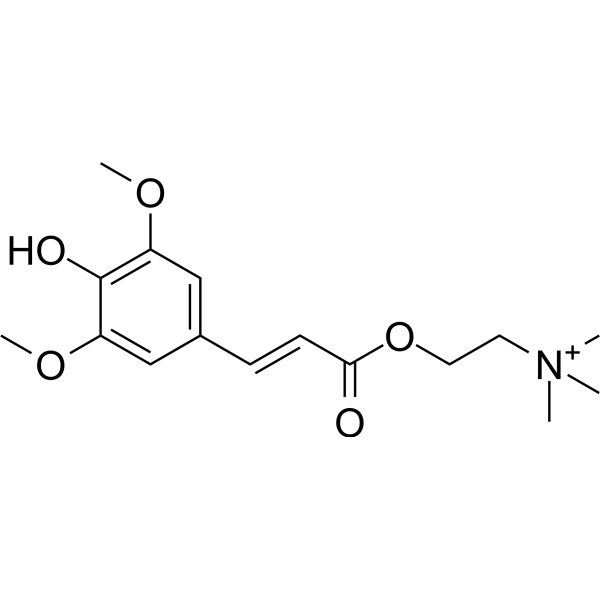
Sinapine is an alkaloid isolated from seeds of the cruciferous species. Sinapine exhibits anti-inflammatory, anti-oxidant, anti-tumor, anti-angiogenic and radio-protective effects. Sinapine is also an acetylcholinesterase (AChE) inhibitor and can be used for the research of Alzheimer’s disease, ataxia, myasthenia gravis, and Parkinson’s disease.
For research use only. We do not sell to patients.
- Purity: 99.94%
- CAS No.: 18696-26-9
- Formula: C16H24NO5+
- Molecular Weight:310.36
-
Storage:
4°C, sealed storage, away from moisture and light
* In solvent : -80°C, 6 months; -20°C, 1 month (sealed storage, away from moisture and light)

To place orders, for customer services and technical support, please contact: MedChemExpress USA
Tel: 609-228-6898 E-mail: [email protected] [email protected]


-
 Biological Activity
-
Chemical Information
-
Solvent & Solubility
- Purity & Documentation
- References
-
 Help & FAQs



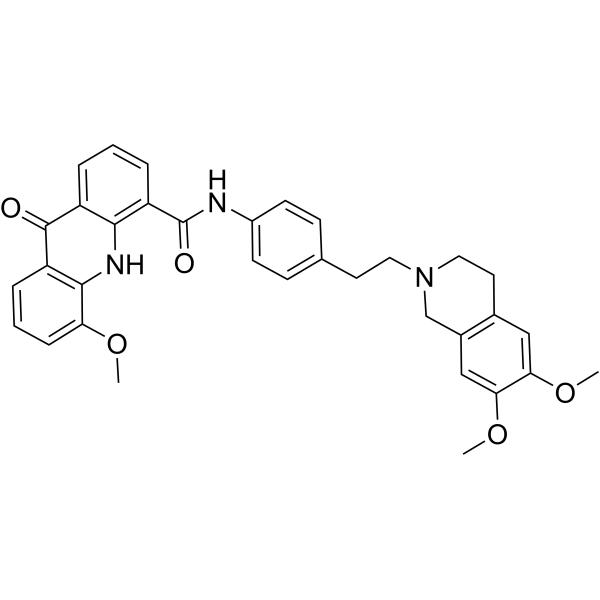
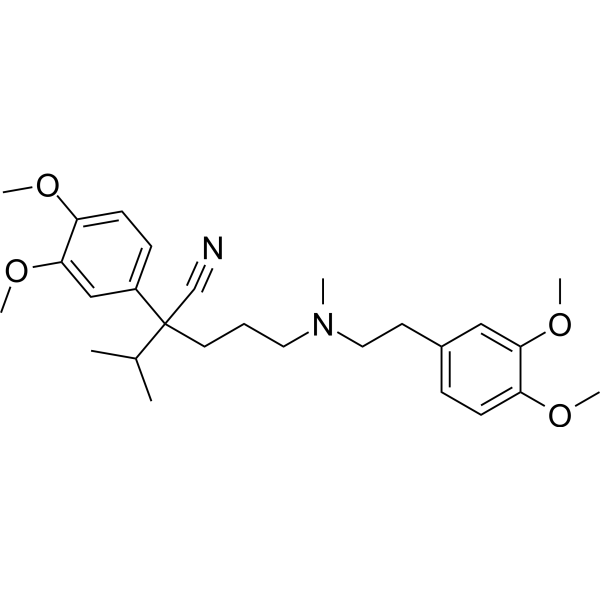

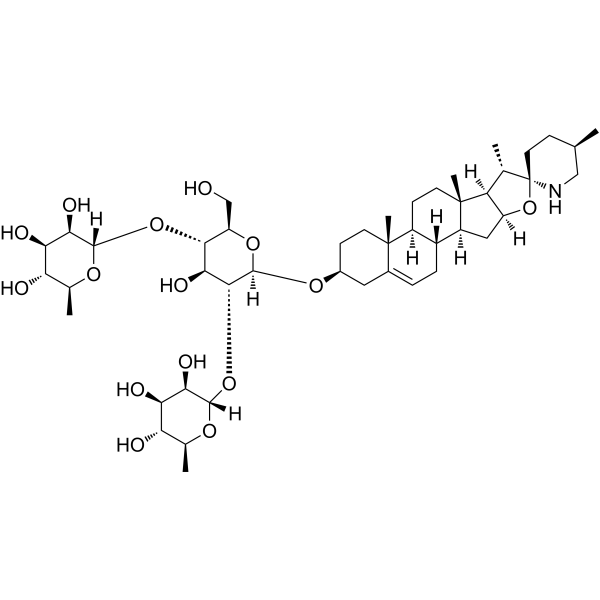
Publications Citing Use of MedChemExpress (MCE) Sinapine
More

Biological Activity
|
AChE |
Sinapine (6 or 60 μM; 1 h) counteracts H2O2 and antimycin A-induced mitochondrial oxidative stress in cardiomyocytes[1].
Sinapine (10-200 μM; 24 h) inhibits the proliferation of Caco-2 cells in a dose-dependent manner, and has relatively low toxicity[3].
Sinapine (10-200 μM; 24 h) promotes doxorubicin accumulation in Caco-2 cell by inducing P-glycoprotein (P-gp) decrease[3].
Sinapine (10-200 μM; 24 h) significantly reduces phosphorylation of FRS2α, ERK1/2[3].
MedChemExpress (MCE) has not independently confirmed the accuracy of these methods. They are for reference only.
MedChemExpress (MCE) has not independently confirmed the accuracy of these methods. They are for reference only.


Chemical Information
-
CAS No. 18696-26-9
-
Appearance Solid
-
Molecular Weight 310.36
-
Formula C16H24NO5+
-
Color Off-white to yellow
-
SMILES
O=C(OCC[N+](C)(C)C)/C=C/C1=CC(OC)=C(O)C(OC)=C1
-
Structure Classification
-
Initial Source
-
Shipping
Room temperature in continental US; may vary elsewhere.
-
Storage
4°C, sealed storage, away from moisture and light
* In solvent : -80°C, 6 months; -20°C, 1 month (sealed storage, away from moisture and light)


Publications (2)
-
Journal Impact Factor
-
Most Recent
-
Cancer Biol Ther
Sinapine thiocyanate exhibited anti-colorectal cancer effects by inhibiting KRT6A/S100A2 axis. [Abstract]2023 Dec 31;24(1):2249170. PMID: 37647260 -
J Cancer
Sinapine Thiocyanate Inhibits the Proliferation and Mobility of Pancreatic Cancer Cells by Up-Regulating GADD45A. [Abstract]2022 Jan 24;13(4):1229-1240. PMID: 35281859


Solvent & Solubility
DMSO : 100 mg/mL (322.21 mM; Need ultrasonic; Hygroscopic DMSO has a significant impact on the solubility of product, please use newly opened DMSO)
Please refer to the solubility information to select the appropriate solvent. Once prepared, please aliquot and store the solution to prevent product inactivation from repeated freeze-thaw cycles.
Storage method and period of stock solution: -80°C, 6 months; -20°C, 1 month (sealed storage, away from moisture and light). When stored at -80°C, please use it within 6 months. When stored at -20°C, please use it within 1 month.
Please refer to the solubility information to select the appropriate solvent. Once prepared, please aliquot and store the solution to prevent product inactivation from repeated freeze-thaw cycles.
Storage method and period of stock solution: -80°C, 6 months; -20°C, 1 month (sealed storage, away from moisture and light). When stored at -80°C, please use it within 6 months. When stored at -20°C, please use it within 1 month.
Concentration (start) × Volume (start) = Concentration (final) × Volume (final)
Select the appropriate dissolution method based on your experimental animal and administration route.
- For the following dissolution methods, please ensure to first prepare a clear stock solution using an In Vitro approach and then sequentially add co-solvents:
- To ensure reliable experimental results, the clarified stock solution can be appropriately stored based on storage conditions. As for the working solution for In Vivo experiments, it is recommended to prepare freshly and use it on the same day.
- The percentages shown for the solvents indicate their volumetric ratio in the final prepared solution. If precipitation or phase separation occurs during preparation, heat and/or sonication can be used to aid dissolution.
Add each solvent one by one: 10% DMSO 40% PEG300 5% Tween-80 45% Saline
Solubility: ≥ 2.08 mg/mL (6.70 mM); Clear solution
This protocol yields a clear solution of ≥ 2.08 mg/mL (saturation unknown).
Taking 1 mL working solution as an example, add 100 μL DMSO stock solution (20.8 mg/mL) to 400 μL PEG300, and mix evenly; then add 50 μL Tween-80 and mix evenly; then add 450 μL Saline to adjust the volume to 1 mL.
Preparation of Saline: Dissolve 0.9 g sodium chloride in ddH₂O and dilute to 100 mL to obtain a clear Saline solution.
Add each solvent one by one: 10% DMSO 90% (20% SBE-β-CD in Saline)
Solubility: ≥ 2.08 mg/mL (6.70 mM); Clear solution
This protocol yields a clear solution of ≥ 2.08 mg/mL (saturation unknown).
Taking 1 mL working solution as an example, add 100 μL DMSO stock solution (20.8 mg/mL) to 900 μL 20% SBE-β-CD in Saline, and mix evenly.
Preparation of 20% SBE-β-CD in Saline (4°C, storage for one week): 2 g SBE-β-CD powder is dissolved in 10 mL Saline, completely dissolve until clear.
Please enter the basic information of animal experiments:
-
-
-
-
Recommended: Prepare an additional quantity of animals to account for potential losses during experiments.
Please enter your animal formula composition:
-
%DMSO +
Recommended: Keep the proportion of DMSO in working solution below 2% if your animal is weak.
-
%+
-
+%Tween-80 + +
-
%Saline +
The co-solvents required include: DMSO, . All of co-solvents are available by MedChemExpress (MCE). , Tween 80. All of co-solvents are available by MedChemExpress (MCE).
Working solution concentration: 0.22 mg/mL
Method for preparing stock solution: mg drug dissolved in μL DMSO. Stock solution concentration: mg/mL. * In solvent : -80°C, 6 months; -20°C, 1 month (sealed storage, away from moisture and light)
1. Take μL DMSO stock solution;
2. Add μL .
μL , mix evenly;
3. Then add μL Tween 80, mix evenly;
4. Then add μL
Please ensure that the stock solution in the first step is dissolved to a clear state, and add co-solvents in sequence. You can use ultrasonic heating (ultrasonic cleaner, recommended frequency 20-40 kHz), vortexing, etc. to assist dissolution.


Purity & Documentation
-
Data Sheet (273 KB)
-
SDS (480 KB)
- English - EN (480 KB)
- Français - FR (480 KB)
- Deutsch - DE (480 KB)
- Norwegian - NO (480 KB)
- Español - ES (480 KB)
- Swedish - SV (480 KB)
- Italian - IT (480 KB)
- Korean - KR (480 KB)
- Portuguese - PT (480 KB)
-
Handling Instructions (2659 KB)
References
[1]. Boulghobra D, et, al. Sinapine, but not sinapic acid, counteracts mitochondrial oxidative stress in cardiomyocytes. Redox Biol. 2020 Jul;34:101554. [Content Brief]
[2]. Li Y, et, al. Sinapine reduces non-alcoholic fatty liver disease in mice by modulating the composition of the gut microbiota. Food Funct. 2019 Jun 19;10(6):3637-3649. [Content Brief]
[3]. Guo Y, et al. Sinapine as an active compound for inhibiting the proliferation of Caco-2 cells via downregulation of P-glycoprotein. Food Chem Toxicol. 2014 May;67:187-92. [Content Brief]
[4]. Yates K, et, al. Determination of sinapine in rapeseed pomace extract: Its antioxidant and acetylcholinesterase inhibition properties. Food Chem. 2019 Mar 15;276:768-775. [Content Brief]


Complete Stock Solution Preparation Table
Please refer to the solubility information to select the appropriate solvent. Once prepared, please aliquot and store the solution to prevent product inactivation from repeated freeze-thaw cycles.
Storage method and period of stock solution: -80°C, 6 months; -20°C, 1 month (sealed storage, away from moisture and light). When stored at -80°C, please use it within 6 months. When stored at -20°C, please use it within 1 month.
| Optional Solvent | Concentration Solvent Mass | 1 mg | 5 mg | 10 mg | 25 mg |
|---|---|---|---|---|---|
| DMSO | 1 mM | 3.2221 mL | 16.1103 mL | 32.2206 mL | 80.5516 mL |
| 5 mM | 0.6444 mL | 3.2221 mL | 6.4441 mL | 16.1103 mL | |
| 10 mM | 0.3222 mL | 1.6110 mL | 3.2221 mL | 8.0552 mL | |
| 15 mM | 0.2148 mL | 1.0740 mL | 2.1480 mL | 5.3701 mL | |
| 20 mM | 0.1611 mL | 0.8055 mL | 1.6110 mL | 4.0276 mL | |
| 25 mM | 0.1289 mL | 0.6444 mL | 1.2888 mL | 3.2221 mL | |
| 30 mM | 0.1074 mL | 0.5370 mL | 1.0740 mL | 2.6851 mL | |
| 40 mM | 0.0806 mL | 0.4028 mL | 0.8055 mL | 2.0138 mL | |
| 50 mM | 0.0644 mL | 0.3222 mL | 0.6444 mL | 1.6110 mL | |
| 60 mM | 0.0537 mL | 0.2685 mL | 0.5370 mL | 1.3425 mL | |
| 80 mM | 0.0403 mL | 0.2014 mL | 0.4028 mL | 1.0069 mL | |
| 100 mM | 0.0322 mL | 0.1611 mL | 0.3222 mL | 0.8055 mL |


Sinapine Related Classifications
HY-N5077 Related Classifications
 Powered by Bioz