



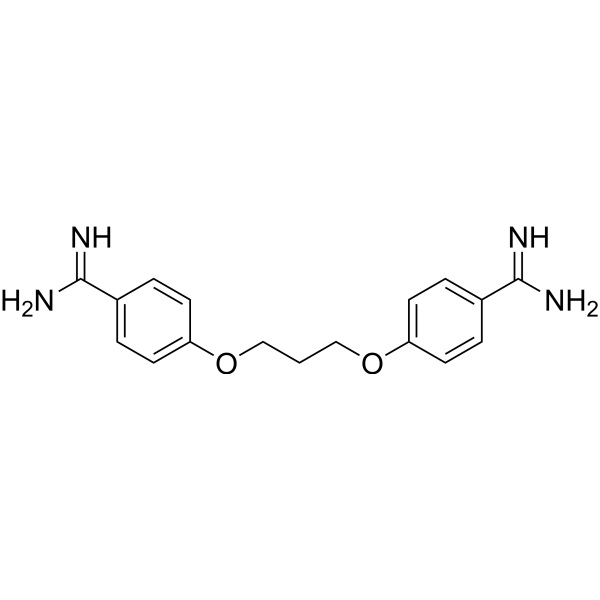
Propamidine

Based on 1 Customer Validation
Propamidine is a covalent inhibitor of TMPRSS2 and has some antibacterial activity..
For research use only. We do not sell to patients.
- Purity : 96.15%
- CAS No.: 104-32-5
- Formula: C17H20N4O2
- Molecular Weight:312.37
-
Storage:Powder -20°C, 3 years , 4°C, 2 years ; In solvent -80°C, 6 months , -20°C, 1 month

To place orders, for customer services and technical support, please contact: MedChemExpress USA
Tel: 609-228-6898 E-mail: [email protected] [email protected]


-
 Biological Activity
-
Chemical Information
-
Solvent & Solubility
- Protocols
- Purity & Documentation
- References
-
 Help & FAQs


All Parasite Isoforms
More

Biological Activity
Description
Cellular Effect
|
Cell Line

|
Type | Value | Description | References |
|---|---|---|---|---|
| Calu-3 | CC50 |
>500 μM
Compound: Propamidine
|
Cytotoxicity against human Calu-3 cells assessed as reduction in cell viability
Cytotoxicity against human Calu-3 cells assessed as reduction in cell viability
|
[PMID: 37284689] |
| HCT-116 | GI50 |
11 μM
Compound: 2 (Propamidine)
|
Tested for in vitro concentration required to inhibit growth by 50% against HCT116 human colon cancer cell line
Tested for in vitro concentration required to inhibit growth by 50% against HCT116 human colon cancer cell line
|
[PMID: 11755363] |
| HT-29 | GI50 |
>50 μM
Compound: 2 (Propamidine)
|
Tested for in vitro concentration required to inhibit growth by 50% against HT-29 human colon cancer cell line
Tested for in vitro concentration required to inhibit growth by 50% against HT-29 human colon cancer cell line
|
[PMID: 11755363] |
| MCF7 | GI50 |
9 μM
Compound: 2 (Propamidine)
|
Tested for in vitro concentration required to inhibit growth by 50% against MCF-7 human breast cancer cell line cell line
Tested for in vitro concentration required to inhibit growth by 50% against MCF-7 human breast cancer cell line cell line
|
[PMID: 11755363] |
| NCI/ADR-RES | GI50 |
33 μM
Compound: 2 (Propamidine)
|
Tested for in vitro concentration required to inhibit growth by 50% against MCF-7/ADR human breast cancer cell line cell line
Tested for in vitro concentration required to inhibit growth by 50% against MCF-7/ADR human breast cancer cell line cell line
|
[PMID: 11755363] |
Clinical Trial
| NCT Number | Sponsor | Condition | Start Date |
Phase
|
|---|---|---|---|---|
| NCT01329991 | 2011-05 | PHASE1 |


Chemical Information
-
CAS No. 104-32-5
-
Appearance Solid
-
Molecular Weight 312.37
-
Formula C17H20N4O2
-
Color White to off-white
-
SMILES
N=C(C1=CC=C(C=C1)OCCCOC(C=C2)=CC=C2C(N)=N)N
-
Shipping
Room temperature in continental US; may vary elsewhere.
-
Storage
Powder -20°C 3 years 4°C 2 years In solvent -80°C 6 months -20°C 1 month


Solvent & Solubility
In Vitro:
DMSO : 8.33 mg/mL (26.67 mM; ultrasonic and warming and heat to 60°C; Hygroscopic DMSO has a significant impact on the solubility of product, please use newly opened DMSO)
Please refer to the solubility information to select the appropriate solvent. Once prepared, please aliquot and store the solution to prevent product inactivation from repeated freeze-thaw cycles.
Storage method and period of stock solution: -80°C, 6 months; -20°C, 1 month. When stored at -80°C, please use it within 6 months. When stored at -20°C, please use it within 1 month.
Please refer to the solubility information to select the appropriate solvent. Once prepared, please aliquot and store the solution to prevent product inactivation from repeated freeze-thaw cycles.
Storage method and period of stock solution: -80°C, 6 months; -20°C, 1 month. When stored at -80°C, please use it within 6 months. When stored at -20°C, please use it within 1 month.
Concentration (start) × Volume (start) = Concentration (final) × Volume (final)


Purity & Documentation
-
Data Sheet (264 KB)
-
SDS (251 KB)
- English - EN (251 KB)
- Français - FR (251 KB)
- Deutsch - DE (251 KB)
- Norwegian - NO (251 KB)
- Español - ES (251 KB)
- Swedish - SV (251 KB)
- Italian - IT (251 KB)
- Korean - KR (251 KB)
- Portuguese - PT (251 KB)
-
Handling Instructions (2659 KB)
References


Complete Stock Solution Preparation Table
Please refer to the solubility information to select the appropriate solvent. Once prepared, please aliquot and store the solution to prevent product inactivation from repeated freeze-thaw cycles.
Storage method and period of stock solution: -80°C, 6 months; -20°C, 1 month. When stored at -80°C, please use it within 6 months. When stored at -20°C, please use it within 1 month.
| Optional Solvent | Concentration Solvent Mass | 1 mg | 5 mg | 10 mg | 25 mg |
|---|---|---|---|---|---|
| DMSO | 1 mM | 3.2013 mL | 16.0067 mL | 32.0133 mL | 80.0333 mL |
| 5 mM | 0.6403 mL | 3.2013 mL | 6.4027 mL | 16.0067 mL | |
| 10 mM | 0.3201 mL | 1.6007 mL | 3.2013 mL | 8.0033 mL | |
| 15 mM | 0.2134 mL | 1.0671 mL | 2.1342 mL | 5.3356 mL | |
| 20 mM | 0.1601 mL | 0.8003 mL | 1.6007 mL | 4.0017 mL | |
| 25 mM | 0.1281 mL | 0.6403 mL | 1.2805 mL | 3.2013 mL |


Propamidine Related Classifications
HY-130402B Related Classifications
 Powered by Bioz