



PSB-12054

Based on 1 Customer Validation
PSB-12054 is a P2X4 receptor antagonist with IC50 values of 0.19 μM, 2.10 μM and 1.77 μM against human, rat and mouse receptors, respectively, and exhibits selectivity over other human P2X receptor subtypes. PSB-12054 inhibits ATP-induced calcium influx, suppresses shear stress-induced transverse Ca2+ wave generation, and elevates basal Ca2+ levels in rat atrial myocytes. PSB-12054 binds to the 5-HT2B receptor. PSB-12054 can be used in research related to neuropathic pain, traumatic brain injury, cerebral ischemia and spinal cord injury.
Nur für Forschungszwecke. Wir verkaufen nicht an Patienten.
- Reinheit : 98.94%
- CAS. Nr.: 1407632-07-8
- Formel: C20H15NO3
- Molecular Weight:317.34
-
Speicherung:Powder -20°C, 3 years ; In solvent -80°C, 6 months , -20°C, 1 month


To place orders, for customer services and technical support, please contact: MedChemExpress USA
Tel: 609-228-6898 E-mail: [email protected] [email protected]


-
 Biologische Aktivität
-
Chemical Information
-
Lösungsmittel & Löslichkeit
- Protokoll
- Reinheit & Dokumentation
- Verweise
-
 Help & FAQs


Alle P2X Receptor Isoform-spezifische Produkte anzeigen
MoreAlle 5-HT Receptor Isoform-spezifische Produkte anzeigen
More

Biologische Aktivität
Beschreibung
|
P2X4 Receptor 0.19-2.1 μM (IC50) |
5-HT2B Receptor |
In Vitro
PSB-12054 (10 μM; 4-5 min) suppresses shear-stress-induced T-wave generation in isolated rat right atrial myocytes, with a concomitant increase in basal Ca2+ levels[2].
PSB-12054 (compound 26) (10 nM-100 μM; 30 min pre-incubation) potently inhibits ATP-induced calcium influx in 1321N1 astrocytoma cells stably transfected with human P2X4 receptors with an IC50 of 0.189 μM, reaching a maximal inhibition of 77%[1].
PSB-12054 (30 min pre-incubation) inhibits ATP-induced calcium influx in 1321N1 astrocytoma cells stably transfected with rat P2X4 receptors with an IC50 of 2.10 μM[1].
PSB-12054 (30 min pre-incubation) inhibits ATP-induced calcium influx in 1321N1 astrocytoma cells stably transfected with mouse P2X4 receptors with an IC50 of 1.77 μM[1].
PSB-12054 (30 min pre-incubation) inhibits ATP-induced calcium influx in 1321N1 astrocytoma cells stably transfected with human P2X1 receptors with an IC50 of 6.52 μM[1].
PSB-12054 (10 μM; 30 min pre-incubation) shows weak inhibition of ATP-induced calcium influx in 1321N1 astrocytoma cells stably transfected with human P2X2, P2X3, and P2X7 receptors, with 13%, ~49%, and 9% inhibition respectively[1].
PSB-12054 (10-100 μM; 6 h) is hydrolytically stable under acidic, neutral, and basic conditions, showing no degradation after 6 h of incubation at relevant temperatures[1].
PSB-12054 (10 μM) shows high selectivity for P2X4 receptors, with significant interaction only observed with serotonin 5-HT2B receptors among 80 tested targets[1].
PSB-12054 inhibits human P2X4 receptors with higher potency (IC50 = 0.19 μM) than rat (IC50 = 2.10 μM) and mouse (IC50 = 1.77 μM) P2X4 receptors[3].
PSB-12054 impairs the chemotactic response of human umbilical cord blood-derived CFU-GM clonogenic progenitors to SDF-1, S1P, and eATP gradients[4].
PSB-12054 (10 μM; 30 min prior to imaging) impairs the migration of murine Sca-1+c-kit+Lin− (SKL) cells in response to ATP, reducing total migration path length and average velocity[4].
MedChemExpress (MCE) has not independently confirmed the accuracy of these methods. They are for reference only.
-
Cell Line:murine Sca-1+c-kit+Lin− (SKL) cells
-
Concentration:10 μM
-
Incubation Time:30 min (prior to imaging); variable (80 sequential images at 45-s intervals)
-
Result:Significantly decreased migration of murine SKL cells in response to ATP.
Reduced the total path length of migration.
Reduced the average migration velocity.
In Vivo
PSB-12054 (3 mg/kg; i.p.; daily; 8 days) impairs G-CSF-induced HSPC mobilization in wild-type mice[4].
PSB-12054 (3 mg/kg; i.p.; daily; 8 days) impairs short-term AMD3100-induced HSPC mobilization in wild-type mice[4].
PSB-12054 (3 mg/kg; i.p.; daily; 8 days) impairs AMD3100 (Plerixafor) (HY-10046)-induced HSPC mobilization in P2X7-KO mice[4].
MedChemExpress (MCE) has not independently confirmed the accuracy of these methods. They are for reference only.
-
Animal Model:C57BL/6 J (6-8-week-old female, lethally irradiated hematopoietic transplantation model)[4]
-
Dosage:3 mg/kg
-
Administration:i.p.; daily; 8 days
-
Result:Reduced the number of fluorochrome-labeled donor cells in BM by 40% at 24 hours post-transplantation.
Reduced donor-derived CFU-GM colonies in BM by more than 50% at 24 hours post-transplantation.
Reduced donor-derived CFU-GM colonies in BM and CFU-S colonies in spleen by more than 50% at 12 days post-transplantation.
Delayed recovery kinetics for WBC and PLT counts compared to controls.
-
Animal Model:C57BL/6 J (6-8-week-old female, G-CSF-induced mobilization model)[4]
-
Dosage:3 mg/kg
-
Administration:i.p.; daily; 8 days
-
Result:Reduced numbers of circulating WBCs, SKL cells, and CFU-GM progenitors compared to G-CSF-only treated mice.
-
Animal Model:C57BL/6 J (6-8-week-old female, AMD3100-induced mobilization model)[4]
-
Dosage:3 mg/kg
-
Administration:i.p.; daily; 8 days
-
Result:Reduced numbers of circulating WBCs, SKL cells, and CFU-GM progenitors compared to AMD3100-only treated mice.
-
Animal Model:P2X7-KO (6-8-week-old female, AMD3100-induced mobilization model)[4]
-
Dosage:3 mg/kg
-
Administration:i.p.; daily; 8 days
-
Result:Reduced numbers of circulating WBCs, SKL cells, and CFU-GM progenitors compared to AMD3100-only treated P2X7-KO mice.


Chemical Information
-
CAS. Nr. 1407632-07-8
-
Appearance Solid
-
Molecular Weight 317.34
-
Formel C20H15NO3
-
Color White to off-white
-
SMILES
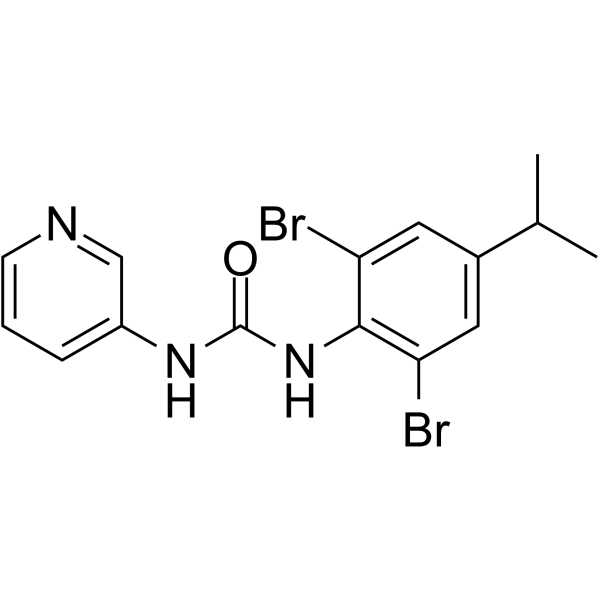
O=C(OCC=1C=CC=CC1)N2C=3C=CC=CC3OC=4C=CC=CC42
-
Versand
Room temperature in continental US; may vary elsewhere.
-
Speicherung
Powder -20°C 3 years In solvent -80°C 6 months -20°C 1 month


Lösungsmittel & Löslichkeit
In Vitro:
DMSO : 28.57 mg/mL (90.03 mM; ultrasonic and warming and heat to 60°C; Hygroscopic DMSO has a significant impact on the solubility of product, please use newly opened DMSO)
Please refer to the solubility information to select the appropriate solvent. Once prepared, please aliquot and store the solution to prevent product inactivation from repeated freeze-thaw cycles.
Storage method and period of stock solution: -80°C, 6 months; -20°C, 1 month. When stored at -80°C, please use it within 6 months. When stored at -20°C, please use it within 1 month.
Please refer to the solubility information to select the appropriate solvent. Once prepared, please aliquot and store the solution to prevent product inactivation from repeated freeze-thaw cycles.
Storage method and period of stock solution: -80°C, 6 months; -20°C, 1 month. When stored at -80°C, please use it within 6 months. When stored at -20°C, please use it within 1 month.
Konzentration (Stammlösung) × Volumen (Stammlösung) = Konzentration (Ziellösung) × Volumen (Ziellösung)
In Vivo:
Select the appropriate dissolution method based on your experimental animal and administration route.
- For the following dissolution methods, please ensure to first prepare a clear stock solution using an In Vitro approach and then sequentially add co-solvents:
- To ensure reliable experimental results, the clarified stock solution can be appropriately stored based on storage conditions. As for the working solution for In Vivo experiments, it is recommended to prepare freshly and use it on the same day.
- The percentages shown for the solvents indicate their volumetric ratio in the final prepared solution. If precipitation or phase separation occurs during preparation, heat and/or sonication can be used to aid dissolution.
In Vivo Dissolution Calculator
Please enter the basic information of animal experiments:
-
-
-
-
Recommended: Prepare an additional quantity of animals to account for potential losses during experiments.
Please enter your animal formula composition:
-
%DMSO +
Recommended: Keep the proportion of DMSO in working solution below 2% if your animal is weak.
-
%+
-
+%Tween-80 + +
-
%Saline +
The co-solvents required include: DMSO, . All of co-solvents are available by MedChemExpress (MCE). , Tween 80. All of co-solvents are available by MedChemExpress (MCE).
Working solution concentration: 0.22 mg/mL
Method for preparing stock solution: mg drug dissolved in μL DMSO. Stock solution concentration: mg/mL.
1. Take μL DMSO stock solution;
2. Add μL .
μL , mix evenly;
3. Then add μL Tween 80, mix evenly;
4. Then add μL
Please ensure that the stock solution in the first step is dissolved to a clear state, and add co-solvents in sequence. You can use ultrasonic heating (ultrasonic cleaner, recommended frequency 20-40 kHz), vortexing, etc. to assist dissolution.


Reinheit & Dokumentation
-
Data Sheet (299 KB)
-
SDS (393 KB)
- English - EN (393 KB)
- Français - FR (393 KB)
- Deutsch - DE (393 KB)
- Norwegian - NO (393 KB)
- Español - ES (393 KB)
- Swedish - SV (393 KB)
- Italian - IT (393 KB)
- Korean - KR (393 KB)
- Portuguese - PT (393 KB)
-
Handling Instructions (2659 KB)
Verweise
[1]. Hernandez-Olmos V, et al. N-substituted phenoxazine and acridone derivatives: structure-activity relationships of potent P2X4 receptor antagonists. Journal of medicinal chemistry. 2012 Nov 26;55(22):9576-88. [Content Brief]
[2]. Le QA, et al. Distinct shear-induced Ca signaling in the left and right atrial myocytes: Role of P2 receptor context. Journal of molecular and cellular cardiology. 2020 Jun;143:38-50. [Content Brief]
[3]. Li B, et al. Molecular mechanism underlying the subtype-selectivity of competitive inhibitor NF110 and its distinct potencies in human and rat P2X3 receptors. Sci Bull (Beijing). 2018 Dec 30;63(24):1616-1625. [Content Brief]
[4]. Adamiak M, et al. The P2X4 purinergic receptor has emerged as a potent regulator of hematopoietic stem/progenitor cell mobilization and homing-a novel view of P2X4 and P2X7 receptor interaction in orchestrating stem cell trafficking. Leukemia. 2022 Jan;36(1):248-256. [Content Brief]


Complete Stock Solution Preparation Table
Please refer to the solubility information to select the appropriate solvent. Once prepared, please aliquot and store the solution to prevent product inactivation from repeated freeze-thaw cycles.
Storage method and period of stock solution: -80°C, 6 months; -20°C, 1 month. When stored at -80°C, please use it within 6 months. When stored at -20°C, please use it within 1 month.
| Optional Solvent | Concentration Solvent Mass | 1 mg | 5 mg | 10 mg | 25 mg |
|---|---|---|---|---|---|
| DMSO | 1 mM | 3.1512 mL | 15.7560 mL | 31.5119 mL | 78.7799 mL |
| 5 mM | 0.6302 mL | 3.1512 mL | 6.3024 mL | 15.7560 mL | |
| 10 mM | 0.3151 mL | 1.5756 mL | 3.1512 mL | 7.8780 mL | |
| 15 mM | 0.2101 mL | 1.0504 mL | 2.1008 mL | 5.2520 mL | |
| 20 mM | 0.1576 mL | 0.7878 mL | 1.5756 mL | 3.9390 mL | |
| 25 mM | 0.1260 mL | 0.6302 mL | 1.2605 mL | 3.1512 mL | |
| 30 mM | 0.1050 mL | 0.5252 mL | 1.0504 mL | 2.6260 mL | |
| 40 mM | 0.0788 mL | 0.3939 mL | 0.7878 mL | 1.9695 mL | |
| 50 mM | 0.0630 mL | 0.3151 mL | 0.6302 mL | 1.5756 mL | |
| 60 mM | 0.0525 mL | 0.2626 mL | 0.5252 mL | 1.3130 mL | |
| 80 mM | 0.0394 mL | 0.1969 mL | 0.3939 mL | 0.9847 mL |


PSB-12054 Related Classifications
HY-101228 Related Classifications
 Powered by Bioz
Keywords