249 Results for "

raspberry crops

" in MedChemExpress (MCE) Product Catalog:
Products (249)

249 Results for "raspberry crops" in MCE Product Catalog:

Cat. No.: HY-185314
CAS No.: 1848207-89-5
Research Areas:  

Others

Metproxybicyclone is a graminaceous herbicide. Metproxybicyclone also acts as an ACCase inhibitor, with an IC50 of 0.19 μM against Lolium multiflorum. Metproxybicyclone inhibits eukaryotic homomeric acetyl-CoA carboxylase, which catalyzes the first key step in fatty acid biosynthesis of graminaceous plants. Metproxybicyclone controls susceptible graminaceous weeds as well as graminaceous weed populations with target-site, non-target-site, and ACCase D2078G target-site resistance mechanisms. Metproxybicyclone is safe to dicotyledonous crops and is suitable for pre-plant burndown applications .
loading...
    loading...
Cat. No.: HY-189259
CAS No.: 3105221-19-7
Target:  

Fungal

Research Areas:  

Infection

Antifungal agent 179 is an indole-oxazole alkaloid analog with broad-spectrum antifungal activity against plant pathogenic fungi. Antifungal agent 179 disrupts the integrity of fungal hyphal cell membranes, increases membrane permeability, and causes leakage of intracellular electrolytes and cytoplasm. Antifungal agent 179 exhibits protective and curative activity in a tomato in vivo model infected with Botrytis cinerea, with low toxicity to mung bean plants. Antifungal agent 179 can be used for research on crop fungal infections .
loading...
    loading...
Cat. No.: HY-N7058R
CAS No.: 488-10-8
cis-Jasmone (Standard) is the analytical standard of cis-Jasmone. This product is intended for research and analytical applications. Cis-Jasmone is a plant-derived natural product. Cis-Jasmone is a plant-derived natural product. Cis-Jasmone is constitutively released by many flowers and sometimes by leaves as an attractant for pollinators or as a chemical cue for host location by insect flower herbivores. Cis-Jasmone treatment of crop plants not only induces direct defense against herbivores, but also induces indirect defense by releasing VOCs that attract natural enemies .
loading...
    loading...
Cat. No.: HY-N9868
CAS No.: 423170-79-0
(-)-Phaselic acid is a protein protectant that can be isolated from red clover (Trifolium pratense) leaves. (-)-Phaselic acid is synthesized through an acyl transfer reaction between caffeoyl-CoA and malic acid catalyzed by the HCT2 enzyme. As a substrate for endogenous polyphenol oxidase (PPO), its oxidation to o-quinone can inhibit protein degradation during forage storage. (-)-Phaselic acid can be used to improve the protein preservation performance of forage crops such as alfalfa, reducing nutritional losses during storage and environmental nitrogen pollution .
loading...
    loading...
Cat. No.: HY-W017140S
CAS No.: 1335436-01-5
Synonyms: SBMP-d3
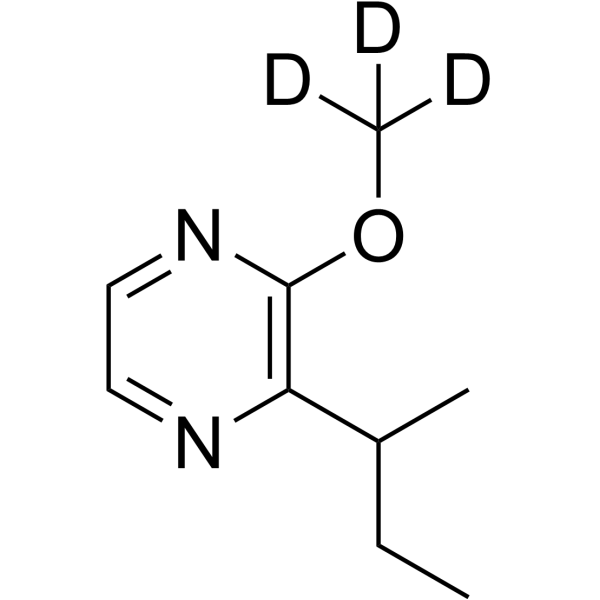
2-Sec-butyl-3-methoxypyrazine-d3 is deuterated labeled cis-?Jasmone (HY-N7058). Cis-Jasmone is a plant-derived natural product. Cis-Jasmone is constitutively released by many flowers and sometimes by leaves as an attractant for pollinators or as a chemical cue for host location by insect flower herbivores. Cis-Jasmone treatment of crop plants not only induces direct defense against herbivores, but also induces indirect defense by releasing VOCs that attract natural enemies .
loading...
    loading...
Cat. No.: HY-W758421
Diquat-d8 dibromide is a deuterium labeled Diquat dibromide (HY-122984). Diquat dibromide is a comprehensive herbicide. Diquat dibromide increases the production of ROS and triggers mitochondrial Autophagy. Diquat dibromide generates free radicals such as superoxide anions through redox cycles, which induce oxidative stress. Diquat dibromide is cytotoxic, reproductive, and neurotoxic. Diquat dibromide is used in cotton, soybean, and other crops to combat noxious weeds .
loading...
    loading...
Cat. No.: HY-129300R
CAS No.: 52888-80-9
Research Areas:  

Others

Prosulfocarb (Standard) is the analytical standard of Prosulfocarb. This product is intended for research and analytical applications. Prosulfocarb is a herbicide with a rapidly growing use trend. Prosulfocarb is used in winter cereals to help address the problem of increasing biotic resistance of weeds to certain pesticides. Environmental and food effects of prosulfocarb have been observed, and its transfer pattern from target crops to non-target areas has been studied. The volatility effect of prosulfocarb is an important factor explaining the inefficiency of isolated area contamination and marginal protection against residue spread .
loading...
    loading...
Cat. No.: HY-17518R
CAS No.: 283159-90-0
Synonyms: IR5885 (Standard); Valiphenal (Standard)
Research Areas:  

Infection

Valifenalate (Standard) is the analytical standard of Valifenalate. This product is intended for research and analytical applications. Valifenalate (IR5885; Valiphenal) is an insecticide agent and fungicide, which is approved for application on high-value crops such as grapes, tomatoes and other vegetables. Valifenalate interferes with cell-wall synthesisValifenalate is effective against various types of mildew. Valifenalate can be used against crown rot of rose cuased by Phytophthora citrophthora. Valifenalate induces non-adverse thyroid changes via adaptive induction of uridine 5’-diphosphoglucuronosyltransferase (UGT) in the liver of dogs and rats .
loading...
    loading...
Cat. No.: HY-B0828S
CAS No.: 1773496-62-0
Synonyms: Hostathion 40EC-d5; Hostathion-d5; Hostation-d5
Triazophos-d5 (Hostathion 40EC-d5) is the deuterium labeled Triazophos(HY-B0828) . Triazophos, a non-systemic insecticide and acaricide that acts as an acetylcholinesterase (AChE) inhibitor, covalently and irreversibly binds to the acetylcholine binding site, thus blocking the hydrolysis of acetylcholine and leading to hyperexcitability; it is effective against a variety of soil insects and mites, including aphids, thrips, midges, beetles, Lepidoptera larvae, cutworms, and spider mites in crops such as ornamentals, cotton, rice, maize, soybeans, oil palms, olives, and coffee.
loading...
    loading...
Cat. No.: HY-N7176R
CAS No.: 22688-78-4
Synonyms: Kaempferol-3-glucuronide (Standard); Kaempferol-3-O-glucuronide (Standard)
Prosulfocarb (Standard) is the analytical standard of Prosulfocarb. This product is intended for research and analytical applications. Prosulfocarb is a herbicide with a rapidly growing use trend. Prosulfocarb is used in winter cereals to help address the problem of increasing biotic resistance of weeds to certain pesticides. Environmental and food effects of prosulfocarb have been observed, and its transfer pattern from target crops to non-target areas has been studied. The volatility effect of prosulfocarb is an important factor explaining the inefficiency of isolated area contamination and marginal protection against residue spread .
loading...
    loading...
Cat. No.: HY-W040194R
CAS No.: 81777-89-1
Research Areas:  

Metabolic Disease

Clomazone (Standard) is the analytical standard of Clomazone (HY-W040194). This product is intended for research and analytical applications. Clomazone is a broad spectrum herbicide, mainly used to control annual broadleaf weeds and grass weeds in various crops such as rice, soybeans, and peanuts. Clomazone inhibits carotenoid biosynthesis, and treated plants show typical "albinism" symptoms due to the destruction of chloroplast membrane structure leading to chlorophyll degradation. Clomazone exhibits multiple toxic effects on non-target organisms, including aquatic lethality, developmental malformations, liver damage, mitochondrial dysfunction, and hematotoxicity.
loading...
    loading...
Cat. No.: HY-129300S
Synonyms: S-Benzyl dipropylthiocarbamate-d7
Prosulfocarb-d7 (S-Benzyl dipropylthiocarbamate-d7) is deuterium labeled Prosulfocarb. Prosulfocarb is a herbicide with a rapidly growing use trend. Prosulfocarb is used in winter cereals to help address the problem of increasing biotic resistance of weeds to certain pesticides. Environmental and food effects of prosulfocarb have been observed, and its transfer pattern from target crops to non-target areas has been studied. The volatility effect of prosulfocarb is an important factor explaining the inefficiency of isolated area contamination and marginal protection against residue spread .
loading...
    loading...
Cat. No.: HY-136376
CAS No.: 135590-91-9
Purity:  99.45%
Research Areas:  

Others

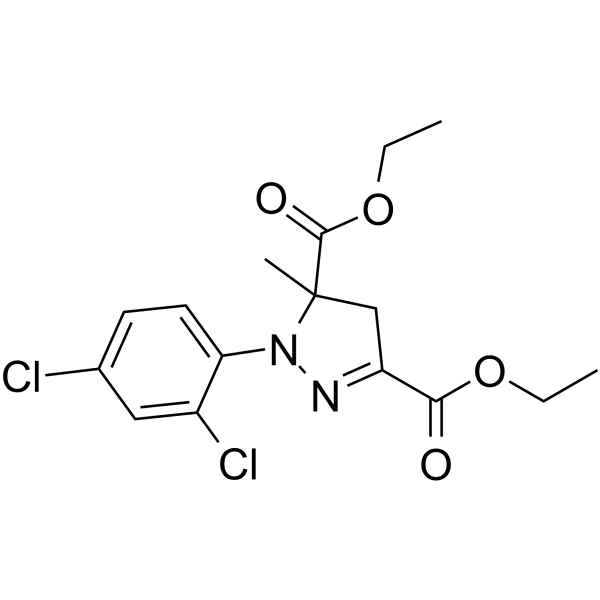
Mefenpyr-diethyl is a pyrazoline-type herbicide safener that functions to enhance lipid biosynthesis. Mefenpyr-diethyl effectively prevents herbicide-induced phytotoxic damage caused by herbicides such as fenoxaprop-p-ethyl (HY-B2013) and mesosulfuron-methyl (HY-126987) by protecting cereal crops including wheat. Mefenpyr-diethyl significantly increases lipid content in wheat either when applied alone or in combination with the herbicide fenoxaprop-p-ethyl. The mechanism of action of Mefenpyr-diethyl does not involve the induction of glutathione S-transferase (GST) activity in wheat .
loading...
    loading...
Cat. No.: HY-170505A
CAS No.: 2254813-53-9
Research Areas:  

Others

(S,S,S)-Icafolin-methyl is an isomer of Icafolin-methyl (HY-170505). Icafolin-methyl is a herbicide and plant β-tubulin (Microtubule/Tubulin) inhibitor. Icafolin-methyl binds to the β-tubulin region of the Colchicine (HY-16569) binding site, thereby blocking the polymerization of plant tubulin. As a non-selective herbicide, Icafolin-methyl exhibits post-emergence activity against weeds in both cool-season and warm-season cropping systems, including resistant ryegrass and darnel biotypes. Icafolin-methyl can be used for herbicide research .
loading...
    loading...
Cat. No.: HY-189501
CAS No.: 2569295-47-0
Research Areas:  

Others

MiZax5 is a zaxinone mimic and plant growth regulator (PGR) that negatively regulates strigolactone (SL) biosynthesis and release and promotes plant growth. MiZax5 downregulates the expression of SL biosynthesis-related genes D27, CCD7, CCD8, and carlactone oxidase, thereby reducing SL levels in rice roots and root exudates and further decreasing seed germination and emergence of the root parasitic plant Striga hermonthica. MiZax5 simultaneously promotes rice root growth and improves growth- and yield-related traits in various crops, making it useful for research related to plant growth regulation .
loading...
    loading...
Cat. No.: HY-121628
CAS No.: 106917-52-6
Target:  

Fungal

Research Areas:  

Infection

Flusulfamide is a sulfonanilide Fungicide that effectively inhibits the germination of resting spores of Plasmodiophora brassicae, the pathogen causing clubroot in cruciferous crops. Flusulfamide blocks the developmental process of resting spores from stage 1 to stage 2. By downregulating germination-related genes and upregulating immunophilin genes (such as PbCyp3), it induces abnormal accumulation of the PbCYP3 protein, thereby causing the spores to deplete energy in a state of continuous energy consumption without germination, and reducing their infectivity. Flusulfamide reduces soil ATP content in the early stage of application, but soil microbial biomass gradually recovers 3 days later. Flusulfamide is widely used in research on clubroot control .
loading...
    loading...
Cat. No.: HY-174388
CAS No.: 3080992-04-4
Research Areas:  

Infection

Antifungal agent 134 (Compound B13) is an antifungal agent with EC50s of 3.24, 1.89, 1.70, 0.36, 4.27, and 1.50 μg/mL for Botrytis cinerea, Alternaria solani, Fusarium graminearum, Rhizoctonia solani, Colletotrichum orbiculare, and Alternaria alternata, respectively. Antifungal agent 134 can disrupt the cell membrane and mitochondria of the hyphae, leading to significant ROS accumulation. Antifungal agent 134 also has significant herbicidal activities against field weeds, such as Amaranthus retroflexus L and Abutilon theophrasti Medicus. Antifungal agent 134 can be used for crop diseases and field weeds research .
loading...
    loading...
Cat. No.: HY-W102893
CAS No.: 99910-50-6
4,6-Dibromo indole is a natural product found in the adipose tissue of bottlenose dolphins, algae, and invertebrates including species of the genus Tubastrea, with multiple activities such as nematicidal and antifungal properties. 4,6-Dibromo indole inhibits the motility of Caenorhabditis elegans and induces a multi-stage nematicidal effect. 4,6-Dibromo indole inhibits the growth, biofilm formation, and yeast-hypha transition of Candida, induces ROS accumulation, disrupts hyphal networks, and reduces biofilm biomass. 4,6-Dibromo indole can be used in studies on crop damage related to nematode infestation and Candida infection .
loading...
    loading...
Cat. No.: HY-W109523
CAS No.: 4299-07-4
Research Areas:  

Infection

2-Butylbenzo[d]isothiazol-3(2H)-one is a bioactive compound with potent antibacterial and antifungal activity. 2-Butylbenzo[d]isothiazol-3(2H)-one is often used as a pesticide ingredient in agriculture to protect crops from diseases. 2-Butylbenzo[d]isothiazol-3(2H)-one is also used in coatings to prevent the growth of mold and algae. 2-Butylbenzo[d]isothiazol-3(2H)-one is also used as a preservative in personal care products to extend the shelf life of the product .
loading...
    loading...
Cat. No.: HY-W019334
CAS No.: 202842-98-6
Synonyms: 3,4-DMPP
Target:  

Bacterial

Research Areas:  

Others

3,4-Dimethylpyrazole phosphate (3,4-DMPP) is a nitrification inhibitor and microbial community regulator, whose activity is dose- and soil pH-dependent. 3,4-Dimethylpyrazole phosphate inhibits ammonia monooxygenase, ammonia-oxidizing bacteria, as well as ammonia-oxidizing archaea and nitrite-oxidizing bacteria. 3,4-Dimethylpyrazole phosphate alters the community composition of prokaryotes, fungi and ammonia-oxidizing bacteria. 3,4-Dimethylpyrazole phosphate reduces nitrate leaching, nitrous oxide emission and soil nitrate accumulation, and enhances nitrogen use efficiency and crop yield in agricultural production. 3,4-Dimethylpyrazole phosphate is applicable to agriculture-related research .
loading...
    loading...

