119 Results for "

S-Transferase

" in MedChemExpress (MCE) Product Catalog:
Products (119)

119 Results for "S-Transferase" in MCE Product Catalog:

Cat. No.: HY-P811894A
Synonyms: GSTS, PGDS, PTGDS2, HPGDS, Hematopoietic prostaglandin D synthase, H-PGDS, GST class-sigma, Glutathione S-Transferase, Glutathione-dependent PGD synthase, Glutathione-requiring prostaglandin D synthase, Prostaglandin-H2 D-isomerase

Host:  

Mouse

Application:  

WB, FC

Reactivity:  

Human, Mouse, Rat

loading...
    loading...
Cat. No.: HY-133997
CAS No.: 3327-24-0
2'-Hydroxy-4-methoxychalcone is a PPARγ agonist. 2'-Hydroxy-4-methoxychalcone also exhibits inhibitory activity against gelatinase/collagenase and human glutathione S-transferase (GST), with an IC50 of 5.2 μM and a Ki of 15.36 μM against GST. 2'-Hydroxy-4-methoxychalcone inhibits both the NF-κB and AP-1 signaling pathways, exerting anti-inflammatory activity; it also inhibits COX-2, conferring anti-cancer/anti-angiogenic activity. 2'-Hydroxy-4-methoxychalcone can be used in studies related to atherosclerosis, inflammatory diseases and cancer .
loading...
    loading...
Cat. No.: HY-W020788R
CAS No.: 98730-04-2
Synonyms: CGA 154281 (Standard)
Benoxacor (Standard) is the analytical standard of Benoxacor. This product is intended for research and analytical applications. Benoxacor (CGA 154281) is a herbicide safener and xenobiotic metabolism regulator. Benoxacor protects maize from the toxicity of metolachlor mainly by inducing detoxifying enzymes such as Glutathione S-transferase. Benoxacor also activates FXR, PXR and ERRα, and inhibits aromatase (aromatase). However, Benoxacor exhibits potential subacute oral toxicity and a high risk of hepatotoxicity in animal models. Benoxacor induces reactive oxygen species accumulation, interferes with embryonic heart development, and causes increased liver and kidney weights as well as alterations in gut microbiota in mice. Benoxacor can be used in studies related to hepatic steatosis, infertility, breast cancer and developmental toxicity .
loading...
    loading...
Cat. No.: HY-P88758
Synonyms: GSTT2B

Host:  

Mouse

Application:  

IHC-P, ICC/IF, FC

Reactivity:  

Human

loading...
    loading...
Cat. No.: HY-23201
CAS No.: 1035557-09-5
Synonyms: Phytoprostane A1; PPA1
Research Areas:  

Others

A1-Phytoprostane-I (Phytoprostane A1) is a cyclopentenone-type phytoprostane that forms via free radical-catalyzed non-enzymatic oxidation of α-linolenic acid. A1-Phytoprostane-I exhibits multiple biological activities, including inducing the accumulation of phytoalexins (e.g., Scopoletin (HY-N0342)) in tobacco cells, activating mitogen-activated protein kinases (MAPK) in tomato cells, and inducing the expression of glutathione-S-transferase 1 (Glutathione-S-transferase 1) in Arabidopsis thaliana .
loading...
    loading...
Cat. No.: HY-137330
CAS No.: 26289-39-4
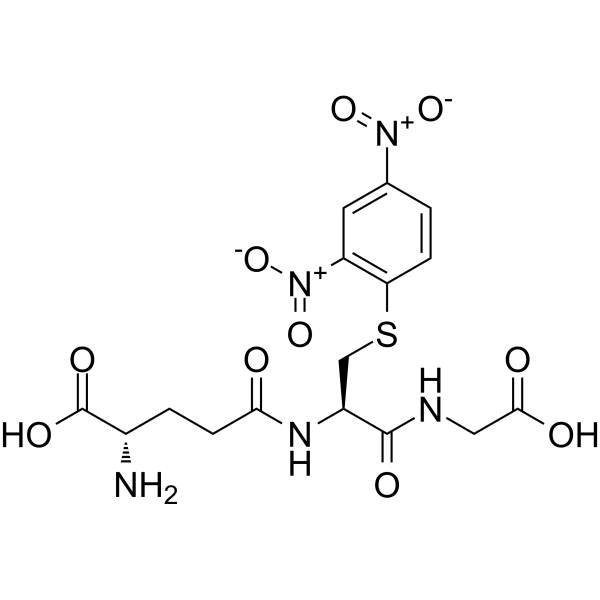
S-(2,4-Dinitrophenyl)glutathione is a substrate for glutathione-S-transferase. (2,4-Dinitrophenyl)glutathione can be used as an irreversible glutathione reductase inhibitor with an Ki value of 30 µM .
loading...
    loading...
Cat. No.: HY-P88758A
Synonyms: GSTT2B

Host:  

Mouse

Application:  

IHC-P, ICC/IF, FC

Reactivity:  

Human

loading...
    loading...
Cat. No.: HY-N1282R
CAS No.: 480-81-9
Seneciphylline (Standard) is the analytical standard of Seneciphylline. This product is intended for research and analytical applications. Seneciphylline is a toxic pyrrolizidine alkaloid in Gynura japonica . Seneciphylline significantly increases the activities of epoxide hydrase and glutathione-S-transferase but causes reduction of cytochrome P-450 and related monooxygenase activities .
loading...
    loading...
Cat. No.: HY-106064
CAS No.: 79672-88-1
Synonyms: U-60257
Piriprost (U-60257) is an inhibitor of Glutathione-S-transferase and leukotriene biosynthesis inhibitor. Piriprost inhibits the biosynthesis of leukotriene C/D without affecting cyclooxygenase-mediated arachidonic acid metabolites. Piriprost increases the activity of alkaline phosphatase (ALP). Piriprost antagonizes contractions induced by leukotriene C/D in vitro. Piriprost is used in asthma research .
loading...
    loading...
Cat. No.: HY-106064A
CAS No.: 88851-62-1
Synonyms: U 60257B
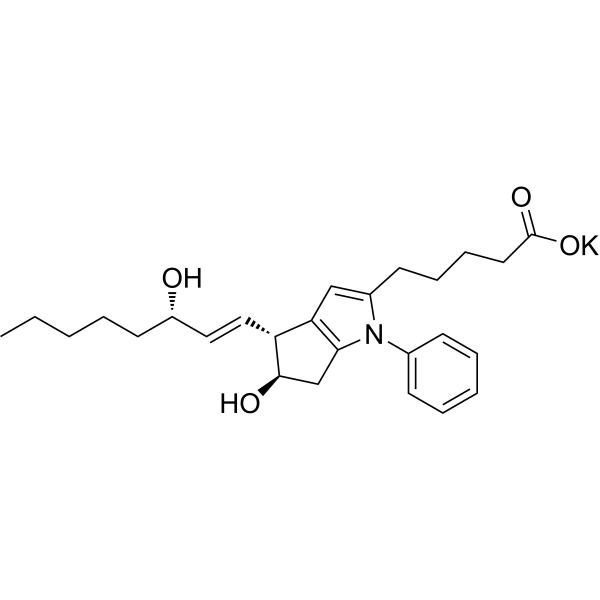
Piriprost potassium (U 60257B) is an inhibitor of Glutathione-S-transferase and leukotriene biosynthesis inhibitor. Piriprost potassium inhibits the biosynthesis of leukotriene C/D without affecting cyclooxygenase-mediated arachidonic acid metabolites. Piriprost potassium increases the activity of alkaline phosphatase (ALP). Piriprost potassium antagonizes contractions induced by leukotriene C/D in vitro. Piriprost potassium is used in asthma research .
loading...
    loading...
Cat. No.: HY-187808
CAS No.: 257880-89-0
Insecticidal agent 38 is a AChE inhibitor and Insecticide, with an IC50 of 49.08 μg/mL against AChE. Insecticidal agent 38 inhibits the activities of SOD, Catalase and Glutathione-S-transferase. Insecticidal agent 38 induces intracellular ROS, lipofuscin and lipid accumulation, increases malondialdehyde levels, disrupts redox homeostasis and triggers oxidative damage. Insecticidal agent 38 inhibits the feeding and reproductive capabilities of the pine wood nematode (Bursaphelenchus xylophilus). Insecticidal agent 38 exhibits insecticidal activity against nematodes. Insecticidal agent 38 can be used in studies of plant-parasitic nematode infections .
loading...
    loading...
Cat. No.: HY-N2853
CAS No.: 7559-04-8
Synonyms: α-Tocopherylquinone
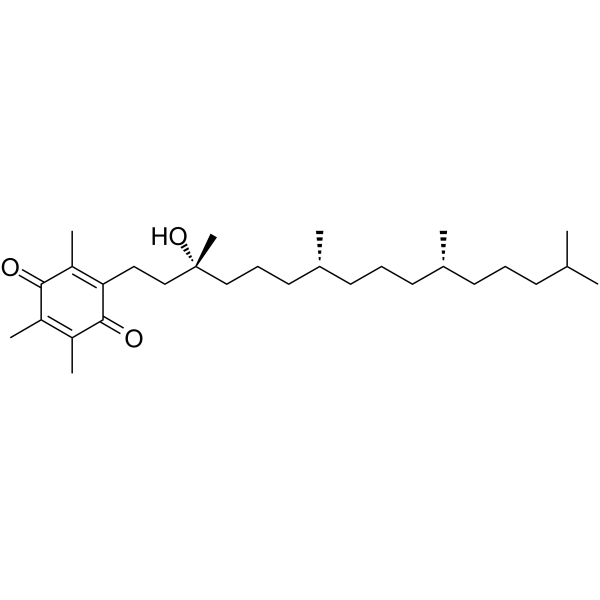
D-α-Tocopherylquinone (α-Tocopherylquinone) is a quinone, can be isolated from Phaeodactylum tricornutum. D-α-Tocopherylquinone is an oxidation product of α-Tocopherol (vitamin E). D-α-Tocopherylquinone can act as an anticoagulant and as an antioxidant. D-α-Tocopherylquinone reduces cellular oxidative damage produced by oxidized lipids. D-α-Tocopherylquinone binds to a liver cytosolic protein with a molecular mass of about 40 kDa. D-α-Tocopherylquinone binds to glurathione-S-transferase (GST) and can be transported to the site of metabolism or excreted in the bile .
loading...
    loading...
Cat. No.: HY-P82563
Synonyms: MU; H-B; GST1; GTH4; GTM1; MU-1; GSTM1-1; MGC26563; GSTM1a-1a; GSTM1b-1b

Host:  

Rabbit

Application:  

WB

Reactivity:  

Human, Mouse, Rat

loading...
    loading...
Cat. No.: HY-P83183
Synonyms: MU; H-B; GST1; GTH4; GTM1; MU-1; GSTM1-1; MGC26563; GSTM1a-1a; GSTM1b-1b

Host:  

Rabbit

Application:  

WB

Reactivity:  

Human, Hamster

loading...
    loading...
Cat. No.: HY-N17963
CAS No.: 229483-41-4
Cappariloside A is a larvicide that exhibits larvicidal activity against Aedes aegypti larvae and reduces larval glutathione-S-transferase activity. Cappariloside A also possesses antiviral activity, decreases the level of phosphorylated STAT1 in cells, inhibits the replication of influenza viruses H1N1, H3N2, PIV3 and ADV, and downregulates the expression of IL-6, IP-10, MIG, RANTES/CCL-5, IFN-β and IL-29. Cappariloside A suppresses the inflammatory response induced by mouse lung-adapted influenza virus strains. Cappariloside A can be used in studies related to larvicidal applications and influenza virus infection .
loading...
    loading...
Cat. No.: HY-N2853R
CAS No.: 7559-04-8
Synonyms: α-Tocopherylquinone (Standard)
D-α-Tocopherylquinone (α-Tocopherylquinone) (Standard) is the analytical standard of D-α-Tocopherylquinone. This product is intended for research and analytical applications. D-α-Tocopherylquinone is a quinone, can be isolated from Phaeodactylum tricornutum. D-α-Tocopherylquinone is an oxidation product of α-Tocopherol (vitamin E). D-α-Tocopherylquinone can act as an anticoagulant and as an antioxidant. D-α-Tocopherylquinone reduces cellular oxidative damage produced by oxidized lipids. D-α-Tocopherylquinone binds to a liver cytosolic protein with a molecular mass of about 40 kDa. D-α-Tocopherylquinone binds to glurathione-S-transferase (GST) and can be transported to the site of metabolism or excreted in the bile .
loading...
    loading...
Cat. No.: HY-P83183A
Synonyms: MU; H-B; GST1; GTH4; GTM1; MU-1; GSTM1-1; MGC26563; GSTM1a-1a; GSTM1b-1b

Host:  

Rabbit

Application:  

WB

Reactivity:  

Human, Hamster

loading...
    loading...
Cat. No.: HY-167632
CAS No.: 31272-50-1
Synonyms: (3R,3′S)-Zeaxanthin
meso-Zeaxanthin ((3R,3′S)-Zeaxanthin) is an orally active xanthophyll carotenoid. meso-Zeaxanthin inhibits CYP1A1, CYP1A2, CYP2B1/2, COX-2, TNF-α and iNOS, and enhances the activities of Uridine diphosphate glucuronosyltransferase and Glutathione-S-transferase. meso-Zeaxanthin quenches oxygen free radicals. meso-Zeaxanthin filters short-wavelength blue light, alleviates oxidative damage and visual abnormalities. meso-Zeaxanthin reduces tumor incidence, prolongs tumor latency and survival rate of tumor-bearing mice, and inhibits paw edema. meso-Zeaxanthin can be used in research related to sarcoma and age-related macular degeneration .
loading...
    loading...
Cat. No.: HY-P85538
Synonyms: DKFZp779C1727; glutathione S Transferase fusion protein; HAP; HET; HSP27 ERE TATA binding protein; HSP27 ERE-TATA-binding protein; HSP27 estrogen response element-TATA box-binding protein; SAF B; SAF-B1; SAFB 1; SAFB; SAFB1; SAFB1_HUMAN; scaffold attachment factor B1.

Host:  

Mouse

Application:  

WB, ICC/IF

Reactivity:  

Human

loading...
    loading...

