
1484 Results for "

aqueous MEA solution

" in MedChemExpress (MCE) Product Catalog:
Products (1484)

1484 Results for "aqueous MEA solution" in MCE Product Catalog:

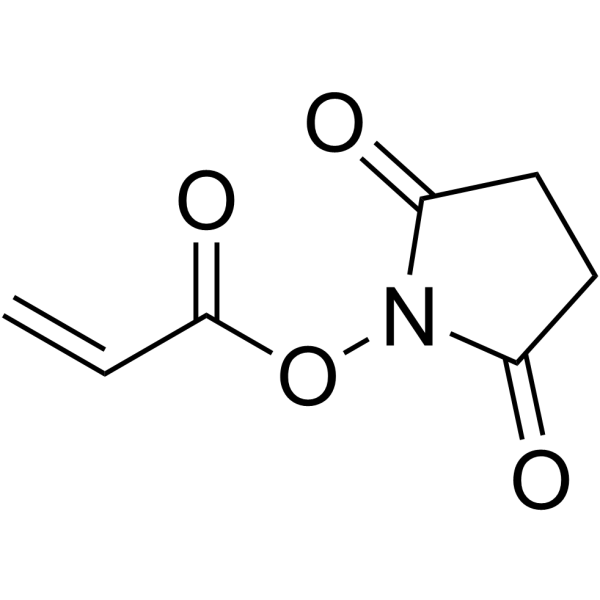
Cat. No.: HY-W043748
CAS No.: 38862-24-7
Synonyms: N-Succinimidyl acrylate
Research Areas:  

Others

2,5-Dioxopyrrolidin-1-yl acrylate (N-Succinimidyl acrylate) is a lysine residue modifier and coupling monomer. 2,5-Dioxopyrrolidin-1-yl acrylate covalently modifies the primary amines of lysine residues on monoclonal anti-horseradish peroxidase IgG antibodies, neutralizes positive charges and replaces them with low-affinity acrylate groups. 2,5-Dioxopyrrolidin-1-yl acrylate inhibits the formation of rapid hard coronas on citrate-coated gold nanoparticles, induces antibody unfolding and loss of antigen-binding function, but does not affect the antigen-binding function of antibodies in free solution. 2,5-Dioxopyrrolidin-1-yl acrylate reacts with the ε-amino groups on lysine residues of L-asparaginase, introduces vinyl groups and generates N-hydroxysuccinimide. 2,5-Dioxopyrrolidin-1-yl acrylate regulates the activity of L-asparaginase .
loading...
    loading...
Cat. No.: HY-L022P
3,663 compounds

New drug development is a time-consuming and high-cost process. Drug repurposing (also called drug repositioning, reprofiling or re‑tasking) offers various advantages over developing an entirely new drug for a given indication. First, the risk of failure is lower. Second, the time frame for drug development can be reduced. Third, less investment is needed. Approved drugs have identified bioactivities, good pharmacokinetic characteristics and safety which are suitable for drug repurposing.

MCE owns a unique collection of 3,663 approved compounds which have been completed extensive preclinical and clinical studies and have well-characterized bioactivities, safety and bioavailability properties. MCE FDA-Approved Drug Library Plus, with more powerful screening capability, further complements FDA-Approved Drug Library (HY-L022) by adding some compounds with low solubility or solution stability (Part B) to this library. All those supplementary are supplied in powder form.

Cat. No.: HY-P7447
Purity:  ≥ 90%, as determined by reducing SDS-PAGE.
Synonyms: TNFRSF9; CDw137; Prev. ILA; Tumor Necrosis Factor Receptor Superfamily, Member 9; CD137; Induced By Lymphocyte Activation (ILA); 4-1BB; Homolog Of Mouse 4-1BB; Tumor Necrosis Factor Receptor Superfamily Member 9; Receptor Protein 4-1BB; T-Cell Antigen 4-1
Species:  
Mouse
Source:  
HEK293
loading...
    loading...
Cat. No.: HY-P70260
Purity:  ≥ 95%, as determined by reducing SDS-PAGE.
Synonyms: ENO1; Enolase 1, (Alpha); Prev. ENO1L1; NNE; Prev. MPB1; Epididymis Secretory Protein Li 17; Prev. ENO1-IT1; C-Myc Promoter-Binding Protein-1; 2-Phospho-D-Glycerate Hydro-Lyase; MYC Promoter-Binding Protein 1; Phosphopyruvate Hydratase; C-Myc Promoter-Bin
Species:  
Human
Source:  
E. coli
loading...
    loading...
Cat. No.: HY-P73249
Purity:  ≥ 95%, as determined by reducing SDS-PAGE.
Synonyms: IFNA8; IFN-Alpha-8; Interferon Alpha 8; LeIF B; IFN-AlphaB; Interferon Alpha-B''; Interferon Alpha Type 201; Interferon, Alpha 8; Interferon Alpha-B2; Interferon Alpha-B'; Interferon Alpha-8; Interferon 1AA8; Interferon Alpha-B
Species:  
Cynomolgus
Source:  
HEK293
loading...
    loading...
Cat. No.: HY-P73342
Purity:  ≥ 90%, as determined by reducing SDS-PAGE.;≥ 95%, as determined by HPLC.
Synonyms: PDCD1; Systemic Lupus Erythematosus Susceptibility 2; Prev. SLEB2; HPD-1; PD1; Programmed Cell Death 1 Protein; Programmed Cell Death Protein 1; CD279 Antigen; CD279; ADMIO4; HSLE1; AIMTBS; PD-1; HPD-L; Programmed Cell Death 1; Protein PD-1
Species:  
Canine
Source:  
HEK293
loading...
    loading...
Cat. No.: HY-P73636
Purity:  ≥ 85%, as determined by reducing SDS-PAGE.
Synonyms: SMAD3; MAD, Mothers Against Decapentaplegic Homolog 3; Prev. MADH3; SMAD, Mothers Against DPP Homolog 3; JV15-2; SMA- And MAD-Related Protein 3; HsT17436; Mothers Against DPP Homolog; Mothers Against Decapentaplegic Homolog 3; Mad Protein Homolog; Mothers
Species:  
Rat Mouse Human
Source:  
Sf9 insect cells
loading...
    loading...
Cat. No.: HY-P74864
Purity:  ≥ 95%, as determined by reducing SDS-PAGE.
Synonyms: IFNA1; Interferon Alpha-1; Interferon Alpha 1; Interferon Alpha-D; IFN-AlphaD; Interferon-Alpha1; IFN-ALPHA; IFN-Alpha-1; IFNA13; LeIF D; IFNA@; Interferon Alpha-1/13; IFL; IFN-Alpha-1/13; IFN; IFN-Alpha 1b; Interferon Alpha 1b
Species:  
Rat
Source:  
HEK293
loading...
    loading...
Cat. No.: HY-P76924
Purity:  ≥ 95%, as determined by reducing SDS-PAGE.
Synonyms: FCRL2; SH2 Domain Containing Phosphatase Anchor Protein 1; Prev. SPAP1; Immunoglobulin Superfamily Fc Receptor, Gp42; FCRH2; Fc Receptor-Like 2; IRTA4; FcR-Like Protein 2; CD307b; CD307b Antigen; Immunoglobulin Receptor Translocation-Associated Protein 4
Species:  
Human
Source:  
HEK293
loading...
    loading...
Cat. No.: HY-P78542
Purity:  ≥ 95%, as determined by Bis-Tris PAGE.
Synonyms: APOE; Apolipoprotein E3; Prev. AD2; APO-E; Alzheimer Disease 2 (APOE*E4-Associated, Late Onset); ApoE4; Apolipoprotein E Isoform 4; Apo-E; Apolipoprotein E Isoform 5; LPG; Apolipoprotein E Isoform 2; Apolipoprotein E; LDLCQ5
Species:  
Human
Source:  
HEK293
loading...
    loading...
Cat. No.: HY-P74862A
Purity:  ≥ 95%, as determined by reducing SDS-PAGE.
Synonyms: IFNAR2; IFN-R-2; Prev. IFNABR; Interferon-Alpha/Beta Receptor Beta Chain; Interferon Alpha/Beta Receptor 2; Human Interferon Alpha/Beta Receptor; Type I Interferon Receptor 2; IFN-Alpha Binding Protein; Interferon (Alpha, Beta And Omega) Receptor 2; Inter
Species:  
Human
Source:  
HEK293
loading...
    loading...
Cat. No.: HY-P72625A
Purity:  ≥ 95%, as determined by reducing SDS-PAGE.
Synonyms: ERBB3; Receptor Protein-Tyrosine Kinase; Prev. LCCS2; P45-SErbB3; HER3; P85-SErbB3; V-Erb-B2 Avian Erythroblastic Leukemia Viral Oncogene Homolog 3; ErbB-3 R31; Tyrosine Kinase-Type Cell Surface Receptor HER3; MDA-BF-1; Human Epidermal Growth Factor Recep
Species:  
Human
Source:  
HEK293
loading...
    loading...
Cat. No.: HY-P72209A
Purity:  ≥ 95%, as determined by reducing SDS-PAGE.
Synonyms: GOLM1; FLJ23608; Prev. C9orf155; CDNA PSEC0257 Fis, Clone NT2RP3003642, Highly Similar To Golgi Phosphoprotein 2; Prev. GOLPH2; CDNA FLJ14811 Fis, Clone NT2RP4001975, Highly Similar To Golgi Phosphoprotein 2; Golgi Phosphoprotein 2; Golgi Phosphoprotein 2
Species:  
Human
Source:  
E. coli
loading...
    loading...
Cat. No.: HY-P74423Y
Purity:  ≥ 90%, as determined by reducing SDS-PAGE.
Synonyms: AGO2; HAGO2; Prev. EIF2C2; Eukaryotic Translation Initiation Factor 2C 2; Prev. CASC7; Long Intergenic Non-Protein Coding RNA 980; LINC00980; Argonaute 2, RISC Catalytic Component; Q10; Argonaute 2; Cancer Susceptibility Candidate 7 (Non-Protein Coding);
Species:  
Mouse
Source:  
Sf9 insect cells
loading...
    loading...
Cat. No.: HY-P76688A
Purity:  ≥ 95%, as determined by reducing SDS-PAGE.
Synonyms: UBE2F; Ubiquitin Conjugating Enzyme E2 F (Putative); NCE2; Ubiquitin-Conjugating Enzyme E2F (Putative); RING-Type E3 NEDD8 Transferase UBE2F; NEDD8-Conjugating Enzyme UBE2F; NEDD8 Carrier Protein UBE2F; NEDD8 Protein Ligase UBE2F; NEDD8-Conjugating Enzyme
Species:  
Human
Source:  
E. coli
loading...
    loading...
Cat. No.: HY-P703821
Purity:  ≥ 95%, as determined by Bis-Tris PAGE.
Synonyms: NCR1; NK Cell-Activating Receptor; Prev. LY94; Lymphocyte Antigen 94 Homolog (Activating NK-Receptor; NK-P46); NK-P46; Lymphocyte Antigen 94 Homolog; Natural Killer Cell P46-Related Protein; CD335 Antigen; NKP46; HNKp46; CD335; NKp46; Natural Cytotoxicity
Species:  
Human
Source:  
HEK293
loading...
    loading...
Cat. No.: HY-P75977Y
Purity:  ≥ 95%, as determined by reducing SDS-PAGE.
Synonyms: PLA2G2A; Non-Pancreatic Secretory Phospholipase A2; Prev. PLA2B; Phospholipase A2; Prev. PLA2L; RASF-A; Phosphatidylcholine 2-Acylhydrolase 2A; PLA2S; Phospholipase A2, Membrane Associated; PLAS1; Group IIA Phospholipase A2; SPLA2; GIIC SPLA2; MOM1; Phosp
Species:  
Human
Source:  
HEK293
loading...
    loading...
Cat. No.: HY-132184
CAS No.: 87173-80-6
Purity:  ≥99.0%
Synonyms: 5,6-EET; (±)5,6-EpETrE
Research Areas:  

Endocrinology

5,6-Epoxyeicosatrienoic acid (5,6-EET; (±)5,6-EpETrE) is a fully racemic version of the enantiomeric forms biosynthesized from arachidonic acid by cytochrome P450 enzymes. In solution, 5,6-Epoxyeicosatrienoic acid degrades into 5,6-DiHET and 5,6-δ-lactone, which can be converted to 5,6-DiHET and quantified by GC-MS. In neuroendocrine cells, such as the anterior pituitary and pancreatic islets, 5,6-Epoxyeicosatrienoic acid has been implicated in the mobilization of calcium and hormone secretion. 5,6-Epoxyeicosatrienoic acid is an inhibitor of T-type voltage-gated calcium channels (Cav3) that inhibits isoforms Cav3.1, Cav3.2 (IC50=0.54 μM), and Cav3. and decreases nifedipine-resistant phenylephrine-induced vasoconstriction in isolated mouse mesenteric arteries via Cav3.2 blockade when used at a concentration of 3 μM. In addition, it is a substrate of COX-1 and COX-2.
loading...
    loading...
Cat. No.: HY-142104
CAS No.: 934816-82-7
Synonyms: 2-Chlorotrityl Chloride Resin (100-200 mesh,1% DVB,0.4-3.0mmol/g)
Target:  

Drug Intermediate

Research Areas:  

Cancer

2-CTC Resin (100-200 mesh,1% DVB,0.4-3.0mmol/g) is a solid-phase synthesis carrier that has been used to study metabolic disorders in prostate cancer cells. 2-CTC Resin (100-200 mesh,1% DVB,0.4-3.0mmol/g) can be used as a reaction solution of terminal residues and adenine nucleotides to form cyclic peptides. 2-CTC Resin (100-200 mesh,1% DVB,0.4-3.0mmol/g) can prevent racemization during the incorporation of the first protected amino acid and minimized diketopiperazine formation. 2-CTC Resin (100-200 mesh,1% DVB,0.4-3.0mmol/g) is one of the most commonly used and versatile resins available for large-scale production of peptides .
loading...
    loading...
Cat. No.: HY-L901P
80,000 compounds
A Lead-like, diverse library is the foundation for achieving biological activity diversity. The MCE Lead-like Diverse Library Plus is a further supplement to the 50K Lead-like Compound Library (HY-L901), consisting of over 80,000 lead-like compounds, with an additional 30,000 structurally novel lead-like molecules. These compounds occupy a broader "chemical space", making it a powerful tool for new drug discovery.

