2087 Results for "

Probe L

" in MedChemExpress (MCE) Product Catalog:
Products (2087)

2087 Results for "Probe L" in MCE Product Catalog:

Cat. No.: HY-120093
CAS No.: 1663564-42-8
Research Areas:  

Neurological Disease

GAT100 is a negative allosteric modulator and covalent allosteric probe for cannabinoid receptor type 1 (CB1R). GAT100 acts as a positive allosteric modulator for orthosteric agonist CP55,940 binding to regulate the CB1R signaling pathway. GAT100 reduces the potency and efficacy of orthosteric CB1R agonists in terms of β-arrestin 1 recruitment, phosphorylation of PLCβ3 and ERK1/2, cAMP accumulation, and CB1R internalization. GAT100 is applicable to the research of psychobehavioral and somatic diseases .
loading...
    loading...
Cat. No.: HY-121634
CAS No.: 794466-17-4
Research Areas:  

Others

DAP-81 is an inhibitory agent targeting Polo-like kinases (Plks), a class of evolutionarily conserved serine/threonine kinases. DAP-81 dose-dependently increases the number of monopolar spindles in treated cells. High-resolution live-cell microscopy revealed that Plk activity is required for the assembly and maintenance of bipolar mitotic spindles. Plk inhibition destabilizes centromeric microtubules while stabilizing other spindle microtubules, leading to the formation of monopolar spindles. Further testing of compounds based on "privileged scaffolds" such as the DAP scaffold may lead to the discovery of new cell division probes and anti-microtubule agents.
loading...
    loading...
Cat. No.: HY-122802
CAS No.: 1838592-80-5
Research Areas:  

Cancer

TPP2a bromide is a thioredoxin reductase (TrxR) inhibitor with an IC50 value of 1.16 μM, and also acts as a TrxR-specific fluorescent probe with environment-sensitive fluorescence. TPP2a bromide selectively forms covalent interactions with subcellular mitochondrial TrxR, thereby modifying its Sec498 residue. TPP2a bromide can increase the level of reactive oxygen species (ROS) in cells and induce mitochondrial apoptosis in cancer cells. TPP2a bromide exhibits enhanced cytotoxicity against cancer cell lines. TPP2a bromide can be used in research related to cervical cancer, lung cancer, etc .
loading...
    loading...
Cat. No.: HY-126220A
CAS No.: 1372642-78-8
Purity:  95.02%
Target:  

Fluorescent Dye

Research Areas:  

Others

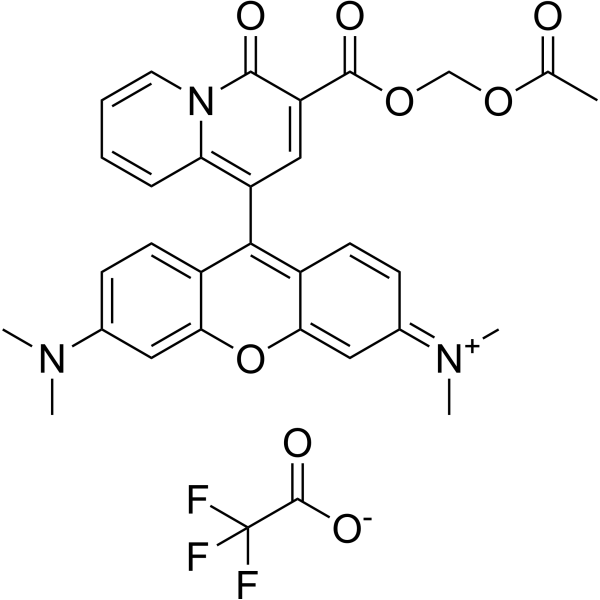
KMG-301AM TFA is the acetoxy methyl esterified form of KMG-301. KMG-301AM TFA successfully accumulates in mitochondria and then it is hydrolyzed to KMG-301. KMG-301 is an Mg 2+-selective fluorescent probe functional in mitochondria in intact cells. Since the mitochondrial membrane is impermeable to KMG-301, it is not released upon depolarization of the mitochondrial membrane potential. KMG-301 can indicate changes in mitochondrial Mg2+ concentration and shows Mg 2+ transport across the mitochondrial membrane in the early phases of a cellular model .
loading...
    loading...
Cat. No.: HY-138563
CAS No.: 2138473-38-6
Purity:  99.97%
Research Areas:  

Cancer

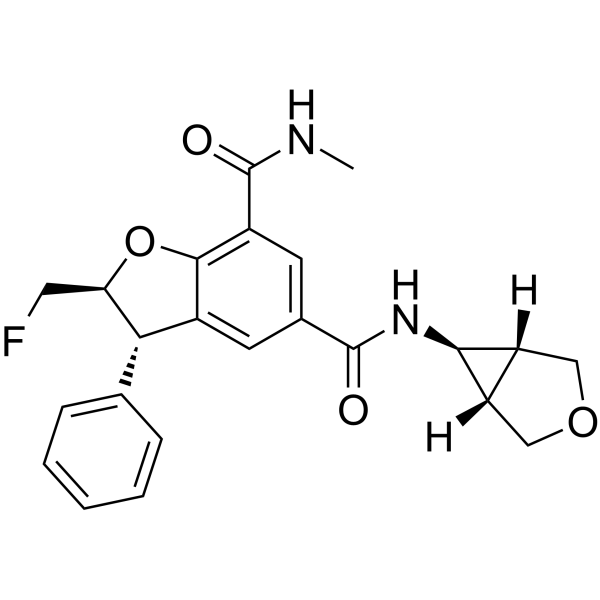
GSK973, a chemical probe, is a highly selective, orally bioavailable inhibitor of the BD2s (second bromodomains) of the BET family, with a pIC50 of 7.8 and a pKd of 8.7 for BRD4 BD2. GSK973 displays a 1600-fold selectivity for BRD4 BD2 over BRD4 BD1. GSK973 shows good potency against BRD2 BD2, BRD3 BD2, and BRDT BD2 (pIC50=7.4~7.8; pKd=8.3~8.5) .
loading...
    loading...
Cat. No.: HY-149026
CAS No.: 1997321-20-6
Purity:  99.65%
Target:  

SWI/SNF Complex

Research Areas:  

Others

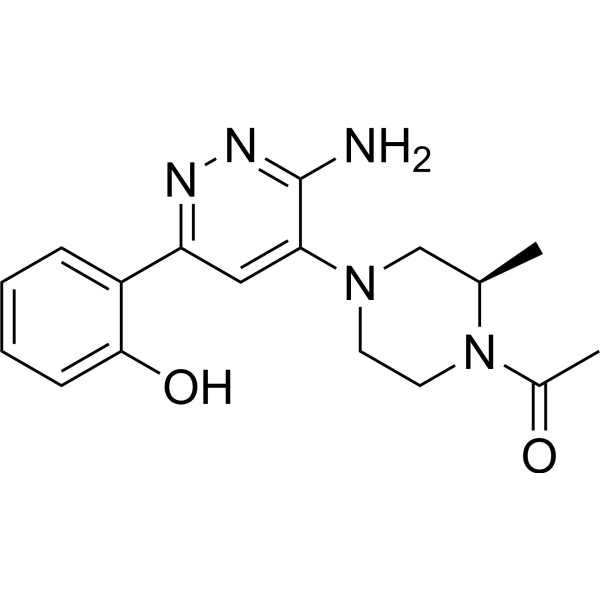
GNE-064 (compound 5) is a selective, orally active and highly soluble inhibitor of SMARCA4, SMARCA2 and PBRM1 bromodomains 5. GNE-064 inhibits SMARCA4 with an IC50 of 0.035 μM and inhibits SMARCA2 with an EC50 of 0.10 μM. GNE-064 possess Kds with 0.01, 0.016, 0.018 and 0.049 μM for SMARCA4, SMARCA2, PBRM1 bromodomains 5 and PBRM1 bromodomains 2, repectively. GNE-064 can be used as a chemical probe for the research of agent synthesis .
loading...
    loading...
Cat. No.: HY-149203A
Purity:  97.36%
Target:  

Fluorescent Dye

Research Areas:  

Others

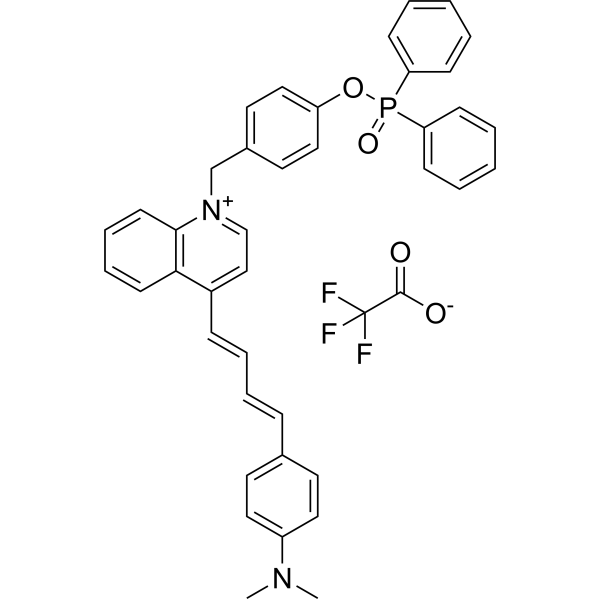
MQA-P is a multifunctional near-infrared (NIR) fluorescent probe that simultaneously detects ONOO -, viscosity, and polarity within mitochondria. MQA-P exhibits significant response to ONOO -, λem=645 nm; and NIR channel at λem>704 nm Medium is highly sensitive to viscosity/polarity. MQA-P possesses excited-state intramolecular charge transfer (ESICT) properties that are highly sensitive to polarity by designing the N,N-dimethylamino group as the electron donor and the quinoline cation unit as the electron acceptor. MQA-P is used for ferroptosis or cancer diagnosis in vitro and in vivo via dual-channel images .
loading...
    loading...
Cat. No.: HY-153738
CAS No.: 2169302-75-2
Purity:  95.91%
Target:  

ERK

Research Areas:  

Cancer

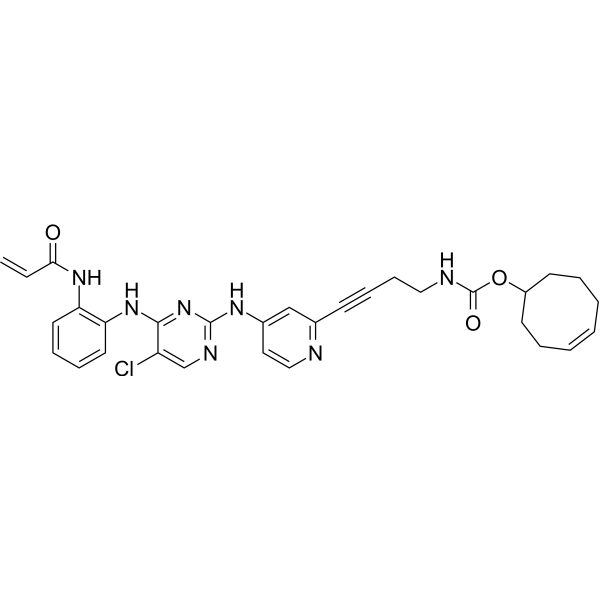
ERK1/2 inhibitor 9 (Probe 1) is a covalent ERK1/2 inhibitor. ERK1/2 inhibitor 9 shows sub-micromolar activity in cells (A375 GI50=0.47 μM). ERK1/2 inhibitor 9 causes the downregulation of phospho-ERK1/2. ERK1/2 inhibitor 9 tagged trans-cyclo-octene (TCO) and Tz-Thalidomide (tetrazine tagged Thalidomide) can form the corresponding ERK-CLIPTAC to elicit degradation of ERK1/2 .
loading...
    loading...
Cat. No.: HY-161011
CAS No.: 1557337-03-7
Target:  

Arp2/3 Complex

Research Areas:  

Others

Spire2/FMN2 PPI-IN-1 (Compound 13) is a selective inhibitory fragment targeting the Spire2-FMN2 interaction, with an IC50 of 62 μM. Spire2/FMN2 PPI-IN-1 has affinity for KIND2, with a Kd of 87.7 μM, and does not inhibit KIND1. Spire2/FMN2 PPI-IN-1 can be used for the development of chemical probes for the Spire2-FMN2 interaction .
loading...
    loading...
Cat. No.: HY-161011A
Target:  

Arp2/3 Complex

Research Areas:  

Others

Spire2/FMN2 PPI-IN-1 (Compound 13) dihydrochloride is a selective inhibitory fragment targeting the Spire2-FMN2 interaction, with an IC50 of 62 μM. Spire2/FMN2 PPI-IN-1 dihydrochloride has affinity for KIND2, with a Kd of 87.7 μM, and does not inhibit KIND1. Spire2/FMN2 PPI-IN-1 dihydrochloride can be used for the development of chemical probes for the Spire2-FMN2 interaction .
loading...
    loading...
Cat. No.: HY-168534
CAS No.: 2929223-35-6
Target:  

SF3B1 Apoptosis FOXA

Research Areas:  

Cancer

WX-02-23 is a small-molecule probe that stereoselectively and site-specifically binds to C258 of FOXA1 and C1111 of SF3B1. WX-02-23 remodels FOXA1's chromatin binding and pioneer activity in a DNA-dependent manner, disrupts spliceosome assembly, and enhances the thermal stability of SF3B1. WX-02-23 inhibits tumor cell proliferation and induces apoptosis. WX-02-23 can be used for research on cancers such as prostate cancer .
loading...
    loading...
Cat. No.: HY-175083
Target:  

Drug Derivative PI3K

Research Areas:  

Others

PtdIns-(4,5)-P2-biotin trisodium is a Biotin-labeled PtdIns-(4,5)-P2 analog. PtdIns-(4,5)-P2-biotin trisodium is an affinity probe of PI3Kγ. PI3Kγ can catalyse the phosphorylation of PtdIns-(4,5)-P2 at the 3′-OH group, giving rise to the second messenger PtdIns(3,4,5)-P3 .
loading...
    loading...
Cat. No.: HY-178271
CAS No.: 147597-66-8
Target:  

Drug Intermediate

Research Areas:  

Cancer

P-SCN-Bn-NOTA is a metal chelator and molecular imaging probe precursor that allows radiolabeling with Ga-68. P-SCN-Bn-NOTA can be conjugated to CD70-specific molecules B3, B6, ABDB3 and ABDB6 to form NOTA-labeled derivatives. P-SCN-Bn-NOTA is applicable for preclinical PET/CT imaging of CD70-expressing tumors in NCG mouse PDX models. P-SCN-Bn-NOTA can be used in studies related to CD70-positive tumors .
loading...
    loading...
Cat. No.: HY-181506
CAS No.: 3109321-90-3
TYMJ-01 is a fluorescent probe and eEF2K degrader. TYMJ-01 induces dose-dependent and specific degradation of eEF2K via the ubiquitin-proteasome pathway, with a DC50 of 82 nM. TYMJ-01 inhibits the proliferation, migration and invasion of triple-negative breast cancer cells. TYMJ-01 enables dynamic fluorescent imaging of eEF2K degradation in triple-negative breast cancer cells; it enhances the anti-tumor activity of Paclitaxel (HY-B0015). TYMJ-01 can be used for the research of triple-negative breast cancer .
loading...
    loading...
Cat. No.: HY-182399
CAS No.: 2421117-94-2
Research Areas:  

Cancer

BC-DXI-495 is a AIMP2-DX2 inhibitor. BC-DXI-495 disrupts the interaction of HSP70 and destabilizes DX2. BC-DXI-495 induces DX2 degradation via Siah1-mediated ubiquitination. BC-DXI-495 exerts tumor suppressive activity in cancer cells. BC-DXI-495 serves as a chemical probe to elucidate the mechanism of action of arylsulfonamide-based DX2 inhibitors. BC-DXI-495 can be used in lung cancer research .
loading...
    loading...
Cat. No.: HY-185697
CAS No.: 3136609-62-3
Target:  

PROTACs IFNAR c-Myc

Research Areas:  

Cancer

dIRF4-2 is a selective IRF4 PROTAC degrader with a DC50 value of 2.2 μM. dIRF4-2 forms a ternary complex between IRF4 and CRBN, inducing ubiquitination and proteasomal degradation of IRF4. dIRF4-2 downregulates MYC. dIRF4-2 exhibits anticancer activity against myeloma. dIRF4-2 acts as a chemical probe for investigating IRF4 function, mimicking the IRF4 gene knockout phenotype. dIRF4-2 can be used in the research of multiple myeloma .
loading...
    loading...
Cat. No.: HY-186281
CAS No.: 2231747-83-2
Research Areas:  

Others

MAUra-DTB is a 1-methyl-4-arylurazole (MAUra) chemical probe conjugated with desthiobiotin, which preferentially labels tyrosine residues exposed on protein surfaces under photocatalytic or laccase-catalyzed conditions (). The desthiobiotin moiety of MAUra-DTB supports affinity enrichment based on streptavidin or NeutrAvidin. MAUra-DTB enables proteome-wide labeling in cell lysates, and after enrichment of labeled peptides by NeutrAvidin, the labeling sites can be identified via nanoLC-MS/MS. MAUra-DTB can be used for photocatalytic proximity labeling, target protein identification and proteomic studies .
loading...
    loading...
Cat. No.: HY-B1259R
CAS No.: 57-08-9
Synonyms: Acexamic acid (Standard); 6-Acetamidocaproic acid (Standard)
6-Acetamidohexanoic acid (Acexamic acid; 6-Acetamidocaproic acid) (Standard) is the analytical standard of 6-Acetamidohexanoic acid. This product is intended for research and analytical applications. 6-Acetamidohexanoic acid (Acexamic acid; 6-Acetamidocaproic acid) is a metabolite of Hexamethylene bisacetamide (HMBA) (HY-124284) with anti-pulmonary fibrosis activity. 6-Acetamidohexanoic acid does not induce differentiation of human promyelocytic leukemia cells, but is taken up by such cells. 6-Acetamidohexanoic acid serves as a carboxylic acid substrate component for constructing carboxylesterase-responsive near-infrared phototheranostic probes. 6-Acetamidohexanoic acid is applicable to research related to pulmonary fibrosis, refractory hypoxemia and cervical cancer.
loading...
    loading...
Cat. No.: HY-D1090
CAS No.: 82855-40-1
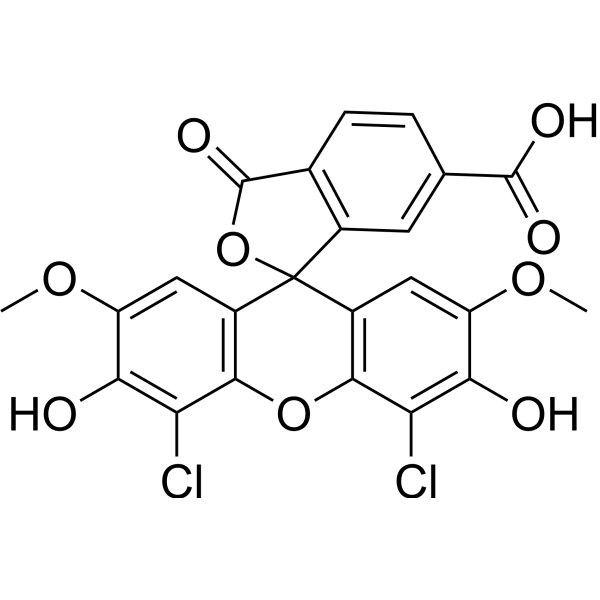
JOE is a xanthene fluorophore (i.e., 4′,5′-dichloro-2′,7′-dimethoxy-5 (6)-carboxyfluorescein; 2',7'-dimethoxy-4',5'-dichloro-6-carboxyfluorescein) with an absorption wavelength of approximately 525 nm and an emission wavelength of approximately 550 nm. The fluorescence quantum yield of JOE correlates with the rigidity of the linker arm and the distance to dG nucleoside. JOE is commonly used as a fluorescent label for oligonucleotides and molecular beacon probes, and also serves as the acceptor fluorophore in fluorescence energy transfer primers for DNA sequencing .
loading...
    loading...
Cat. No.: HY-D1804
Vari Fluor 680-Streptavidin is a dye marker of Vari Fluor-streptavidin consisting of labeling streptavidin with a Vari Fluor series of fluorescent probes. Streptavidin is a high-affinity tetramer protein, each tetramer consisting of four identical streptavidin subunits. Streptavidin binds to biotin specifically via a reversible non-covalent effect. Streptavidin can achieve rapid and efficient detection of biotin markers, and is often used in immunofluorescence (IF), enzyme-linked immunosorbent assay (ELISA), immunohistochemical staining (IFH), in situ hybridization (ISH) and other experiments. Ex/Em=680 nm/701 nm.
Product Concentration: 0.8 mg/mL
loading...
    loading...

