
1. Search Result
Search Result
Results for "

basic fibroblast growth factor

" in MedChemExpress (MCE) Product Catalog:

9

Inhibitors & Agonists

1

Screening Libraries

1

Peptides

18

Recombinant Proteins

1

Isotope-Labeled Compounds

5

Antibodies

Cat. No. Product Name Target Research Areas Chemical Structure
  • HY-B0636
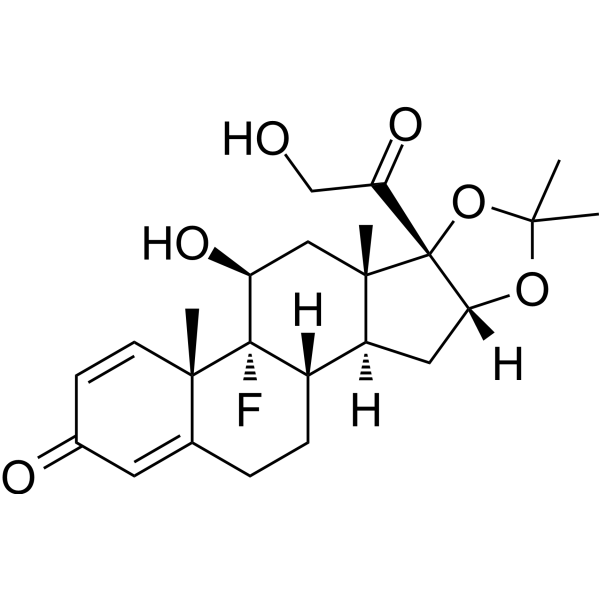
    Triamcinolone acetonide
    5+ Cited Publications

    Glucocorticoid Receptor FGFR Cardiovascular Disease Inflammation/Immunology Endocrinology Cancer
    Triamcinolone acetonide inhibits basic fibroblast growth factor (bFGF) induced proliferation of retinal endothelial cells. Triamcinolone acetonide reduces chondrocyte viability and leads to cartilage destruction. Triamcinolone acetonide activates macrophage with anti-inflammatory characteristics. Triamcinolone acetonide can be used in the study of diseases such as atopic dermatitis .
    Triamcinolone acetonide
  • HY-128341

    ERK Cardiovascular Disease Cancer
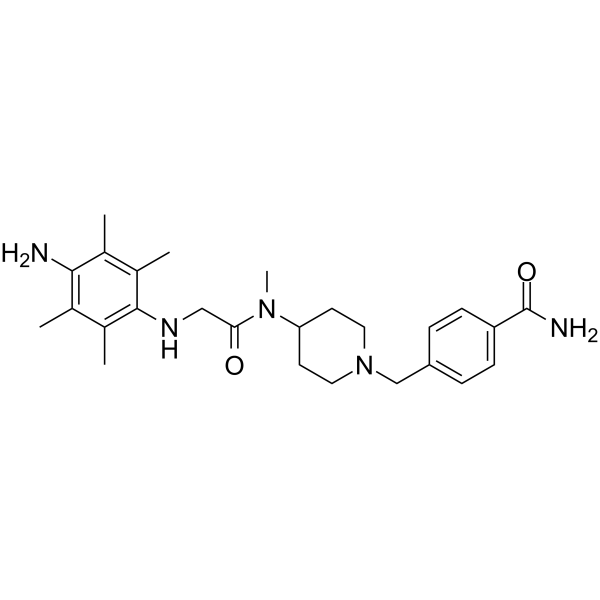
    ERK5-IN-2 is an orally active, sub-micromolar, selective ERK5 inhibitor with IC50s of 0.82 μM, 3 μM for ERK5 and ERK5 MEF2D, respectively. ERK5-IN-2 does not interact with the BRD4 bromodomain. ERK5-IN-2 suppresses both tumor xenograft growth and basic fibroblast growth factor (bFGF) driven Matrigel plug angiogenesis .
    ERK5-IN-2
  • HY-101493
    SUN11602
    2 Publications Verification

    FGFR Neurological Disease
    SUN11602 is a novel aniline compound with basic fibroblast growth factor-like activity.
    SUN11602
  • HY-P3601

    FGF basic (1-24)

    Bacterial HBV Infection Inflammation/Immunology
    Brain Derived Basic Fibroblast Growth Factor (1-24) (FGF basic 1-24) is a synthetic peptide, shows anti-bacterial and anti-HBV activities. Brain Derived Basic Fibroblast Growth Factor (1-24) can be used in infection disease and immune disease research .
    Brain Derived Basic Fibroblast Growth Factor (1-24)
  • HY-Z8648

    Drug Intermediate Inflammation/Immunology Endocrinology Cancer
    Δ14-Triamcinolone acetonide is a potential impurity. Triamcinolone acetonide inhibits basic fibroblast growth factor (bFGF) induced proliferation of retinal endothelial cells. Triamcinolone acetonide reduces chondrocyte viability and leads to cartilage destruction. Triamcinolone acetonide can be used in the study of diseases such as atopic dermatitis .
    Δ14-Triamcinolone acetonide
  • HY-121701

    Calcium Channel Cardiovascular Disease
    SR 33805 (analog) is an orally active Ca 2+ channel blocker that selectively inhibits the proliferation of smooth muscle cells. SR 33805 (analog) reduces calcium uptake by blocking calcium channels, thereby inhibiting smooth muscle cell proliferation induced by serum, platelet-derived growth factor, and basic fibroblast growth factor. SR 33805 (analog) significantly reduces intimal thickening following endothelial injury in rabbits. SR 33805 (analog) shows promise for cardiovascular disease research, such as in early atherosclerosis .
    SR33805 analog
  • HY-B0636S1

    Isotope-Labeled Compounds Glucocorticoid Receptor FGFR Cardiovascular Disease Inflammation/Immunology Endocrinology Cancer
    Triamcinolone acetonide- 13C3 is the 13C-labeled Triamcinolone acetonide (HY-B0636). Triamcinolone acetonide inhibits basic fibroblast growth factor (bFGF) induced proliferation of retinal endothelial cells. Triamcinolone acetonide reduces chondrocyte viability and leads to cartilage destruction. Triamcinolone acetonide activates macrophage with anti-inflammatory characteristics. Triamcinolone acetonide can be used in the study of diseases such as atopic dermatitis .
    Triamcinolone acetonide-13C3
  • HY-167262

    RAR/RXR Metabolic Disease Cancer
    AGN-191659 is an orally active RAR/RXR agonist with EC50 values of 11 nM, 23 nM, and 37 nM for RXRα, RARβ, and RARγ, respectively. AGN-191659 activates RXRα, RARβ and RARγ to induce gene transcription. AGN-191659 induces tissue transglutaminase activity, inhibits ornithine decarboxylase activity induced by tumor promoters, and suppresses chondrogenesis. AGN-191659 reverses basic fibroblast growth factor-induced endothelial cell proliferation. AGN-191659 induces hypertriglyceridemia in rat models. AGN-191659 inhibits total heparin-releasable lipase activity. AGN-191659 can be used in research related to promyelocytic leukemia and hypertriglyceridemia .
    AGN-191659
  • HY-183946

    FAK Cancer
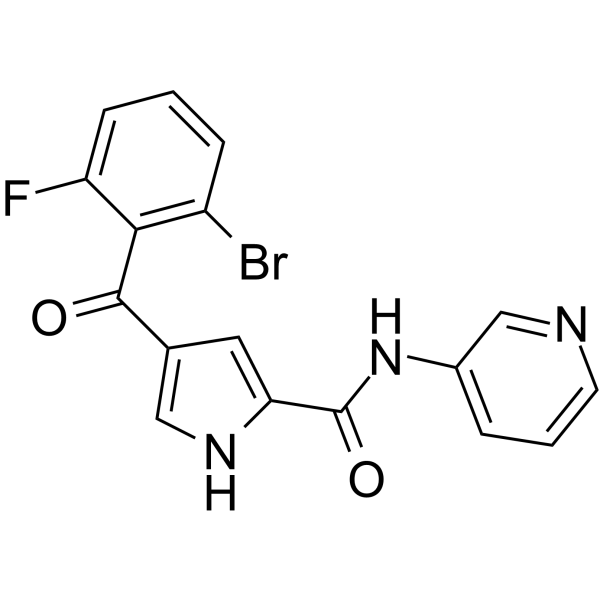
    NVP-TAC544 is a focal adhesion kinase (FAK) inhibitor. NVP-TAC544 inhibits angiogenesis. NVP-TAC544 can be used for the research of melanoma (primary or metastatic) .
    NVP-TAC544

Inquiry Online

Your information is safe with us. * Required Fields.

Salutation


Country or Region *

Applicant Name *


Organization Name *

Department *


Email Address *


Product Name *

Cat. No.


Requested quantity *

Phone Number *


Remarks

Inquiry Online

Inquiry Information

Product Name:
Cat. No.:
Quantity:
MCE Japan Authorized Agent:

