1. Search Result
Search Result
Results for "

cerebroside

" in MedChemExpress (MCE) Product Catalog:

18

Inhibitors & Agonists

15

Natural
Products

1

Recombinant Proteins

1

Isotope-Labeled Compounds

Cat. No. Product Name Target Research Areas Chemical Structure
  • HY-B1122
    L-Cycloserine
    2 Publications Verification

    (S)-Cycloserine; (S)-4-Amino-3-isoxazolidone

    GABA Receptor HIV Neurological Disease Cancer
    L-Cycloserine ((S)-4-Amino-3-isoxazolidone) is an oral inhibitor of the enzyme gamma-aminobutyric acid (GABA) transaminase (GABA-t) and branched-chain transaminases in Mycobacterium tuberculosis. L-Cycloserine has anticonvulsant properties and inhibits the synthesis of neurotensin in mouse brains .
    L-Cycloserine
  • HY-121447

    Endogenous Metabolite Metabolic Disease
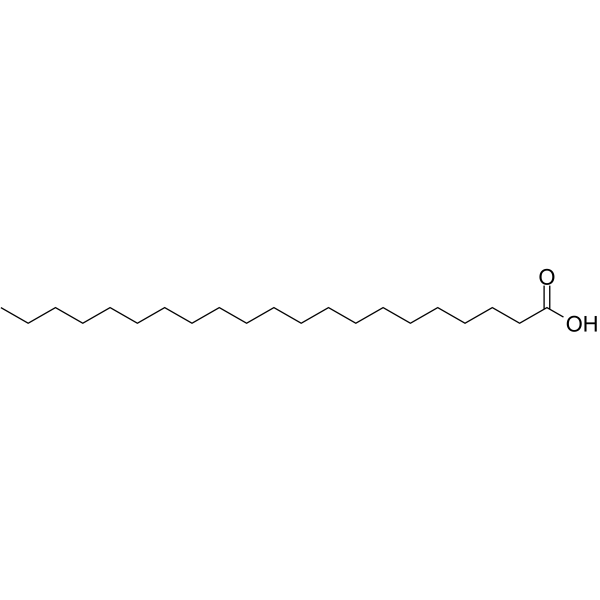
    Heneicosanoic acid is an odd-chain saturated fatty acid widely present in human milk, fish, seeds, and cerebrosides in the cell membranes of the nervous system. Heneicosanoic acid can form Langmuir monolayers and is often used as a model to study lipid self-assembly and disassembly processes in biological membranes and drug delivery systems. In the low-temperature L'2 and CS crystalline phases, Heneicosanoic acid undergoes local oscillations, which in turn drive the spontaneous formation and expulsion of micelles and vesicles .
    Heneicosanoic acid
  • HY-N7345

    Others Neurological Disease
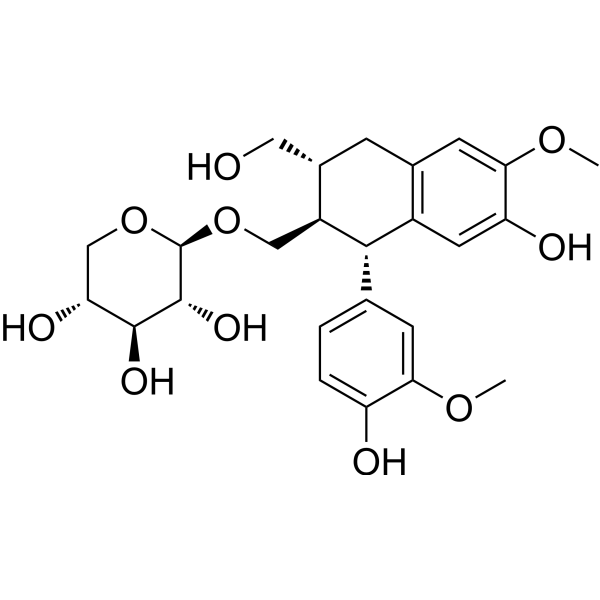
    Schizandriside is a cerebroside, which can be isolated from Uvaria tonkinensis var. .
    Schizandriside
  • HY-165035

    Glucocerebrosides; Gaucher cerebroside; GluCers (gaucher's spleen)

    Endogenous Metabolite Neurological Disease Metabolic Disease
    Glucosylceramides are sphingolipid molecules found in both neuronal and non-neuronal mammalian tissues, as well as in low quantities across various plant species. Elevated levels of glucosylceramides provide cellular protection and prepare certain cells for proliferation; however, they have also been linked to obesity-induced insulin resistance in mice and to neuronal deficits observed in neuronopathic Gaucher disease .
    Glucosylceramide (gaucher's spleen)
  • HY-N3570

    Fungal Infection
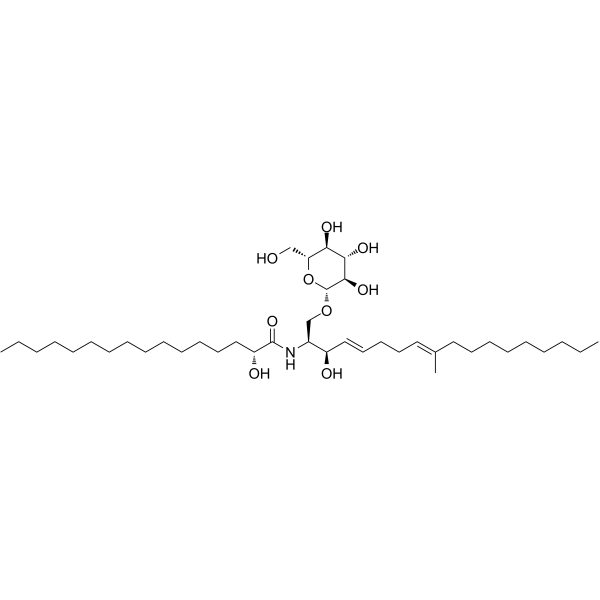
    Cerebroside B, a sphingolipid compound, is a non-racespecific elicitor, which elicits defense responses in rice .
    Cerebroside B
  • HY-N10196

    Endogenous Metabolite Inflammation/Immunology
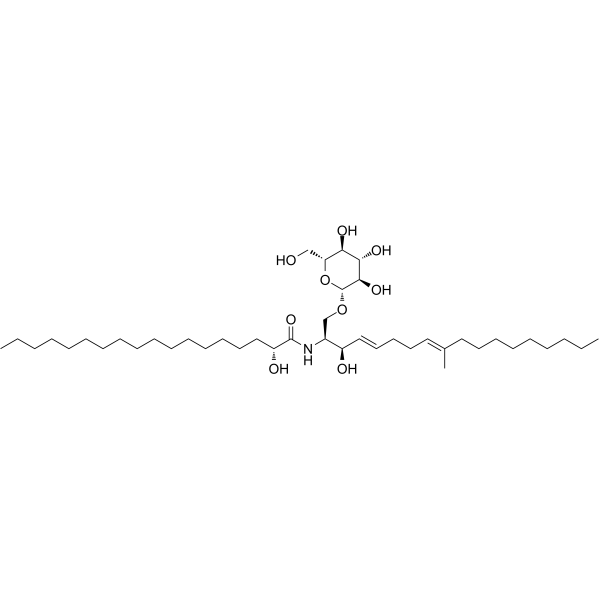
    Cerebroside D, a glycoceramide compound, improves experimental colitis in mice with multiple targets against activated T lymphocytes .
    Cerebroside D
  • HY-N3249

    Others Others
    Momor-cerebroside I is a cerebroside compound isolated from Momordica charantia .
    Momor-cerebroside I
  • HY-N13061

    Others Neurological Disease
    Nervon is a crystalline cerebroside. Nervon can be used for the research of peripheral neuropathies and megaloblastic anemia caused by vitamin B12 deficiency .
    Nervon
  • HY-N7157

    Others Others
    2-2'-(Hydroxytetracosanoylamino)-octadecane-1,3,4-triol tetraacetate is a Cerebrosides product that can be isolated from the herbs of Phyllanthus emblica .
    2-2'-(Hydroxytetracosanoylamino)-octadecane-1,3,4-triol tetraacetate
  • HY-N12174

    Others Others
    Orthosphenic acid (compound 12) is a natural product isolated from the roots of Tripterygium wilfordii .
    Orthosphenic acid
  • HY-131992

    C2 Galactosylceramide (d18:1/2:0)

    Apoptosis Inflammation/Immunology
    N-Acetylpsychosine (C2 Galactosylceramide (d18:1/2:0)), α-galactosylated C2-ceramide, has immunostimulatory activity. N-Acetylpsychosine can be a useful tool to investigate the mechanism of apoptosis and the immune reponses induced by dendritic cells (DCs) .
    N-Acetylpsychosine
  • HY-N15466

    Apoptosis Caspase Bcl-2 Family Neurological Disease
    Longan cerebroside II is a cerebroside found in Typhonium giganteum. Longan cerebroside II shows anti-apoptosis and neuroprotective activity. Longan cerebroside II reduces protein expression of caspase-9, caspase-3, and Bax, increases Bcl-2, cytochrome c levles .
    Longan cerebroside II
  • HY-B1122R

    (S)-Cycloserine (Standard); (S)-4-Amino-3-isoxazolidone (Standard)

    Reference Standards GABA Receptor HIV Neurological Disease Cancer
    L-Cycloserine (Standard) is the analytical standard of L-Cycloserine. This product is intended for research and analytical applications. L-Cycloserine ((S)-4-Amino-3-isoxazolidone) is an oral inhibitor of the enzyme gamma-aminobutyric acid (GABA) transaminase (GABA-t) and branched-chain transaminases in Mycobacterium tuberculosis. L-Cycloserine has anticonvulsant properties and inhibits the synthesis of neurotensin in mouse brains[1][2][3][4].
    L-Cycloserine (Standard)
  • HY-N3984

    Others Others
    Gynuramide II is a Cerebrosides product that can be isolated from the herbs of Exochorda racemosa (Lindl.) Rehd .
    Gynuramide II
  • HY-128792R

    1,3-Dipalmitoylglycerol (Standard); Glycerol 1,3-dipalmitate (Standard)

    Reference Standards Biochemical Assay Reagents Others
    1,3-Dipalmitin (1,3-Dipalmitoylglycer) Standard is the analytical standard of 1,3-Dipalmitin (HY-128792). This product is intended for research and analytical applications. 1,3-Dipalmitin (1,3-Dipalmitoylglycerol) is a diacylglycerol compound that can be found in the tuberous roots of Typhonium giganteum Engl. 1,3-Dipalmitin acts as an adsorption inhibitor for 1,3-diglycerides and β-carotene.
    1,3-Dipalmitin (Standard)
  • HY-N15472

    C24:0(2R-OH) Galactosyl(ß) Ceramide (d18:1/24:0)

    Others Others
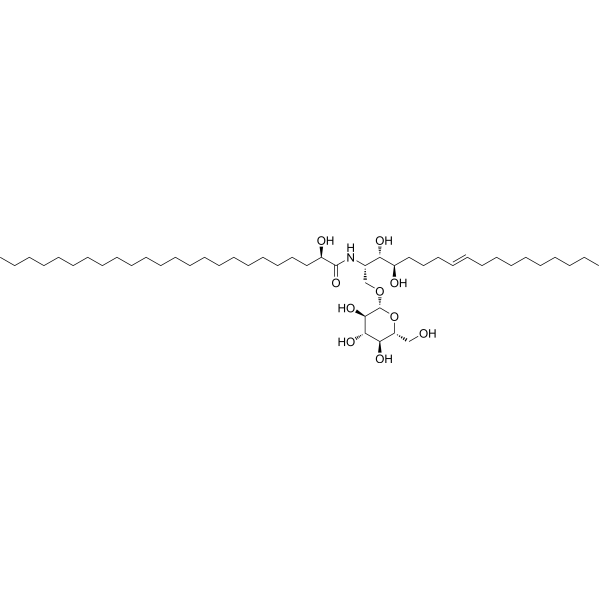
    Phrenosine (C24:0(2R-OH) Galactosyl(ß) Ceramide (d18:1/24:0)) is a cerebroside with a 24-carbon fatty acid chain and an 18-carbon sphingosine moiety .
    Phrenosine
  • HY-W743123

    1,3-Dipalmitoylglycerol-d5; Glycerol 1,3-dipalmitate-d5

    Isotope-Labeled Compounds Others
    1,3-Dipalmitin-d5 (1,3-Dipalmitoylglycerol-d5) is a deuterium labeled 1,3-Dipalmitin (HY-128792). 1,3-Dipalmitin (1,3-Dipalmitoylglycerol) is a cerebroside that can be found in Typhonium giganteum Engl .
    1,3-Dipalmitin-d5
  • HY-N15464

    Aldehyde Dehydrogenase (ALDH) Metabolic Disease
    Antihepatotoxic agent-1 is a cerebroside present in Lycium chinense Fruits with antihepatotoxic activity. Antihepatotoxic agent-1 exerts a protective effect by blocking the release of alanine aminotransferase and sorbitol dehydrogenase from primary cultured rat hepatocytes intoxicated with carbon tetrachloride. Antihepatotoxic agent-1 can be used in studies related to liver injury .
    Antihepatotoxic agent-1

Inquiry Online

Your information is safe with us. * Required Fields.

Salutation


Country or Region *

Applicant Name *


Organization Name *

Department *


Email Address *


Product Name *

Cat. No.


Requested quantity *

Phone Number *


Remarks

Inquiry Online

Inquiry Information

Product Name:
Cat. No.:
Quantity:
MCE Japan Authorized Agent:

