



Sesame Oil
Based on 2 publication(s) in Google Scholar
Sesame Oil is a vegetable oil. Sesame Oil can be extracted from the seeds of Sesamum indicum L. Sesame Oil decreases NF-κB, aspartate aminotransferase, alanine aminotransferase, IL-1β, IL-4 and nitric oxide. Sesame Oil has antitumor activity against malignant melanoma. Sesame Oil has protective effects against liver damage caused by various agents such as Cisplatin (HY-17394) and Acetaminophen (HY-66005). Sesame Oil shows antinociceptive and anti-inflammatory activities.
For research use only. We do not sell to patients.
- Assay : 98.2%
- CAS No.: 8008-74-0
-
Storage:Pure form -20°C, 3 years , 4°C, 2 years ; In solvent -80°C, 6 months , -20°C, 1 month

To place orders, for customer services and technical support, please contact: MedChemExpress USA
Tel: 609-228-6898 E-mail: [email protected] [email protected]


-
 Biological Activity
-
Chemical Information
-
Solvent & Solubility
- Protocols
- Purity & Documentation
- References
-
 Help & FAQs


-
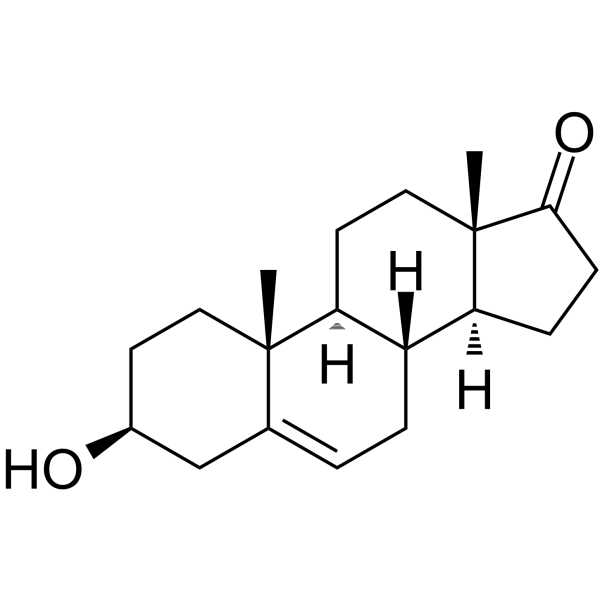
HY-14650
DHEASteroid Hormone -
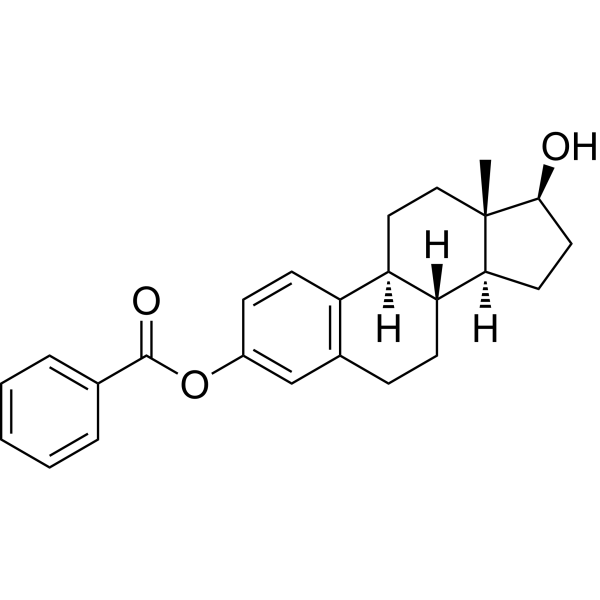
HY-B1192
Estradiol benzoateHBx inhibitor -
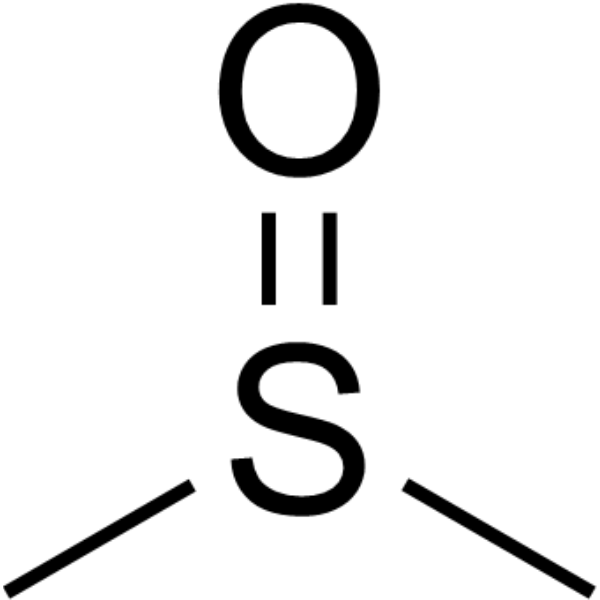
HY-Y0320C
Dimethyl sulfoxideAprotic Solvent -
HY-N0437
ProgesteroneEndogenous Metabolite -
HY-108749
Olive oilAnti-Inflammation Agent -
HY-Y1887
Cottonseed oilEdible Oil -
HY-108750
Soybean oilEdible Vegetable Oil -
HY-154631
Peanut OilPharmaceutical Excipient -
HY-Y0873
PEG300Neutral Polymer -

HY-Y1891
Tween 80 -

HY-106591A
4-Vinylcyclohexene dioxideMetabolite -
HY-13683
MifepristoneProgesterone Receptor Antagonist
Publications Citing Use of MedChemExpress (MCE) Sesame Oil
More

Biological Activity
Description
In Vitro
In Vivo
Sesame Oil (8 mL/kg; p.o.; once; 6 h after endotoxin administration or cecal ligation and puncture (CLP)) reduces lipid peroxidation, decreases superoxide anion counts, increases glutathione levels, and increases the survival rate in septic rats[3].
Sesame Oil (100-400 mg/kg; p.o.) shows antinociceptive and anti-inflammatory activities in mice, reducing the number of abdominal contortions, inhibiting paw licking time in Formalin-induced nociception, increasing the reaction time, reducing paw edema and exudate volume, and inhibiting leucocyte migration[4].
Sesame Oil (2-8 mL/kg; p.o.; daily for 3 days) attenuates Cisplatin (HY-17394)-induced hepatic and renal injuries in mice by decreasing lipid peroxidation, production of hydroxyl radical, peroxynitrite, and nitrite in blood and tissue[5].
Sesame Oil (8 mL/kg; p.o.; once) protects rats against Acetaminophen (HY-66005)-induced acute liver injury by reversing APAP-altered parameters such as increasing aspartate and alanine aminotransferase levels[6].
Sesame Oil (8 mL/kg; p.o.; after Pb acetate plus LPS injection) protects against lead-plus-lipopolysaccharide (Pb + LPS)-induced acute hepatic injury in mice by decreasing serum aspartate aminotransferase and alanine aminotransferase levels, reducing TNF-α, IL-1β, and nitric oxide production in serum and liver tissue, and decreasing inducible nitric oxide synthase expression in leukocytes and liver tissue[7].
MedChemExpress (MCE) has not independently confirmed the accuracy of these methods. They are for reference only.
-
Animal Model:Male Sprague-Dawley rats (weighing 200-250 g) + air-pouch model induced by injecting 24 mL of filtered sterile air subcutaneously and then MSU crystal (5 mg/rat) to induce inflammation[2]
-
Dosage:0 mL/kg, 1 mL/kg, 2 mL/kg, 4 mL/kg
-
Administration:Oral gavage (p.o.), 6 h after MSU crystal injection
-
Result:Decreased MSU crystal-induced total cell counts, TNF-α, IL-1β, and IL-6 levels in lavage and pouch tissue.
Decreased leukocyte and neutrophil counts in lavage, activated mast cell counts in skin tissue, NF-κB activity and IL-4 level in isolated mast cells, and lavage complement proteins C3a and C5a levels.
Clinical Trial
| NCT Number | Sponsor | Condition | Start Date |
Phase

|
|---|---|---|---|---|
| NCT01329991 | Plexxikon| | 2011-05 | PHASE1 |


Chemical Information
-
CAS No. 8008-74-0
-
Appearance Liquid (Density: 0.919 g/cm3)
-
Color Colorless to light yellow
-
SMILES
[Sesame Oil]
-
Shipping
Room temperature in continental US; may vary elsewhere.
-
Storage
Pure form -20°C 3 years 4°C 2 years In solvent -80°C 6 months -20°C 1 month


Publications (2)
-
Journal Impact Factor
-
Most Recent
-
J Ethnopharmacol
She ethnomedicine ameliorates ovarian dysfunction through enhanced cellular proliferation and anti-inflammation. [Abstract]2025 Jul 14;353(Pt A):120294. PMID: 40669675 -
J Ovarian Res
Nicotinamide riboside supplementation ameliorates ovarian dysfunction in a PCOS mouse model. [Abstract]2025 Jan 20;18(1):9. PMID: 39833950


Solvent & Solubility
In Vitro:
DMSO : 200 mg/mL (Need ultrasonic; Hygroscopic DMSO has a significant impact on the solubility of product, please use newly opened DMSO)
In Vivo:
Select the appropriate dissolution method based on your experimental animal and administration route.
- For the following dissolution methods, please ensure to first prepare a clear stock solution using an In Vitro approach and then sequentially add co-solvents:
- To ensure reliable experimental results, the clarified stock solution can be appropriately stored based on storage conditions. As for the working solution for In Vivo experiments, it is recommended to prepare freshly and use it on the same day.
- The percentages shown for the solvents indicate their volumetric ratio in the final prepared solution. If precipitation or phase separation occurs during preparation, heat and/or sonication can be used to aid dissolution.
In Vivo Dissolution Calculator
Please enter the basic information of animal experiments:
-
-
-
-
Recommended: Prepare an additional quantity of animals to account for potential losses during experiments.
Please enter your animal formula composition:
-
%DMSO +
Recommended: Keep the proportion of DMSO in working solution below 2% if your animal is weak.
-
%+
-
+%Tween-80 + +
-
%Saline +
The co-solvents required include: DMSO, . All of co-solvents are available by MedChemExpress (MCE). , Tween 80. All of co-solvents are available by MedChemExpress (MCE).
Working solution concentration: 0.22 mg/mL
Method for preparing stock solution: mg drug dissolved in μL DMSO. Stock solution concentration: mg/mL.
1. Take μL DMSO stock solution;
2. Add μL .
μL , mix evenly;
3. Then add μL Tween 80, mix evenly;
4. Then add μL
Please ensure that the stock solution in the first step is dissolved to a clear state, and add co-solvents in sequence. You can use ultrasonic heating (ultrasonic cleaner, recommended frequency 20-40 kHz), vortexing, etc. to assist dissolution.


Purity & Documentation
-
Data Sheet (274 KB)
-
SDS (251 KB)
- English - EN (251 KB)
- Français - FR (251 KB)
- Deutsch - DE (251 KB)
- Norwegian - NO (251 KB)
- Español - ES (251 KB)
- Swedish - SV (251 KB)
- Italian - IT (251 KB)
- Korean - KR (251 KB)
- Portuguese - PT (251 KB)
-
Handling Instructions (2659 KB)
References
[1]. Smith DE, et al. Selective growth inhibition of a human malignant melanoma cell line by sesame oil in vitro. Prostaglandins Leukot Essent Fatty Acids. 1992 Jun;46(2):145-50. [Content Brief]
[2]. Hsu DZ, et al. Therapeutic effects of sesame oil on monosodium urate crystal-induced acute inflammatory response in rats. Springerplus. 2013 Dec 7;2:659. [Content Brief]
[3]. Hsu DZ, et al. Effects of sesame oil on oxidative stress after the onset of sepsis in rats. Shock. 2004 Dec;22(6):582-5. [Content Brief]
[4]. Monteiro EM, et al. Antinociceptive and anti-inflammatory activities of the sesame oil and sesamin. Nutrients. 2014 May 12;6(5):1931-44. [Content Brief]
[5]. Hsu DZ, et al. Sesame oil attenuates Cisplatin-induced hepatic and renal injuries by inhibiting nitric oxide-associated lipid peroxidation in mice. Shock. 2007 Feb;27(2):199-204. [Content Brief]
[6]. Chandrasekaran VR, et al. Effects of sesame oil against after the onset of acetaminophen-induced acute hepatic injury in rats. JPEN J Parenter Enteral Nutr. 2010 Sep-Oct;34(5):567-73. [Content Brief]
[7]. Hsu DZ, et al. Sesame oil protects against lead-plus-lipopolysaccharide-induced acute hepatic injury. Shock. 2007 Mar;27(3):334-7. [Content Brief]
[8]. Elder DP, et al. Pharmaceutical excipients - quality, regulatory and biopharmaceutical considerations. Eur J Pharm Sci. 2016 May 25;87:88-99. [Content Brief]

Calculators
Concentration (start) × Volume (start) = Concentration (final) × Volume (final)


Sesame Oil Related Classifications
HY-154629 Related Classifications
 Powered by Bioz