



Soyasaponin Aa
Based on 1 publication(s) in Google Scholar
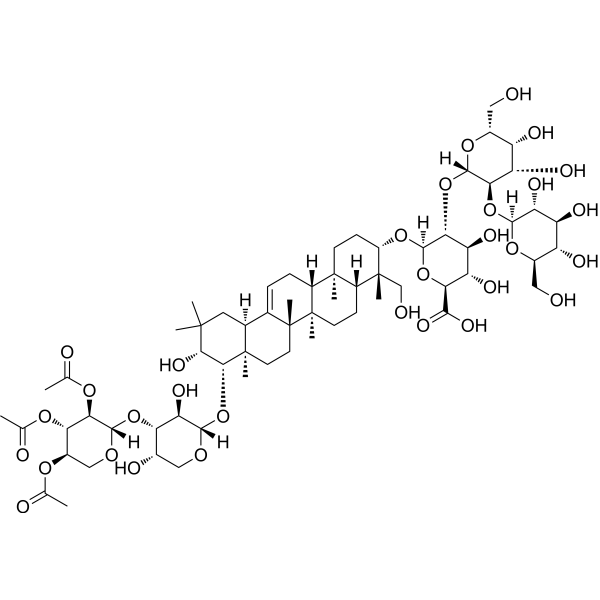
Soyasaponin Aa is a soyasaponin that can be found in soy. Soyasaponin Aa suppresses PPARγ transcriptional activity, reduces PPARγ and C/EBPα expression, inhibits adipocyte differentiation and lipid accumulation, and reduces adipogenic marker gene expression. Soyasaponin Aa reduces hydrogen peroxide-induced reactive oxygen species (ROS) production and malondialdehyde levels. Soyasaponin Aa exhibits cellular antioxidant activity. Soyasaponin Aa can be used for the research of obesity.
For research use only. We do not sell to patients.
- Purity : 99.88%
- CAS No.: 117230-33-8
- Formula: C64H100O31
- Molecular Weight:1365.46
-
Storage:Powder -20°C, 3 years , 4°C, 2 years ; In solvent -80°C, 6 months , -20°C, 1 month

To place orders, for customer services and technical support, please contact: MedChemExpress USA
Tel: 609-228-6898 E-mail: [email protected] [email protected]


-
 Biological Activity
-
Chemical Information
-
Solvent & Solubility
- Protocols
- Purity & Documentation
- References
-
 Help & FAQs


Publications Citing Use of MedChemExpress (MCE) Soyasaponin Aa
More

Biological Activity
Description
In Vitro
Soyasaponin Aa (12.5-200 μM; 24 h) shows no significant cytotoxicity toward 3T3-L1 preadipocytes[1].
Soyasaponin Aa (25-100 μM; 8 days) dose-dependently inhibits lipid accumulation during 3T3-L1 adipocyte differentiation, leaving 75% of control lipid content remaining at 100 μM[1].
Soyasaponin Aa (50-100 μM; 8 days) downregulates PPARγ and C/EBPα mRNA expression in fully differentiated 3T3-L1 adipocytes, with statistically significant suppression observed at 100 μM[1].
Soyasaponin Aa (50-100 μM; 8 days) downregulates the mRNA expression of adipogenic marker genes (adiponectin, ADD1/SREBP1c, aP2, Fas, resistin) in fully differentiated 3T3-L1 adipocytes[1].
Soyasaponin Aa (50-100 μM; 8 days) significantly suppresses PPARγ and C/EBPα protein expression in fully differentiated 3T3-L1 adipocytes[1].
Soyasaponin Aa (25-100 μM; 24 h) significantly inhibits PPARγ transcriptional activity in HEK 293T cells[1].
Soyasaponin Aa (25-400 μg/mL; 24 h) exhibits no cytotoxicity to human HepG2 cells at concentrations up to 100 μg/mL[2].
Soyasaponin Aa (100 μg/mL; 24 h) protects human HepG2 cells from hydrogen peroxide-induced apoptotic morphological changes[2].
Soyasaponin Aa (100 μg/mL; 24 h) reduces hydrogen peroxide-induced ROS generation in human HepG2 cells, lowering ROS content to 58.7%[2].
Soyasaponin Aa (100 μg/mL; 24 h) reduces hydrogen peroxide-induced MDA levels and increases SOD, GSH-Px, and CAT antioxidant enzyme activities in human HepG2 cells[2].
MedChemExpress (MCE) has not independently confirmed the accuracy of these methods. They are for reference only.
-
Cell Line:3T3-L1 preadipocytes
-
Concentration:12.5; 25; 50; 100; 200 μM
-
Incubation Time:24 h
-
Result:Showed no significant cytotoxic effects on 3T3-L1 cells, with relative cell survival remaining near control levels.
-
Cell Line:3T3-L1 adipocytes
-
Concentration:50; 100 μM
-
Incubation Time:8 days
-
Result:Did not significantly suppress PPARγ mRNA expression at 50 μM.
Caused a statistically significant suppression of both PPARγ and C/EBPα mRNA expression relative to differentiated controls at 100 μM.\n
Caused a marked, statistically significant reduction in the mRNA expression of adiponectin, ADD1/SREBP1c, aP2, Fas, and resistin relative to differentiated controls at 50 μM and 100 μM, with the effect being dose-dependent for most genes.
-
Cell Line:3T3-L1 adipocytes
-
Concentration:50; 100 μM
-
Incubation Time:8 days
-
Result:Did not significantly suppress PPARγ or C/EBPα protein expression at 50 μM.
Caused a statistically significant suppression of both PPARγ and C/EBPα protein expression relative to differentiated controls, with densitometric analysis confirming reduced protein levels.
-
Cell Line:human HepG2 cells
-
Concentration:25; 50; 100; 200; 400 μg/mL
-
Incubation Time:24 h
-
Result:Showed a concentration-dependent effect on HepG2 cell viability.
Maintained cell survival rate at 92.56% at 100 μg/mL, with no cytotoxicity observed.
Increased cytotoxicity at concentrations over 200 μg/mL.
- RT-PCR
- Dual Luciferin reporter gene assay
- RNA extraction experimental
- 3T3-L1 preadipocyte-to-adipocyte differentiation
- ROS/oxidative-stress fluorescent staining
- Large-size fat particle sorting
- Research Protocol for Metabolic Diseases
- Real Time qPCR (Q-PCR)
- Lipid Droplets: Oil Red O/Sudan Dye Lipid Staining


Chemical Information
-
CAS No. 117230-33-8
-
Appearance Solid
-
Molecular Weight 1365.46
-
Formula C64H100O31
-
Color White to off-white
-
SMILES
C[C@]12[C@@](CC=C3[C@]2(CC[C@]4(C)[C@@]3([H])CC(C)(C)[C@@H](O)[C@H]4O[C@@]5([H])[C@@H]([C@H]([C@@H](O)CO5)O[C@@]6([H])[C@@H]([C@H]([C@H](OC(C)=O)CO6)OC(C)=O)OC(C)=O)O)C)([H])[C@@]7([C@@]([C@](C)([C@@H](O[C@@]8([H])[C@@H]([C@H]([C@H](O)[C@@H](C(O)=O)O8)O)O[C@@]9([H])[C@@H]([C@H]([C@@H](O)[C@@H](CO)O9)O)O[C@]%10([H])O[C@@H]([C@@H](O)[C@H](O)[C@H]%10O)CO)CC7)CO)([H])CC1)C
-
Structure Classification
-
Initial Source
-
Shipping
Room temperature in continental US; may vary elsewhere.
-
Storage
Powder -20°C 3 years 4°C 2 years In solvent -80°C 6 months -20°C 1 month


Publications (1)
-
Journal Impact Factor
-
Most Recent
-
Neuroendocrinology
Soyasaponin Aa prevents obesity-related precocious puberty by inhibiting hypothalamic-pituitary-gonadal axis in female Sprague-Dawley rats. [Abstract]2025 Dec 22:1-16. PMID: 41428574


Solvent & Solubility
In Vitro:
DMSO : 100 mg/mL (73.24 mM; Need ultrasonic; Hygroscopic DMSO has a significant impact on the solubility of product, please use newly opened DMSO)
Please refer to the solubility information to select the appropriate solvent. Once prepared, please aliquot and store the solution to prevent product inactivation from repeated freeze-thaw cycles.
Storage method and period of stock solution: -80°C, 6 months; -20°C, 1 month. When stored at -80°C, please use it within 6 months. When stored at -20°C, please use it within 1 month.
Please refer to the solubility information to select the appropriate solvent. Once prepared, please aliquot and store the solution to prevent product inactivation from repeated freeze-thaw cycles.
Storage method and period of stock solution: -80°C, 6 months; -20°C, 1 month. When stored at -80°C, please use it within 6 months. When stored at -20°C, please use it within 1 month.
Concentration (start) × Volume (start) = Concentration (final) × Volume (final)


Purity & Documentation
-
Data Sheet (284 KB)
-
SDS (251 KB)
- English - EN (251 KB)
- Français - FR (251 KB)
- Deutsch - DE (251 KB)
- Norwegian - NO (251 KB)
- Español - ES (251 KB)
- Swedish - SV (251 KB)
- Italian - IT (251 KB)
- Korean - KR (251 KB)
- Portuguese - PT (251 KB)
-
Handling Instructions (2659 KB)
References


Complete Stock Solution Preparation Table
Please refer to the solubility information to select the appropriate solvent. Once prepared, please aliquot and store the solution to prevent product inactivation from repeated freeze-thaw cycles.
Storage method and period of stock solution: -80°C, 6 months; -20°C, 1 month. When stored at -80°C, please use it within 6 months. When stored at -20°C, please use it within 1 month.
| Optional Solvent | Concentration Solvent Mass | 1 mg | 5 mg | 10 mg | 25 mg |
|---|---|---|---|---|---|
| DMSO | 1 mM | 0.7324 mL | 3.6618 mL | 7.3235 mL | 18.3088 mL |
| 5 mM | 0.1465 mL | 0.7324 mL | 1.4647 mL | 3.6618 mL | |
| 10 mM | 0.0732 mL | 0.3662 mL | 0.7324 mL | 1.8309 mL | |
| 15 mM | 0.0488 mL | 0.2441 mL | 0.4882 mL | 1.2206 mL | |
| 20 mM | 0.0366 mL | 0.1831 mL | 0.3662 mL | 0.9154 mL | |
| 25 mM | 0.0293 mL | 0.1465 mL | 0.2929 mL | 0.7324 mL | |
| 30 mM | 0.0244 mL | 0.1221 mL | 0.2441 mL | 0.6103 mL | |
| 40 mM | 0.0183 mL | 0.0915 mL | 0.1831 mL | 0.4577 mL | |
| 50 mM | 0.0146 mL | 0.0732 mL | 0.1465 mL | 0.3662 mL | |
| 60 mM | 0.0122 mL | 0.0610 mL | 0.1221 mL | 0.3051 mL |


Soyasaponin Aa Related Classifications
HY-N3027 Related Classifications
 Powered by Bioz