



Tea polyphenol
Based on 2 publication(s) in Google Scholar
Tea polyphenol is the floorboard of phenolic compounds in tea. Tea polyphenol exhibits biological activity including antioxidant and anti-cancer activities, inhibition of cell proliferation, induction of apoptosis, cell cycle arrest and modulation of carcinogen metabolism.
For research use only. We do not sell to patients.
- Purity : 98.0%
- CAS No.: 84650-60-2
-
Storage:Powder -20°C, 3 years , 4°C, 2 years ; In solvent -80°C, 6 months , -20°C, 1 month


To place orders, for customer services and technical support, please contact: MedChemExpress USA
Tel: 609-228-6898 E-mail: [email protected] [email protected]


-
 Biological Activity
-
Chemical Information
-
Solvent & Solubility
- Protocols
- Purity & Documentation
- References
-
 Help & FAQs


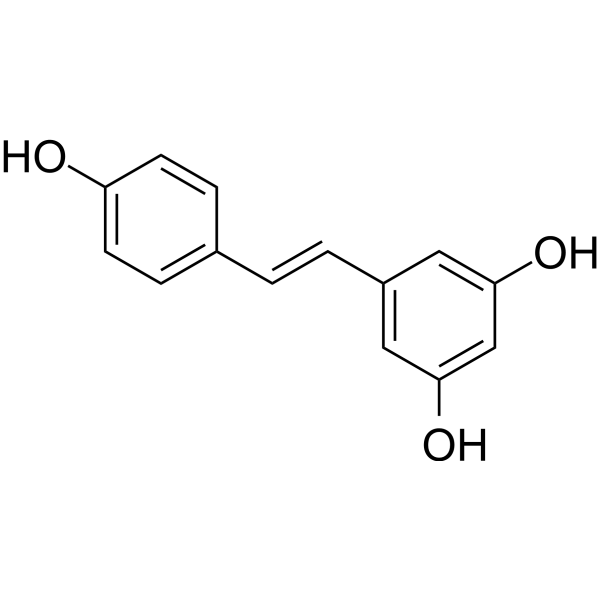
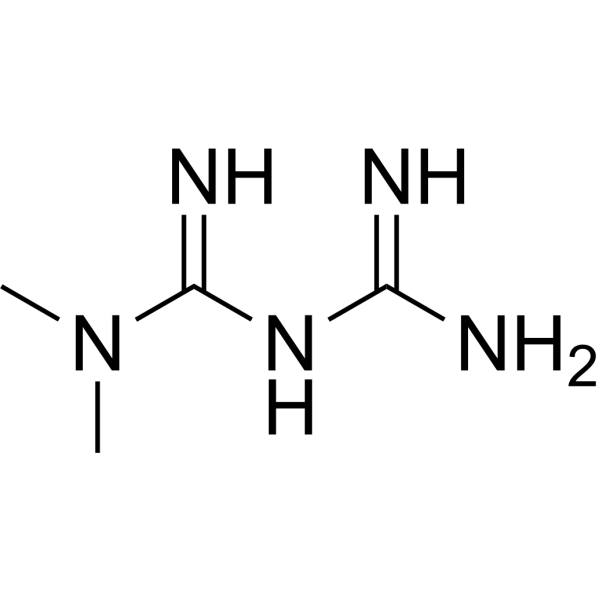
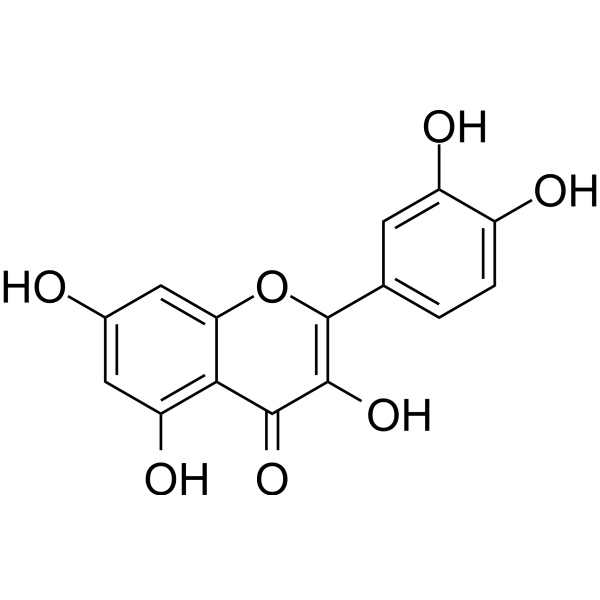
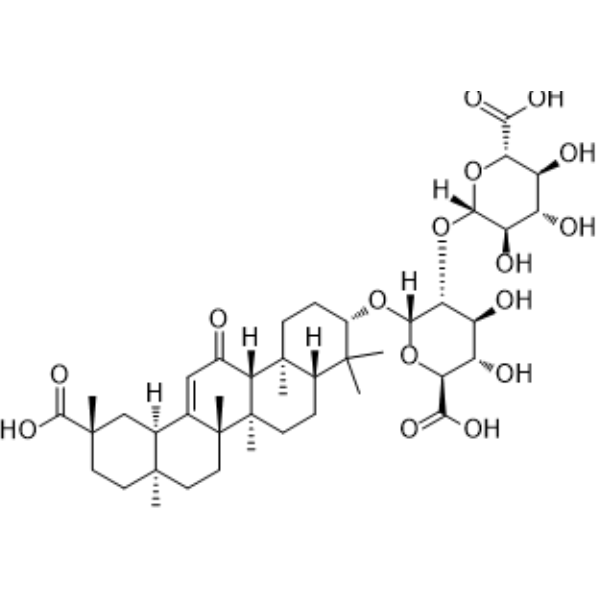
Publications Citing Use of MedChemExpress (MCE) Tea polyphenol
More

Biological Activity
Description
In Vivo
Tea polyphenol (400 mg/(kg∙d) in diet) improves spatial cognitive abilities in rats with chronic cerebral hypoperfusion[5].
Tea polyphenol (5-20mg/kg, p.o., for 7days) shows antidepressant-like effects in mice following the forced swimming test (FST) and tail suspension test (TST)[6].
Tea polyphenol (100-400 mg/kg in diet per day) protects mice from Acetaminophen (HY-66005)-induced hepatotoxicity by reducing CYP2E1 and CYP1A2 expression in mice[7].
MedChemExpress (MCE) has not independently confirmed the accuracy of these methods. They are for reference only.
-
Animal Model:Diabetic cardiomyopathy model rats[1]
-
Dosage:400 mg/(kg∙d)
-
Administration:in diet for eight weeks
-
Result:Lowers serum glucose and blood lipids.
Improved myocardial structure and function.
Induced autophagy in rats in a high-fat state (Increased level of Beclin-1 and the ratio of LC3-II to LC3-I).
- Annexin V plus membrane-impermeant dye apoptosis staining
- BrdU Incorporation Assay
- Somatic Cell Culture
- CFSE Dye Dilution Proliferation Assay
- Dye-dilution cell tracking and proliferation staining
- CCK-8/WST-8 Cell Proliferation Assay
- Protocol for Cell Cycle
- Cell Counting-Based Growth Curve Assay
- Colony Formation (Clonogenic) Assay
- Cell Viability Determination by MTT Colorimetric Assay
- EdU Incorporation Assay (Click Chemistry-Based DNA Synthesis Measurement)
- Ki-67 Immunostaining Proliferation Assay
- Detection of Apoptosis
- TUNEL staining for apoptotic DNA fragmentation
- PCNA Immunodetection Proliferation Assay
- Flow cytometric DNA-content cell-cycle staining
- Protocol for Cell Counting and Cell Density Analysis
- Apoptosis Solutions
- MTT Cell Proliferation Assay
Clinical Trial
| NCT Number | Sponsor | Condition | Start Date |
Phase

|
|---|---|---|---|---|
| NCT01329991 | 2011-05 | PHASE1 |


Chemical Information
-
CAS No. 84650-60-2
-
Appearance Solid
-
Color Brown to reddish brown
-
SMILES
[Tea polyphenol]
-
Structure Classification
-
Initial Source
-
Shipping
Room temperature in continental US; may vary elsewhere.
-
Storage
Powder -20°C 3 years 4°C 2 years In solvent -80°C 6 months -20°C 1 month


Publications (2)
-
Journal Impact Factor
-
Most Recent


Solvent & Solubility
In Vitro:
H2O : 50 mg/mL (Need ultrasonic)
DMSO : 32.5 mg/mL (Need ultrasonic; Hygroscopic DMSO has a significant impact on the solubility of product, please use newly opened DMSO)
In Vivo:
Select the appropriate dissolution method based on your experimental animal and administration route.
- For the following dissolution methods, please ensure to first prepare a clear stock solution using an In Vitro approach and then sequentially add co-solvents:
- To ensure reliable experimental results, the clarified stock solution can be appropriately stored based on storage conditions. As for the working solution for In Vivo experiments, it is recommended to prepare freshly and use it on the same day.
- The percentages shown for the solvents indicate their volumetric ratio in the final prepared solution. If precipitation or phase separation occurs during preparation, heat and/or sonication can be used to aid dissolution.
Add each solvent one by one: 10% DMSO 40% PEG300 5% Tween-80 45% Saline
Solubility: ≥ 3.25 mg/mL; Clear solution
This protocol yields a clear solution of ≥ 3.25 mg/mL (saturation unknown).
Taking 1 mL working solution as an example, add 100 μL DMSO stock solution (32.5 mg/mL) to 400 μL PEG300, and mix evenly; then add 50 μL Tween-80 and mix evenly; then add 450 μL Saline to adjust the volume to 1 mL.
Preparation of Saline: Dissolve 0.9 g sodium chloride in ddH₂O and dilute to 100 mL to obtain a clear Saline solution.
Add each solvent one by one: 10% DMSO 90% (20% SBE-β-CD in Saline)
Solubility: ≥ 3.25 mg/mL; Clear solution
This protocol yields a clear solution of ≥ 3.25 mg/mL (saturation unknown).
Taking 1 mL working solution as an example, add 100 μL DMSO stock solution (32.5 mg/mL) to 900 μL 20% SBE-β-CD in Saline, and mix evenly.
Preparation of 20% SBE-β-CD in Saline (4°C, storage for one week): 2 g SBE-β-CD powder is dissolved in 10 mL Saline, completely dissolve until clear.
In Vivo Dissolution Calculator
Please enter the basic information of animal experiments:
-
-
-
-
Recommended: Prepare an additional quantity of animals to account for potential losses during experiments.
Working solution concentration: 0.22 mg/mL
This product has good water solubility, please refer to the measured solubility data in water/PBS/Saline for details.


Purity & Documentation
-
Data Sheet (271 KB)
-
SDS (393 KB)
- English - EN (393 KB)
- Français - FR (393 KB)
- Deutsch - DE (393 KB)
- Norwegian - NO (393 KB)
- Español - ES (393 KB)
- Swedish - SV (393 KB)
- Italian - IT (393 KB)
- Korean - KR (393 KB)
- Portuguese - PT (393 KB)
-
Handling Instructions (2659 KB)
References
[1]. Suzuki J, et al. Tea polyphenols regulate key mediators on inflammatory cardiovascular diseases. Mediators Inflamm. 2009;2009:494928. [Content Brief]
[2]. Chen D, et al. Tea polyphenols, their biological effects and potential molecular targets. Histol Histopathol. 2008 Apr;23(4):487-96. [Content Brief]
[3]. Mao X, et al. Oxidative stress-induced diseases and tea polyphenols. Oncotarget. 2017 Sep 14;8(46):81649-81661. [Content Brief]
[4]. Hui Zhou, et al. Regulation of autophagy by tea polyphenols in diabetic cardiomyopathy. J Zhejiang Univ Sci B. 2018 May;19(5):333-341. [Content Brief]
[5]. Xu Y, et al. Green tea polyphenols inhibit cognitive impairment induced by chronic cerebral hypoperfusion via modulating oxidative stress. J Nutr Biochem. 2010 Aug;21(8):741-8. [Content Brief]
[6]. Zhu WL, et al. Green tea polyphenols produce antidepressant-like effects in adult mice. Pharmacol Res. 2012 Jan;65(1):74-80. [Content Brief]
[7]. Chen X, et al. Protective effect of tea polyphenols against paracetamol-induced hepatotoxicity in mice is significantly correlated with cytochrome P450 suppression. World J Gastroenterol. 2009 Apr 21;15(15):1829-35. [Content Brief]

Calculators
Concentration (start) × Volume (start) = Concentration (final) × Volume (final)


Tea polyphenol Related Classifications
HY-N1925 Related Classifications
 Powered by Bioz