



Tetrahydroalstonine

Based on 1 Customer Validation
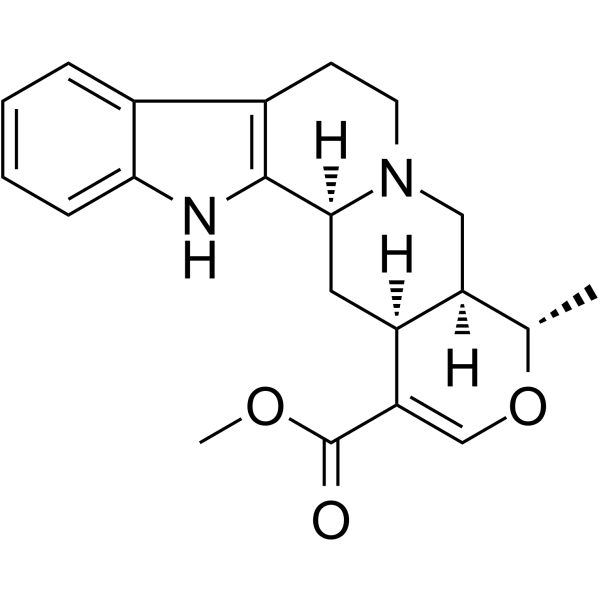
Tetrahydroalstonine ((-)-Tetrahydroalstonine) is an indole alkaloid and a selective α₂-adrenergic receptor antagonist. Tetrahydroalstonine exhibits certain neuroprotective effects. Tetrahydroalstonine can regulate autophagy-lysosomal function by activating the Akt/mTOR pathway, significantly reducing OGD/R-induced primary cortical neuronal injury.
For research use only. We do not sell to patients.
- Purity : 99.84%
- CAS No.: 6474-90-4
- Formula: C21H24N2O3
- Molecular Weight:352.43
-
Storage:
4°C, protect from light
* In solvent : -80°C, 6 months; -20°C, 1 month (protect from light)

To place orders, for customer services and technical support, please contact: MedChemExpress USA
Tel: 609-228-6898 E-mail: [email protected] [email protected]


-
 Biological Activity
-
Chemical Information
-
Solvent & Solubility
- Protocols
- Purity & Documentation
- References
-
 Help & FAQs


All Adrenergic Receptor Isoforms
More

Biological Activity
Description
In Vitro
Tetrahydroalstonine (0.75-3 µM; 3-26 h) improves cell viability and ameliorates abnormal expression of autophagic and lysosomal markers (LC3B-II/I, LAMP1, CSTB, TFEB) in primary cortical neurons treated with oxygen-glucose deprivation/reoxygenation (OGD/R). The mechanism involves activation of the Akt/mTOR pathway[1].
MedChemExpress (MCE) has not independently confirmed the accuracy of these methods. They are for reference only. Further protocols information, click here.
-
Cell Line:OGD/R treated cortical neurons
-
Concentration:0.75, 1.5 and 3 µM
-
Incubation Time:Pretreated with 2 h, then co-incubation for 24 h
-
Result:Increased the cell viability of cortical neurons.
In Vivo
MedChemExpress (MCE) has not independently confirmed the accuracy of these methods. They are for reference only.
-
Animal Model:Male Wistar rats were pithed and artificially ventilated with vagus nerve sectioning
-
Dosage:0.5, 1, 2 and 4 mg/kg
-
Administration:Intravenous injection (i.v.); single dose
-
Result:Significantly potentiated the pressor response to electrical stimulation of sympathetic outflow (shown as negative inhibition) at low doses (0.5-2 mg/kg), while 4 mg/kg significantly reduced this response (PN50: 2.8 mg/kg). The potentiation at low doses suggested blockade of presynaptic α₂-adrenoceptors, leading to increased noradrenaline release.


Chemical Information
-
CAS No. 6474-90-4
-
Appearance Solid
-
Molecular Weight 352.43
-
Formula C21H24N2O3
-
Color Off-white to light yellow
-
SMILES
O=C(OC)C1=CO[C@@H](C)[C@@]2([H])[C@]1([H])C[C@@]3([H])C4=C(C5=CC=CC=C5N4)CCN3C2
-
Synonyms
(-)-Tetrahydroalstonine
-
Structure Classification
-
Initial Source
-
Shipping
Room temperature in continental US; may vary elsewhere.
-
Storage
4°C, protect from light
* In solvent : -80°C, 6 months; -20°C, 1 month (protect from light)


Solvent & Solubility
In Vitro:
DMSO : 100 mg/mL (283.74 mM; Need ultrasonic; Hygroscopic DMSO has a significant impact on the solubility of product, please use newly opened DMSO)
Please refer to the solubility information to select the appropriate solvent. Once prepared, please aliquot and store the solution to prevent product inactivation from repeated freeze-thaw cycles.
Storage method and period of stock solution: -80°C, 6 months; -20°C, 1 month (protect from light). When stored at -80°C, please use it within 6 months. When stored at -20°C, please use it within 1 month.
Please refer to the solubility information to select the appropriate solvent. Once prepared, please aliquot and store the solution to prevent product inactivation from repeated freeze-thaw cycles.
Storage method and period of stock solution: -80°C, 6 months; -20°C, 1 month (protect from light). When stored at -80°C, please use it within 6 months. When stored at -20°C, please use it within 1 month.
Concentration (start) × Volume (start) = Concentration (final) × Volume (final)

Protocols
-
Neurotoxicity Study
This protocol assesses in vitro neurotoxicity by combining neuronal viability, mitochondrial/metabolic activity, neurite outgrowth, and optional neuronal network function readouts. Calcein-AM or resazurin/PrestoBlue readouts estimate viable or metabolically active cells; βIII-tubulin immunofluorescence detects neuronal morphology and neurite networks; TMRE detects mitochondrial membrane potential; and MEA recordings detect functional changes in neuronal network activity.
-
Autophagy
Autophagy is a process in which eukaryotic cells use lysosomes to degrade their own cytoplasmic proteins and damaged organelles under the regulation of autophagy related gene (Atg). Microtubule-associated proteins light chain 3 (LC3) is recognized as autophagy marker, which transfers from cytoplasmic LC3 (LC3-I) to membrane type (LC3-II). LC3-II/I ratio could be detected by Western Blot and fluorescence microscopy.
-
Lysosome and acidic-vesicle live-cell staining
Lysosome and acidic-vesicle live-cell staining detects acidic intracellular compartments by using membrane-permeant acidotropic probes that accumulate in low-pH vesicles, including lysosomes, late endosomes, autolysosomes, and acidic phagosomes. LysoTracker staining is commonly used as an intensity-based readout of acidic lysosomal compartment abundance or enlargement, while acridine orange produces green fluorescence in less concentrated compartments and red fluorescence after concentration-dependent accumulation in acidic vesicular organelles. Loss or reduction of acridine-orange red signal can be used as a readout of lysosomal membrane permeabilization or reduced acidic-vesicle integrity. This protocol is designed for live cultured cells and can be adapted for fluorescence microscopy, high-content imaging, plate-reader readout, or flow cytometry when the selected literature supports the readout. Because these dyes report acidotropic accumulation rather than lysosome identity alone,
-
Macroautophagy Solutions
Macroautophagy is a conserved lysosome-dependent degradation pathway in which cytoplasmic material is sequestered into double-membrane autophagosomes and delivered to lysosomes for degradation and recycling. The pathway supports cellular homeostasis during nutrient limitation, organelle stress, protein-aggregate accumulation, infection, differentiation, and tissue remodeling by coupling cargo sequestration, autophagosome maturation, lysosomal fusion, and degradation of cargo-derived macromolecules. The core molecular sequence includes initiation by nutrient- and stress-regulated autophagy machinery, autophagosome nucleation, LC3/ATG8-family conjugation to autophagosomal membranes, cargo selection through receptors such as SQSTM1/p62, autophagosome-lysosome fusion, and lysosomal degradation. LC3 was identified as a mammalian homolog of yeast Atg8 that localizes to autophagosomal membranes after processing, and p62/SQSTM1 was shown to connect ubiquitinated cargo with autophagic degradati


Purity & Documentation
-
Data Sheet (278 KB)
-
SDS (393 KB)
- English - EN (393 KB)
- Français - FR (393 KB)
- Deutsch - DE (393 KB)
- Norwegian - NO (393 KB)
- Español - ES (393 KB)
- Swedish - SV (393 KB)
- Italian - IT (393 KB)
- Korean - KR (393 KB)
- Portuguese - PT (393 KB)
-
Handling Instructions (2659 KB)
References
[1]. Liao Y, et al. The Protective Effect of (-)-Tetrahydroalstonine against OGD/R-Induced Neuronal Injury via Autophagy Regulation. Molecules. 2023 Mar 4;28(5):2370. [Content Brief]
[2]. Roquebert J, et al. Inhibition of the alpha 1 and alpha 2-adrenoceptor-mediated pressor response in pithed rats by raubasine, tetrahydroalstonine and akuammigine. Eur J Pharmacol. 1984 Oct 30;106(1):203-5.https://www.ncbi.nlm.nih.gov/pubmed/6099269 [Content Brief]
[3]. Malik S, et al. Tetrahydroalstonine from Fruits of Rhazya stricta. Planta Med. 1984 Jun;50(3):283. [Content Brief]


Complete Stock Solution Preparation Table
Please refer to the solubility information to select the appropriate solvent. Once prepared, please aliquot and store the solution to prevent product inactivation from repeated freeze-thaw cycles.
Storage method and period of stock solution: -80°C, 6 months; -20°C, 1 month (protect from light). When stored at -80°C, please use it within 6 months. When stored at -20°C, please use it within 1 month.
| Optional Solvent | Concentration Solvent Mass | 1 mg | 5 mg | 10 mg | 25 mg |
|---|---|---|---|---|---|
| DMSO | 1 mM | 2.8374 mL | 14.1872 mL | 28.3744 mL | 70.9361 mL |
| 5 mM | 0.5675 mL | 2.8374 mL | 5.6749 mL | 14.1872 mL | |
| 10 mM | 0.2837 mL | 1.4187 mL | 2.8374 mL | 7.0936 mL | |
| 15 mM | 0.1892 mL | 0.9458 mL | 1.8916 mL | 4.7291 mL | |
| 20 mM | 0.1419 mL | 0.7094 mL | 1.4187 mL | 3.5468 mL | |
| 25 mM | 0.1135 mL | 0.5675 mL | 1.1350 mL | 2.8374 mL | |
| 30 mM | 0.0946 mL | 0.4729 mL | 0.9458 mL | 2.3645 mL | |
| 40 mM | 0.0709 mL | 0.3547 mL | 0.7094 mL | 1.7734 mL | |
| 50 mM | 0.0567 mL | 0.2837 mL | 0.5675 mL | 1.4187 mL | |
| 60 mM | 0.0473 mL | 0.2365 mL | 0.4729 mL | 1.1823 mL | |
| 80 mM | 0.0355 mL | 0.1773 mL | 0.3547 mL | 0.8867 mL | |
| 100 mM | 0.0284 mL | 0.1419 mL | 0.2837 mL | 0.7094 mL |


Tetrahydroalstonine Related Classifications
HY-N1163 Related Classifications
 Powered by Bioz