



Tubeimoside III
Based on 2 publication(s) in Google Scholar
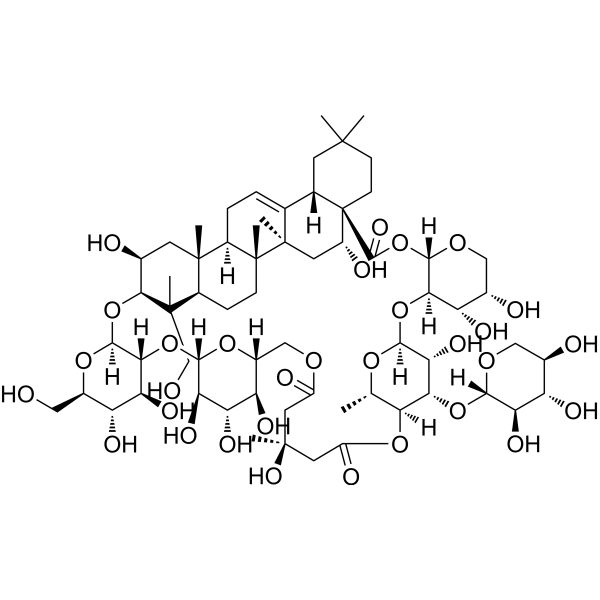
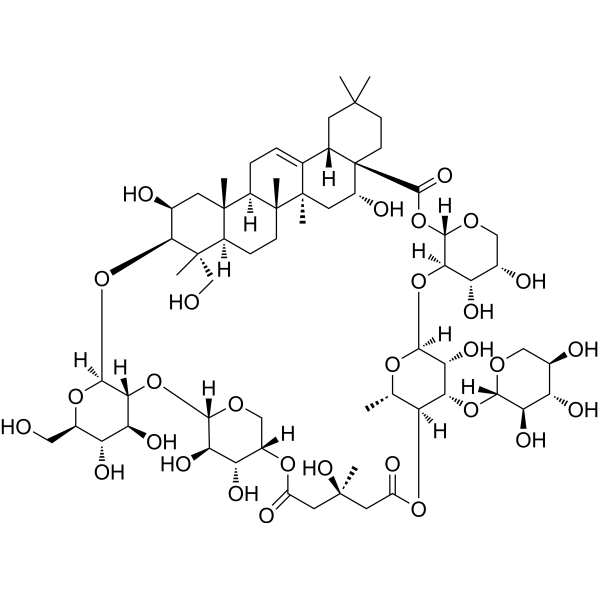
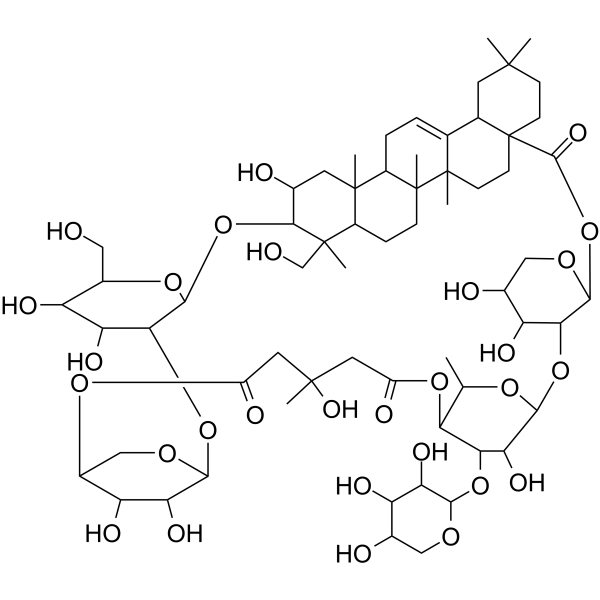
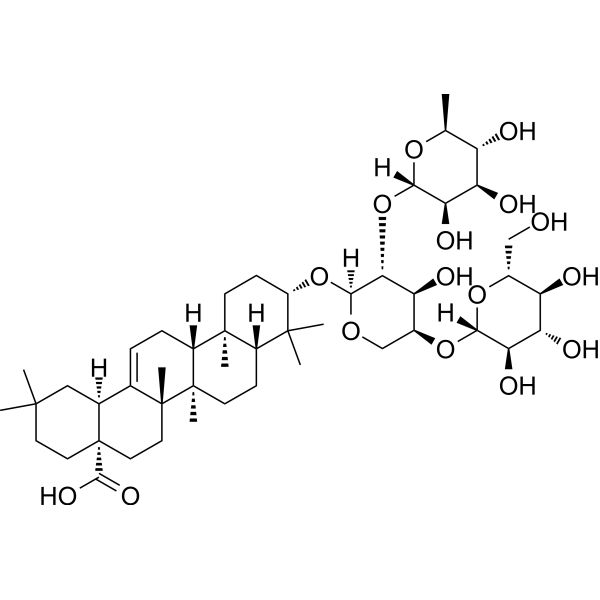
Tubeimoside III is a triterpenoid saponin. Tubeimoside III has anti-inflammatory and antitumor effects. Tubeimoside III has an LD50 of 15 mg/kg by intraperitoneal injection in ICR mice. Tubeimoside III can be used for the research of tumors and inflammatory diseases.
For research use only. We do not sell to patients.
- Purity : 99.91%
- CAS No.: 115810-13-4
- Formula: C64H100O31
- Molecular Weight:1365.46
-
Storage:
4°C, protect from light
* In solvent : -80°C, 6 months; -20°C, 1 month (protect from light)

To place orders, for customer services and technical support, please contact: MedChemExpress USA
Tel: 609-228-6898 E-mail: [email protected] [email protected]


-
 Biological Activity
-
Chemical Information
-
Solvent & Solubility
- Protocols
- Purity & Documentation
- References
-
 Help & FAQs



Publications Citing Use of MedChemExpress (MCE) Tubeimoside III
More

Biological Activity
Description
IC50 & Target
[1]|
IL-6 |
IL-1β |
In Vitro
Tubeimoside III (4 μM; 0-15 h) inhibits NO production, reduces the expression levels of inflammatory factors, suppresses glycolysis and mitochondrial respiration, and increases pyruvate content in LPS (HY-D1056)-induced RAW264.7 cells. The mechanism involves the ATF3-IκBζ pathway and is independent of the NF-κB pathway[1].
MedChemExpress (MCE) has not independently confirmed the accuracy of these methods. They are for reference only. Further protocols information, click here.
-
Cell Line:RAW264.7 treated LPS (HY-D1056)
-
Concentration:4 μM
-
Incubation Time:Pretreated with 3 h, then co-incubation for 0, 6, and 12 h
-
Result:Inhibited the mRNA levels of IL-1β, IL-6 and iNOS, but had no significant effect on the expression of TNF-α.
-
Cell Line:RAW264.7 treated LPS (HY-D1056)
-
Concentration:4 μM
-
Incubation Time:Pretreated with 3 h, then co-incubation for 0, 1, and 4 h
-
Result:Inhibited the level of IκBζ and increased the level of ATF3.
In Vivo
Tubeimoside III (0.0075-0.11 μM; topical administration; single dose) shows anti-inflammatory activity by inhibiting ear edema in a TPA (HY-18739)-induced mouse ear edema model[2].
Tubeimoside III (12 mg/kg; intramuscular injection; 1-3 days) possesses antitumor activity in mice inoculated with S180 sarcoma cells[2].
MedChemExpress (MCE) has not independently confirmed the accuracy of these methods. They are for reference only.
-
Animal Model:Male C57BL/6 mice aged 7-10 weeks old (20-25 g) treated LPS (HY-D1056)[1]
-
Dosage:1 mg/kg
-
Administration:Intraperitoneal injection (i.p.); single dose: 3 hours before LPS modeling
-
Result:Significantly attenuated splenic congestion, inhibited inflammatory cell infiltration in alveoli, prevented necrosis in liver lesions.
Reduced the mRNA and protein expression levels of inflammatory cytokines IL-6, IL-1β, and iNOS in lung and liver tissues.
-
Animal Model:BALB/c mice treated S180 sarcoma cells[2]
-
Dosage:12 mg/kg
-
Administration:Intramuscular injection (i.m.); 1, 2 and 3 days
-
Result:Reduced the tumor weight, with inhibition rates of 36.0%, 65.6% and 72.8% for 1 day, 2 days and 3 days administrations, respectively.


Chemical Information
-
CAS No. 115810-13-4
-
Appearance Solid
-
Molecular Weight 1365.46
-
Formula C64H100O31
-
Color White to off-white
-
SMILES
O[C@H]1[C@@]23[C@](CC(C)(C)CC3)([H])C4=CC[C@@]([C@@]5([C@H]([C@@](C)([C@@H](O[C@@]6([H])[C@]([C@H]([C@H](O)[C@@H](CO)O6)O)([H])O[C@]7([H])O[C@@](COC(C[C@](C)(O)CC(O[C@]8([H])[C@@H](O[C@@]9([H])[C@@H]([C@H]([C@H](O)CO9)O)O)[C@@H](O)[C@](O[C@H]8C)([H])O[C@@]%10([H])[C@](OC[C@H](O)[C@@H]%10O)([H])OC2=O)=O)=O)([H])[C@@H](O)[C@H](O)[C@H]7O)[C@@H](O)C5)CO)CC%11)C)([H])[C@]%11(C)[C@]4(C)C1
-
Structure Classification
-
Initial Source
-
Shipping
Room temperature in continental US; may vary elsewhere.
-
Storage
4°C, protect from light
* In solvent : -80°C, 6 months; -20°C, 1 month (protect from light)


Publications (2)
-
Journal Impact Factor
-
Most Recent
-
Cell
Molecular characterization of Ebola virus glycoprotein V75A substitution in the 2018-2020 epidemic. [Abstract]2026 Feb 5;189(3):818-831.e19. PMID: 41576953 -
Res Sq
2026 Mar 4:rs.3.rs-8437418. PMID: 41858825


Solvent & Solubility
In Vitro:
DMSO : 100 mg/mL (73.24 mM; ultrasonic and warming and heat to 60°C; Hygroscopic DMSO has a significant impact on the solubility of product, please use newly opened DMSO)
Please refer to the solubility information to select the appropriate solvent. Once prepared, please aliquot and store the solution to prevent product inactivation from repeated freeze-thaw cycles.
Storage method and period of stock solution: -80°C, 6 months; -20°C, 1 month (protect from light). When stored at -80°C, please use it within 6 months. When stored at -20°C, please use it within 1 month.
Please refer to the solubility information to select the appropriate solvent. Once prepared, please aliquot and store the solution to prevent product inactivation from repeated freeze-thaw cycles.
Storage method and period of stock solution: -80°C, 6 months; -20°C, 1 month (protect from light). When stored at -80°C, please use it within 6 months. When stored at -20°C, please use it within 1 month.
Concentration (start) × Volume (start) = Concentration (final) × Volume (final)

Protocols
-
How to Select the Route of Administration for Mammals
Route-of-administration selection in mammals is a pharmacokinetic, pharmacodynamic, formulation, animal-welfare, and translational decision, not a default technical choice. The selected route should match the study goal: intravenous dosing is most useful when complete systemic exposure and rapid onset are required, oral dosing is most translational for orally intended medicines but is affected by absorption and first-pass metabolism, subcutaneous or intramuscular dosing can provide slower systemic exposure, and intraperitoneal dosing can be useful in rodent proof-of-concept studies but may have limited clinical translation. Published route-comparison studies show that the same compound can produce different exposure, onset, bioavailability, tissue distribution, and tolerability depending on route; therefore, route choice should be supported by pilot pharmacokinetic or pharmacodynamic evidence when the literature is insufficient. Unresolved questions include how to standardize route sel
-
Research Protocol for Inflammation-related Diseases
The NLRP3 inflammasome is a cytosolic innate immune signaling platform that integrates priming signals and danger-signal activation to promote caspase-1 activation, maturation of IL-1β and IL-18, and gasdermin D-mediated pyroptotic cell death. The core experimental logic is to determine whether inflammatory disease phenotypes are driven by increased NLRP3 expression, ASC-containing inflammasome assembly, caspase-1 cleavage, GSDMD cleavage, and extracellular release of IL-1β/IL-18 rather than by nonspecific cell injury alone. The pathway is strongly linked to inflammation-related disease phenotypes because monosodium urate crystals activate NALP3/NLRP3 inflammasome signaling in gout-like crystal inflammation, cholesterol crystals activate NLRP3 inflammasomes in atherogenesis models, and DSS-induced intestinal inflammation has been reported to involve NLRP3 inflammasome activity. However, experimental colitis studies also show context-dependent protective effects of NLRP3 inflammasome co
-
Acute Systemic Toxicity Study
Acute systemic toxicity studies evaluate adverse effects occurring after a single exposure, or repeated exposure within a short acute window, and the main in vivo readouts are mortality, moribund condition, clinical signs, body-weight change, and gross pathological findings; acute oral toxicity methods were developed to replace classical LD50 testing with reduced-animal designs such as fixed-dose procedure, acute toxic class method, and up-and-down procedure. The fixed-dose procedure classifies acute toxicity by administering predefined dose levels and observing evident toxicity rather than using death as the primary endpoint, whereas the acute toxic class method uses sequential groups of three animals per step and the up-and-down procedure doses animals sequentially to estimate an LD50 with fewer animals than conventional LD50 testing.


Purity & Documentation
-
Data Sheet (289 KB)
-
SDS (392 KB)
- English - EN (392 KB)
- Français - FR (392 KB)
- Deutsch - DE (392 KB)
- Norwegian - NO (392 KB)
- Español - ES (392 KB)
- Swedish - SV (392 KB)
- Italian - IT (392 KB)
- Korean - KR (392 KB)
- Portuguese - PT (392 KB)
-
Handling Instructions (2659 KB)
References


Complete Stock Solution Preparation Table
Please refer to the solubility information to select the appropriate solvent. Once prepared, please aliquot and store the solution to prevent product inactivation from repeated freeze-thaw cycles.
Storage method and period of stock solution: -80°C, 6 months; -20°C, 1 month (protect from light). When stored at -80°C, please use it within 6 months. When stored at -20°C, please use it within 1 month.
| Optional Solvent | Concentration Solvent Mass | 1 mg | 5 mg | 10 mg | 25 mg |
|---|---|---|---|---|---|
| DMSO | 1 mM | 0.7324 mL | 3.6618 mL | 7.3235 mL | 18.3088 mL |
| 5 mM | 0.1465 mL | 0.7324 mL | 1.4647 mL | 3.6618 mL | |
| 10 mM | 0.0732 mL | 0.3662 mL | 0.7324 mL | 1.8309 mL | |
| 15 mM | 0.0488 mL | 0.2441 mL | 0.4882 mL | 1.2206 mL | |
| 20 mM | 0.0366 mL | 0.1831 mL | 0.3662 mL | 0.9154 mL | |
| 25 mM | 0.0293 mL | 0.1465 mL | 0.2929 mL | 0.7324 mL | |
| 30 mM | 0.0244 mL | 0.1221 mL | 0.2441 mL | 0.6103 mL | |
| 40 mM | 0.0183 mL | 0.0915 mL | 0.1831 mL | 0.4577 mL | |
| 50 mM | 0.0146 mL | 0.0732 mL | 0.1465 mL | 0.3662 mL | |
| 60 mM | 0.0122 mL | 0.0610 mL | 0.1221 mL | 0.3051 mL |


Tubeimoside III Related Classifications
HY-N2542 Related Classifications
 Powered by Bioz