



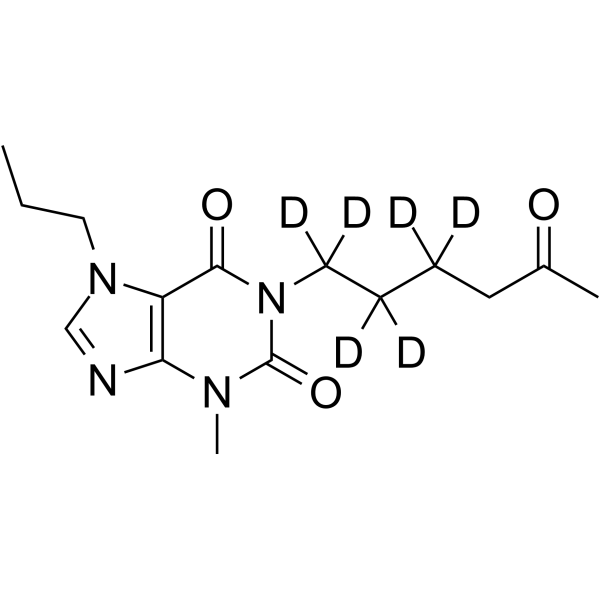
Propentofylline-d6
Propentofylline-d6 (HWA 285-d6) is the deuterium labeled Propentofylline. Propentofylline is an orally active and brain-penetrant phosphodiesterase inhibitor. Propentofylline blocks adenosine reuptake and prevents cyclic nucleotide degradation. Propentofylline can be used for the research of primary degenerative (Alzheimer's) dementia, vascular dementia, cerebral ischemia, acute stroke, and learning and memory disorders.
For research use only. We do not sell to patients.
- CAS No.: 1216516-37-8
- Formula: C15H16D6N4O3
- Molecular Weight:312.40
-
Storage:
Please store the product under the recommended conditions in the Certificate of Analysis.

To place orders, for customer services and technical support, please contact: MedChemExpress USA
Tel: 609-228-6898 E-mail: [email protected] [email protected]


-
 Biological Activity
-
Chemical Information
- Protocols
- Purity & Documentation
- References
-
 Help & FAQs


All Adenosine Receptor Isoforms
More

Biological Activity
Description
In Vitro
Stable heavy isotopes of hydrogen, carbon, and other elements have been incorporated into drug molecules, largely as tracers for quantitation during the drug development process. Deuteration has gained attention because of its potential to affect the pharmacokinetic and metabolic profiles of drugs[1].
MedChemExpress (MCE) has not independently confirmed the accuracy of these methods. They are for reference only. Further protocols information, click here.
Application
1. This compound can be used as a tracer
2. This compound can be used as an internal standard for quantitative analysis by NMR, GC-MS, or LC-MS.


Chemical Information
-
CAS No. 1216516-37-8
-
Unlabeled CAS 55242-55-2
-
Molecular Weight 312.40
-
Formula C15H16D6N4O3
-
SMILES
C(CC)N1C2=C(N(C)C(=O)N(C(C(C(CC(C)=O)([2H])[2H])([2H])[2H])([2H])[2H])C2=O)N=C1
-
Synonyms
HWA 285-d6
-
Shipping
Room temperature in continental US; may vary elsewhere.
-
Storage
Please store the product under the recommended conditions in the Certificate of Analysis.

Protocols
-
Protocol for Shuttle Box Test (TDPA)
The Shuttle Box Test for TDPA, or temporally dissociated passive avoidance, measures hippocampus-dependent associative learning by testing whether a rodent avoids entering a dark compartment that was previously paired with foot shock after a temporal delay between dark-compartment entry and shock delivery. The main behavioral readout is crossover or step-through latency from the light chamber into the dark chamber; increased latency across training or retention trials reflects learned avoidance memory rather than motor performance alone.
-
Protocol for Water Maze
The Morris Water Maze is a rodent spatial learning and memory assay in which a mouse or rat swims in opaque water to find an escape platform; in the hidden-platform version, the animal cannot see the platform and must use distal extra-maze cues to learn its fixed spatial location. The assay primarily measures hippocampus-dependent spatial learning during acquisition trials and spatial reference memory during probe trials after platform removal; readouts include escape latency, swim path length, swim speed, quadrant occupancy, platform-site crossings, and proximity to the former platform location.


Purity & Documentation
References
[1]. Noble S, et al. Propentofylline. CNS Drugs. 1997 Sep;8(3):257-264.
[2]. Parkinson FE, et al. Propentofylline: a nucleoside transport inhibitor with neuroprotective effects in cerebral ischemia. Gen Pharmacol. 1994 Oct;25(6):1053-8. [Content Brief]
[3]. Goto M, et al. Effects of propentofylline on disorder of learning and memory in rodents. Jpn J Pharmacol. 1987 Nov;45(3):373-8. [Content Brief]
[4]. Rother M, et al. Propentofylline in the treatment of Alzheimer's disease and vascular dementia: a review of phase III trials. Dement Geriatr Cogn Disord. 1998;9 Suppl 1:36-43. [Content Brief]

Calculators
Concentration (start) × Volume (start) = Concentration (final) × Volume (final)


Propentofylline-d6 Related Classifications
HY-107203S Related Classifications
 Powered by Bioz
Keywords
- Propentofylline-d6
- 1216516-37-8
- HWA 285-d6
- Isotope-Labeled Compounds
- Phosphodiesterase (PDE)
- Adenosine Receptor
- adenosine transporter
- mouse leukemic L1210/B23.1 cells
- cyclic nucleotide phosphodiesterase
- adenosine receptor
- human blood mononuclear cells
- mouse astroglial cells
- rat peritoneal macrophages
- rat hippocampal neurons
- rat carcinosarcoma Walker 256 cells
- microglial cells
- Inhibitor
- inhibitor
- inhibit