



ZL0590

Based on 1 Customer Validation
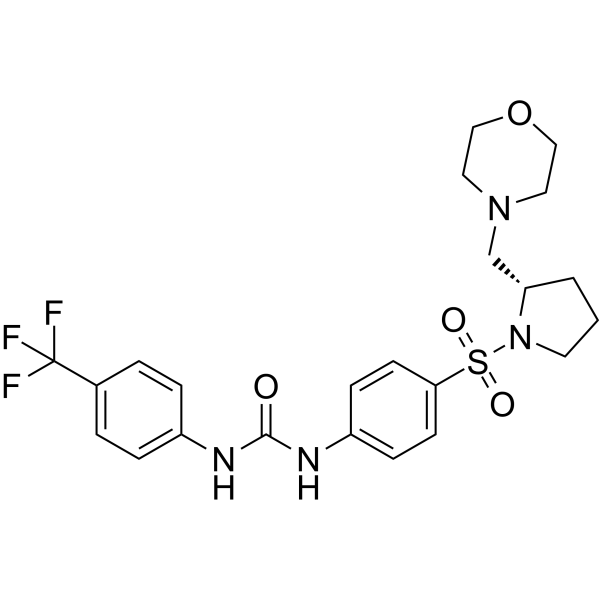
ZL0590 is a potent, orally active BRD4 BD1-selective inhibitor with an IC50 of 90 nM for human BRD4 BD1. ZL0590 exhibits significant anti-inflammatory activities. ZL0590 can reduce mucosal inflammation in animal models of inflammatory bowel disease and restores tissue architecture. ZL0590 can be used in research on inflammatory diseases such as inflammatory bowel disease.
For research use only. We do not sell to patients.
- Purity : 99.86%
- CAS No.: 2230496-99-6
- Formula: C23H27F3N4O4S
- Molecular Weight:512.55
-
Storage:Powder -20°C, 3 years , 4°C, 2 years ; In solvent -80°C, 6 months , -20°C, 1 month

To place orders, for customer services and technical support, please contact: MedChemExpress USA
Tel: 609-228-6898 E-mail: [email protected] [email protected]


-
 Biological Activity
-
Chemical Information
-
Solvent & Solubility
- Protocols
- Purity & Documentation
- References
-
 Help & FAQs




Biological Activity
Description
IC50 & Target
IC50: 90 nM (human BRD4 BD1)[1]
In Vitro
In Vivo
MedChemExpress (MCE) has not independently confirmed the accuracy of these methods. They are for reference only.
-
Animal Model:Male C57BL/6J mice with poly(I:C) stimulation[1]
-
Dosage:10 mg/kg
-
Administration:Oral gavage (p.o.), 1 day before poly(I:C)
-
Result:Significantly attenuated inflammatory cytokines (IL-6, MCP-1, and RANTES) in bronchoalveolar lavage fluid as well as inflammatory gene expression (IL-6, KC, ISG54 and CIG5) in lung tissues of mice.
Significantly blocked poly(I:C)-induced H3K122Ac levels in hSAECs and lung tissues of mice.


Chemical Information
-
CAS No. 2230496-99-6
-
Appearance Solid
-
Molecular Weight 512.55
-
Formula C23H27F3N4O4S
-
Color White to off-white
-
SMILES
O=S(N1[C@@H](CCC1)CN2CCOCC2)(C3=CC=C(C=C3)NC(NC4=CC=C(C=C4)C(F)(F)F)=O)=O
-
Shipping
Room temperature in continental US; may vary elsewhere.
-
Storage
Powder -20°C 3 years 4°C 2 years In solvent -80°C 6 months -20°C 1 month


Solvent & Solubility
In Vitro:
DMSO : 100 mg/mL (195.10 mM; Need ultrasonic; Hygroscopic DMSO has a significant impact on the solubility of product, please use newly opened DMSO)
Please refer to the solubility information to select the appropriate solvent. Once prepared, please aliquot and store the solution to prevent product inactivation from repeated freeze-thaw cycles.
Storage method and period of stock solution: -80°C, 6 months; -20°C, 1 month. When stored at -80°C, please use it within 6 months. When stored at -20°C, please use it within 1 month.
Please refer to the solubility information to select the appropriate solvent. Once prepared, please aliquot and store the solution to prevent product inactivation from repeated freeze-thaw cycles.
Storage method and period of stock solution: -80°C, 6 months; -20°C, 1 month. When stored at -80°C, please use it within 6 months. When stored at -20°C, please use it within 1 month.
Concentration (start) × Volume (start) = Concentration (final) × Volume (final)


Purity & Documentation
-
Data Sheet (274 KB)
-
SDS (251 KB)
- English - EN (251 KB)
- Français - FR (251 KB)
- Deutsch - DE (251 KB)
- Norwegian - NO (251 KB)
- Español - ES (251 KB)
- Swedish - SV (251 KB)
- Italian - IT (251 KB)
- Korean - KR (251 KB)
- Portuguese - PT (251 KB)
-
Handling Instructions (2659 KB)
References


Complete Stock Solution Preparation Table
Please refer to the solubility information to select the appropriate solvent. Once prepared, please aliquot and store the solution to prevent product inactivation from repeated freeze-thaw cycles.
Storage method and period of stock solution: -80°C, 6 months; -20°C, 1 month. When stored at -80°C, please use it within 6 months. When stored at -20°C, please use it within 1 month.
| Optional Solvent | Concentration Solvent Mass | 1 mg | 5 mg | 10 mg | 25 mg |
|---|---|---|---|---|---|
| DMSO | 1 mM | 1.9510 mL | 9.7551 mL | 19.5103 mL | 48.7757 mL |
| 5 mM | 0.3902 mL | 1.9510 mL | 3.9021 mL | 9.7551 mL | |
| 10 mM | 0.1951 mL | 0.9755 mL | 1.9510 mL | 4.8776 mL | |
| 15 mM | 0.1301 mL | 0.6503 mL | 1.3007 mL | 3.2517 mL | |
| 20 mM | 0.0976 mL | 0.4878 mL | 0.9755 mL | 2.4388 mL | |
| 25 mM | 0.0780 mL | 0.3902 mL | 0.7804 mL | 1.9510 mL | |
| 30 mM | 0.0650 mL | 0.3252 mL | 0.6503 mL | 1.6259 mL | |
| 40 mM | 0.0488 mL | 0.2439 mL | 0.4878 mL | 1.2194 mL | |
| 50 mM | 0.0390 mL | 0.1951 mL | 0.3902 mL | 0.9755 mL | |
| 60 mM | 0.0325 mL | 0.1626 mL | 0.3252 mL | 0.8129 mL | |
| 80 mM | 0.0244 mL | 0.1219 mL | 0.2439 mL | 0.6097 mL | |
| 100 mM | 0.0195 mL | 0.0976 mL | 0.1951 mL | 0.4878 mL |


ZL0590 Related Classifications
HY-145310 Related Classifications
 Powered by Bioz