



Cyantraniliprole
Based on 2 publication(s) in Google Scholar
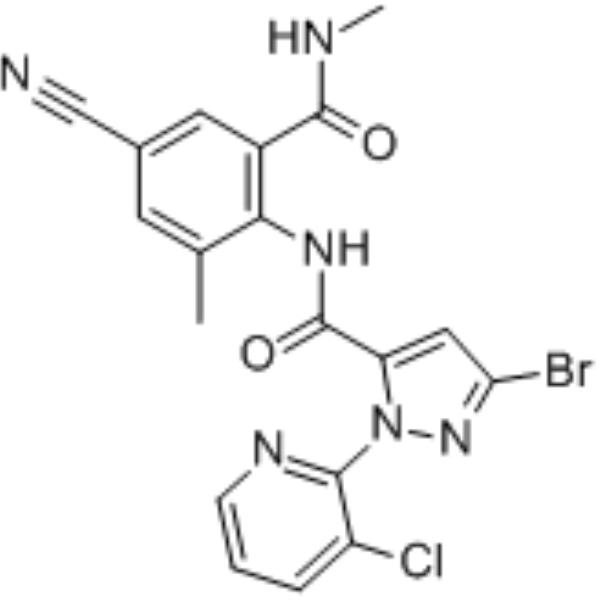
Cyantraniliprole (HGW-86) is a potent and selective aniline receptor activator with oral activity. Cyantraniliprole has insecticidal and antioxidant activity.
For research use only. We do not sell to patients.
- Purity : 99.60%
- CAS No.: 736994-63-1
- Formula: C19H14BrClN6O2
- Molecular Weight:473.71
-
Storage:Powder -20°C, 3 years , 4°C, 2 years ; In solvent -80°C, 2 years , -20°C, 1 year

To place orders, for customer services and technical support, please contact: MedChemExpress USA
Tel: 609-228-6898 E-mail: [email protected] [email protected]


-
 Biological Activity
-
Chemical Information
-
Solvent & Solubility
- Purity & Documentation
- References
-
 Help & FAQs




Publications Citing Use of MedChemExpress (MCE) Cyantraniliprole
MoreAll Parasite Isoforms
More

Biological Activity
Description
In Vitro
Cyantraniliprole (38.0 mg/L 96 h) can cause DNA damage and activate the DNA damage repair pathway of tilapia hepatocytes[2].
MedChemExpress (MCE) has not independently confirmed the accuracy of these methods. They are for reference only. .
-
Cell Line:Fish liver cells
-
Concentration:38 mg/L
-
Incubation Time:96 h
-
Result:Upregulated the Rpa3 and Downregulated the Chk 2 gene.
In Vivo
MedChemExpress (MCE) has not independently confirmed the accuracy of these methods. They are for reference only.
-
Animal Model:Adult female Wistar rats (67 days old)[3]
-
Dosage:10 or 150 mg/kg
-
Administration:p.o.
-
Result:Exhibited higher level of plasma progesterone, elevated levels of lipid peroxidation in reproductive organs, increased superoxide dismutase activity in the uterus and glutathione peroxidase activity on the ovary
Exhibited an increment in estrous cycle length and diminished uterine glandular epithelium.


Chemical Information
-
CAS No. 736994-63-1
-
Appearance Solid
-
Molecular Weight 473.71
-
Formula C19H14BrClN6O2
-
Color White to off-white
-
SMILES
O=C(C1=CC(Br)=NN1C2=NC=CC=C2Cl)NC3=C(C(NC)=O)C=C(C#N)C=C3C
-
Synonyms
HGW-86
-
Shipping
Room temperature in continental US; may vary elsewhere.
-
Storage
Powder -20°C 3 years 4°C 2 years In solvent -80°C 2 years -20°C 1 year


Publications (2)
-
Journal Impact Factor
-
Most Recent
-
J Hazard Mater
Cellular and signaling mechanisms of cyantraniliprole toxicity in the nontarget organism Bombyx mori. [Abstract]2026 Jul 15:513:142404. PMID: 42208291 -
Anal Chem
Exposome-Scale Investigation of Cl-/Br-Containing Chemicals Using High-Resolution Mass Spectrometry, Multistage Machine Learning, and Cloud Computing. [Abstract]2025 Jun 3;97(21):11099-11109. PMID: 40401576


Solvent & Solubility
In Vitro:
DMSO : 50 mg/mL (105.55 mM; Need ultrasonic; Hygroscopic DMSO has a significant impact on the solubility of product, please use newly opened DMSO)
Please refer to the solubility information to select the appropriate solvent. Once prepared, please aliquot and store the solution to prevent product inactivation from repeated freeze-thaw cycles.
Storage method and period of stock solution: -80°C, 2 years; -20°C, 1 year. When stored at -80°C, please use it within 2 years. When stored at -20°C, please use it within 1 year.
Please refer to the solubility information to select the appropriate solvent. Once prepared, please aliquot and store the solution to prevent product inactivation from repeated freeze-thaw cycles.
Storage method and period of stock solution: -80°C, 2 years; -20°C, 1 year. When stored at -80°C, please use it within 2 years. When stored at -20°C, please use it within 1 year.
Concentration (start) × Volume (start) = Concentration (final) × Volume (final)
In Vivo:
Select the appropriate dissolution method based on your experimental animal and administration route.
- For the following dissolution methods, please ensure to first prepare a clear stock solution using an In Vitro approach and then sequentially add co-solvents:
- To ensure reliable experimental results, the clarified stock solution can be appropriately stored based on storage conditions. As for the working solution for In Vivo experiments, it is recommended to prepare freshly and use it on the same day.
- The percentages shown for the solvents indicate their volumetric ratio in the final prepared solution. If precipitation or phase separation occurs during preparation, heat and/or sonication can be used to aid dissolution.
Add each solvent one by one: 10% DMSO 40% PEG300 5% Tween-80 45% Saline
Solubility: ≥ 2.5 mg/mL (5.28 mM); Clear solution
This protocol yields a clear solution of ≥ 2.5 mg/mL (saturation unknown).
Taking 1 mL working solution as an example, add 100 μL DMSO stock solution (25.0 mg/mL) to 400 μL PEG300, and mix evenly; then add 50 μL Tween-80 and mix evenly; then add 450 μL Saline to adjust the volume to 1 mL.
Preparation of Saline: Dissolve 0.9 g sodium chloride in ddH₂O and dilute to 100 mL to obtain a clear Saline solution.
In Vivo Dissolution Calculator
Please enter the basic information of animal experiments:
-
-
-
-
Recommended: Prepare an additional quantity of animals to account for potential losses during experiments.
Please enter your animal formula composition:
-
%DMSO +
Recommended: Keep the proportion of DMSO in working solution below 2% if your animal is weak.
-
%+
-
+%Tween-80 + +
-
%Saline +
The co-solvents required include: DMSO, . All of co-solvents are available by MedChemExpress (MCE). , Tween 80. All of co-solvents are available by MedChemExpress (MCE).
Working solution concentration: 0.22 mg/mL
Method for preparing stock solution: mg drug dissolved in μL DMSO. Stock solution concentration: mg/mL.
1. Take μL DMSO stock solution;
2. Add μL .
μL , mix evenly;
3. Then add μL Tween 80, mix evenly;
4. Then add μL
Please ensure that the stock solution in the first step is dissolved to a clear state, and add co-solvents in sequence. You can use ultrasonic heating (ultrasonic cleaner, recommended frequency 20-40 kHz), vortexing, etc. to assist dissolution.


Purity & Documentation
-
Data Sheet (281 KB)
-
SDS (458 KB)
- English - EN (458 KB)
- Français - FR (458 KB)
- Deutsch - DE (458 KB)
- Norwegian - NO (458 KB)
- Español - ES (458 KB)
- Swedish - SV (458 KB)
- Italian - IT (458 KB)
- Korean - KR (458 KB)
- Portuguese - PT (458 KB)
-
Handling Instructions (2659 KB)
References
[1]. Selby TP, et al. Discovery of cyantraniliprole, a potent and selective anthranilic diamide ryanodine receptor activator with cross-spectrum insecticidal activity. Bioorg Med Chem Lett. 2013 Dec 1;23(23):6341-5. [Content Brief]
[2]. Whitby K, et al. Castanospermine, a potent inhibitor of dengue virus infection in vitro and in vivo. J Virol. 2005 Jul;79(14):8698-706. [Content Brief]
[3]. da Silva Scarton SR, et al. Cyantraniliprole impairs reproductive parameters by inducing oxidative stress in adult female wistar rats. Reprod Toxicol. 2022 Jan;107:166-174. [Content Brief]


Complete Stock Solution Preparation Table
Please refer to the solubility information to select the appropriate solvent. Once prepared, please aliquot and store the solution to prevent product inactivation from repeated freeze-thaw cycles.
Storage method and period of stock solution: -80°C, 2 years; -20°C, 1 year. When stored at -80°C, please use it within 2 years. When stored at -20°C, please use it within 1 year.
| Optional Solvent | Concentration Solvent Mass | 1 mg | 5 mg | 10 mg | 25 mg |
|---|---|---|---|---|---|
| DMSO | 1 mM | 2.1110 mL | 10.5550 mL | 21.1100 mL | 52.7749 mL |
| 5 mM | 0.4222 mL | 2.1110 mL | 4.2220 mL | 10.5550 mL | |
| 10 mM | 0.2111 mL | 1.0555 mL | 2.1110 mL | 5.2775 mL | |
| 15 mM | 0.1407 mL | 0.7037 mL | 1.4073 mL | 3.5183 mL | |
| 20 mM | 0.1055 mL | 0.5277 mL | 1.0555 mL | 2.6387 mL | |
| 25 mM | 0.0844 mL | 0.4222 mL | 0.8444 mL | 2.1110 mL | |
| 30 mM | 0.0704 mL | 0.3518 mL | 0.7037 mL | 1.7592 mL | |
| 40 mM | 0.0528 mL | 0.2639 mL | 0.5277 mL | 1.3194 mL | |
| 50 mM | 0.0422 mL | 0.2111 mL | 0.4222 mL | 1.0555 mL | |
| 60 mM | 0.0352 mL | 0.1759 mL | 0.3518 mL | 0.8796 mL | |
| 80 mM | 0.0264 mL | 0.1319 mL | 0.2639 mL | 0.6597 mL | |
| 100 mM | 0.0211 mL | 0.1055 mL | 0.2111 mL | 0.5277 mL |


Cyantraniliprole Related Classifications
HY-12779 Related Classifications
 Powered by Bioz