



Cancer Immunotherapy
Cancer immunotherapy (CIT) is a type of biological therapy, aiming to improve anti-tumor immune responses with fewer off-target effects than chemotherapy. Several types of immunotherapy include: oncolytic virus therapies, cancer vaccines, cytokine therapies, adoptive cell transfer (ACT), and immune checkpoint inhibitors (ICIs). In particular, ICIs and ACT have obtained immense clinical response, but their efficacy varies from person to person. Immune cells can be harnessed to eliminate tumor cells, such as T cells, B cells, NK cells, and myeloid cells. T cells have potent tumor-killing capability, therefore, a plethora of cancer immunotherapy research have focused on inducing T-cell-mediated anti-tumor responses. CTLA-4 and PD-1 are found on the cell surface of T cells as co-inhibitory receptors. The breakthrough in cancer immunotherapy results from the identification and subsequent targeting of checkpoint mechanisms in T cells with monoclonal antibodies against CTLA-4 and programmed death-ligand 1/programmed death-1 (PD-L1/PD-1).
Several types of cancers (e.g., melanoma, mismatch repair-deficient cancers, bladder cancer, and non-small cell lung cancer) have achieved significant clinical responses in T-cell checkpoint blockade therapies. However, single-mode immunotherapy faces challenges such as low immune response, low tumor infiltration, and complex immunosuppressive tumor microenvironment. Recently, combined therapies based on tumor immunity have received extensive attention in the research of enhancing tumor cells immunogenicity and inhibiting their growth. For example, anti CTLA-4 and PD-1, immune checkpoint blockade (ICB) combined with chemotherapy, anti-angiogenic drugs and kinase inhibitors.
-
Nortopixantrone dihydrochloride
 0 ImagesCat. No.: HY-105165ACAS No.: 438244-41-8Synonyms: BBR 3438
Nortopixantrone dihydrochloride (BBR 3438) is a 9-aza-anthrapyrazole-based antineoplastic antibiotic. Nortopixantrone dihydrochloride plays an important role in cacner research.
-
Pantoprazole-d8
 0 ImagesCat. No.: HY-17507S2CAS No.: 934294-34-5Synonyms: BY1023-d8; SKF96022-d8
Pantoprazole-d8 (BY1023-d8) is deuterium labeled Pantoprazole. Pantoprazole (BY10232) is an orally active and potent proton pump inhibitor (PPI). Pantoprazole, a substituted benzimidazole, is a potent H+/K+-ATPase inhibitor with an IC50 of 6.8 μM. Pantoprazole improves pH stability and has anti-secretory, anti-ulcer activities. Pantoprazole significantly increased tumor growth delay combined with Doxorubicin (HY-15142).
-
Fenhexamid (Standard)
 0 ImagesSynonyms: KBR 2738 (Standard)
Fenhexamid (Standard) is the analytical standard of Fenhexamid. This product is intended for research and analytical applications. Fenhexamid, a botryticide, is a sterol biosynthesis inhibitor. Fenhexamid shows fungicide efficient against the plant pathogenic fungus Botryotinia fuckeliana (Botrytis cinerea).
-
Demethylolivomycin A
 0 ImagesCat. No.: HY-N14720CAS No.: 86917-61-5
Demethylolivomycin A is an antitumor antibiotic. Demethylolivomycin A has anti-Gram-positive bacteria and anti-leukemia P388 activity.
-
15-Keto-prostaglandin E2-d4
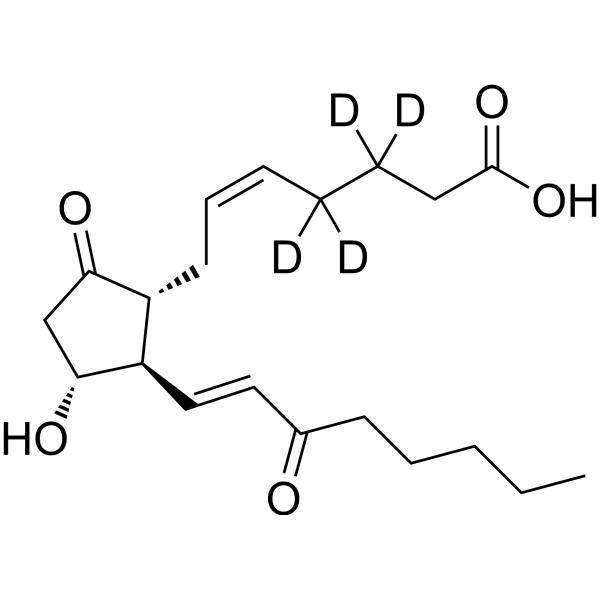 0 ImagesCat. No.: HY-113205S1CAS No.: 2738376-85-5
15-Keto-prostaglandin E2-d4 is the d4 labeled 15-keto-Prostaglandin E2 (HY-113205). 15-keto-Prostaglandin E2 (15-keto-PGE2) is an endogenous PGE2 metabolite. 15-keto-Prostaglandin E2 inhibits STAT3 activation by binding to the Cys259 residue of STAT3. 15-keto-Prostaglandin E2 binds to and stabilizes EP2 and EP4 receptors. 15-keto-Prostaglandin E2 inhibits the growth and progression of breast cancer cells. 15-keto-Prostaglandin E2 activates PPAR-γ and promotes fungal growth. 15-keto-Prostaglandin E2 disrupts glomerular vascularization during zebrafish development and reduces the surface area of the glomerular filtration barrier.
-
Diflunisal-13C6
 0 ImagesCat. No.: HY-18342S1Synonyms: MK-647-13C6
Diflunisal-13C6 (MK-647-13C6) is 13C labeled Diflunisal. Diflunisal (MK-647) is a salicylate derivative with nonsteroidal anti-inflammatory and uricosuric properties, which is used alone as an analgesic and in rheumatoid arthritis patients. The mechanism of action of diflunisal is as a Cyclooxygenase (COX) Inhibitor.
-
Ravuconazole (Standard)
 0 ImagesSynonyms: BMS-207147 (Standard); ER-30346 (Standard)
Ravuconazole (Standard) is the analytical standard of Ravuconazole. This product is intended for research and analytical applications. Ravuconazole (BMS-207147;ER-30346) is an orally available triazole antifungle agent that potently inhibits a wide range of fungi.
-
Gluconapin
 0 ImagesCat. No.: HY-N10346ACAS No.: 19041-09-9Synonyms: 3-Butenyl glucosinolate
Gluconapin (3-Butenyl glucosinolate) is an orally active aliphatic glucosinolate and also a flavor modifier. Gluconapin inhibits the elevation of plasma triglyceride levels in mice. Gluconapin also exhibits certain antibacterial activity.
-
Cetirizine dihydrochloride (Standard)
 0 ImagesSynonyms: P071 (Standard)
Cetirizine (dihydrochloride) (Standard) is the analytical standard of Cetirizine (dihydrochloride). This product is intended for research and analytical applications. Cetirizine dihydrochloride, a second-generation antihistamine and the carboxylated metabolite of hydroxyzine, is a specific, orally active and long-acting histamine H1-receptor antagonist. Cetirizine dihydrochloride marks antiallergic properties and inhibits eosinophil chemotaxis during the allergic response.
-
Itacnosertib hydrochloride (Standard)
 0 ImagesCat. No.: HY-109179ARCAS No.: 2409543-84-4Synonyms: TP-0184 hydrochloride (Standard)
Itacnosertib hydrochloride (Standard) is the analytical standard of Itacnosertib (hydrochloride) (HY-109179A). This product is intended for research and analytical applications. Itacnosertib hydrochloride (TP-0184 hydrochloride) is the inhibitor for FLT3, ACVR1 (ALK2, IC50=8 nM) and JAK2 (IC50=8540 nM). Itacnosertib hydrochloride exhibits anti-leukemic activity.
-
7-Hydroxyflavone (Standard)
 0 Images
7-Hydroxyflavone (Standard) is the analytical standard of 7-Hydroxyflavone. This product is intended for research and analytical applications. 7-Hydroxyflavone is a flavonoid isolated from Clerodendrum phlomidis, with anti-inflammatory activity. 7-Hydroxyflavone protects renal cells from nicotine (NIC)-associated cytotoxicity via the ERK/Nrf2/HO-1 pathway. 7-Hydroxyflavone inhibits PKM2 with an IC50 of 2.12 μM. 7-Hydroxyflavone inhibits COX-2 and 5-LOX with IC50 of 27 µg/mL and 33 µg/mL. 7-Hydroxyflavone is orally active.
-
4-O-Demethyl-11-deoxydoxorubicin
 0 ImagesCat. No.: HY-N14822CAS No.: 81382-05-0
4-O-Demethyl-11-deoxydoxorubicin is an anthracycline antibiotic with antibacterial and antitumor activities. 4-O-Demethyl-11-deoxydoxorubicin is cytotoxic to Hela cells.
-
(Rac)-Efavirenz-d4
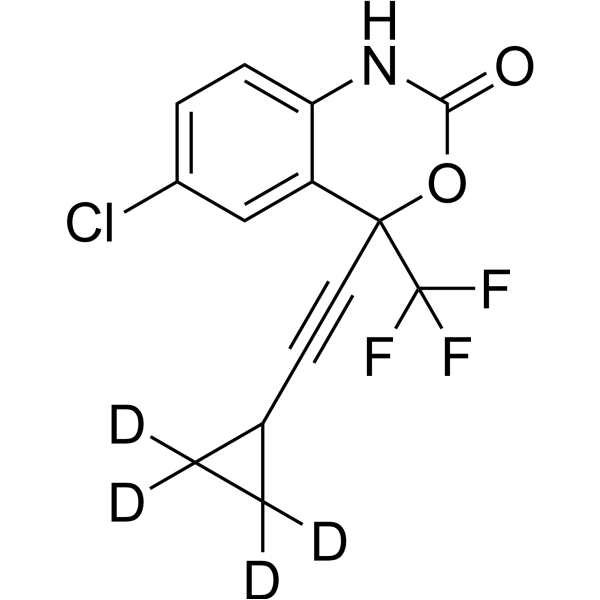 0 ImagesCat. No.: HY-10572BSCAS No.: 1246812-58-7
(Rac)-Efavirenz-d4 is a labelled racemic Efavirenz. Efavirenz (DMP 266) is a potent inhibitor of the wild-type HIV-1 reverse transcriptase with a Ki of 2.93 nM and exhibits an IC95 of 1.5 nM for the inhibition of HIV-1 replicative spread in cell culture. (Rac)-Efavirenz-d4 is a click chemistry reagent, it contains an Alkyne group and can undergo copper-catalyzed azide-alkyne cycloaddition (CuAAc) with molecules containing Azide groups.
-
L-NMMA acetate (Standard)
 0 ImagesSynonyms: Tilarginine acetate (Standard); Methylarginine acetate (Standard)
L-NMMA (Tilarginine) acetate (Standard) is the analytical standard of L-NMMA acetate (HY-18732A). This product is intended for research and analytical applications. L-NMMA (Tilarginine) acetate is a non-selective and competitive inhibitor of nitric oxide synthase. L-NMMA acetate inhibits three subtypes, namely nNOS, eNOS, and iNOS, and reduces NO production. L-NMMA acetate alleviates mechanical allodynia, thermal hyperalgesia, and choroidal fibrosis. L-NMMA acetate is applicable to research related to nociception, bone cancer pain, and myopia.
-
Methyl syringate (Standard)
 0 Images
Methyl syringate is a selective TRPA1 agonist. Methyl syringate regulates food intake and gastric emptying through a TRPA1-mediated pathway. Methyl syringate is an efficient phenolic mediator for bacterial and fungal laccases. Methyl syringate is a chemical marker of Asphodel monofloral honey. Methyl syringate contributes to the antibacterial activity of honey. Methyl syringate inhibits aflatoxin production. Methyl syringate can contribute to weight suppression. Methyl syringate can be studies for cancer prevention (e.g. lung cancer), suppression of hypoxia-induced inflammatory response and tumorigenesis.
-
RKS262
 0 ImagesCat. No.: HY-113720CAS No.: 1041469-97-9
RKS262 is an orally active cyclin/CDK inhibitor. RKS262 is also an apoptosis inducer and cell cycle regulator, exhibiting cytotoxic activity against cancer cells. RKS262 induces caspase-3 cleavage, ROS generation, SAPK/JNK activation, and upregulates the expression of p53, Bid, Bad, Bok, and p27. RKS262 inhibits the expression of Bcl-2, Mcl-1, Bcl-xL, p21, cyclin D1, cyclin B1, cdc-2, cyclin D4, and DNA-pk KU-80 subunit. RKS262 suppresses the phosphorylation of the IGF-1R/PI3K/PKC pathway, ras oncogene activity, and Cdk-6, while increasing total Akt expression. RKS262 induces G2/M or S phase cell cycle arrest, disrupts mitochondrial transmembrane potential, and reduces tumor burden in xenograft models. RKS262 is used in research on neuroblastoma and ovarian cancer.
-
Pipoxolan
 0 ImagesCat. No.: HY-105854ACAS No.: 23744-24-3
Pipoxolan is an orally active smooth muscle relaxant, anti-inflammatory agent and anticancer agent. Pipoxolan modulates PI3K/AKT signaling pathways, and reduces the levels of Ras/MEK/p-ERK, MMP-2 and MMP-9. Pipoxolan inhibits pro-inflammatory transcription factor pathways, activates Nrf2/HO-1, and suppresses the production of pro-inflammatory mediators. Pipoxolan induces ROS generation, endogenous mitochondrial Apoptosis, and G0/G1 cell cycle arrest. Pipoxolan reduces cerebral infarction size and inhibits intimal hyperplasia. Pipoxolan can be used in research related to cerebral ischemia, intimal hyperplasia, oral squamous cell carcinoma, leukemia and lung cancer.
-
Niclosamide olamine (Standard)
 0 ImagesSynonyms: BAY2353 olamine (Standard)
Crocin (Standard) is the analytical standard of Crocin. This product is intended for research and analytical applications. Crocin (Crocin I) is an orally active natural product that can be isolated from the stigma of Crocus sativus. Crocin inhibits tumor cell proliferation and promotes apoptosis through JAK pathway. Crocin has anti-inflammatory, antioxidant and antitumor activities .
-
Apabetalone (Standard)
 0 ImagesCat. No.: HY-16652RCAS No.: 1044870-39-4Synonyms: RVX-208 (Standard); RVX000222 (Standard)
Apabetalone (Standard) is the analytical standard of Apabetalone. This product is intended for research and analytical applications. Apabetalone (RVX-208) is an inhibitor of BET transcriptional regulators with selectivity for the second bromodomain. The IC50s are 87 μM and 0.51 μM for BD1 and BD2, respectively.
-
Antibiotic MX 2
 0 ImagesCat. No.: HY-106289CAS No.: 105026-50-4
Antibiotic MX 2 is an orally active antibiotic that can cross the blood-brain barrier. Antibiotic MX 2 inhibits the growth of drug-sensitive and multidrug-resistant tumor cells, prolongs the survival of tumor-bearing mice, induces single-strand and double-strand DNA breaks, suppresses colony formation of fresh human-derived tumor cells, and overcomes multidrug resistance mediated by P-glycoprotein. Antibiotic MX 2 can be used in research related to L1210 leukemia, Lewis lung cancer, colon adenocarcinoma type 26 and type 38, gastric adenocarcinoma, non-small cell lung cancer, mammary adenocarcinoma, drug-resistant P388 leukemia, renal cancer, melanoma, ovarian cancer, breast cancer, small cell lung cancer, and colorectal cancer.



