



Cancer Targeted Therapy
Cancer targeted therapy is the foundation of precision medicine; it uses drugs or other substances to target specific genes and proteins that control cancer cells’ growth, division and spreading. Compared to traditional chemotherapy drugs, targeted-drugs can specifically act on cancer cells with high efficacy without damaging normal cells. Drugs used in cancer targeted therapy mainly includes small molecules and macromolecules (e.g., monoclonal antibodies), which can target cancer cells and constituents in the tumor microenvironment to activate the immune system. Anti-angiogenesis drugs, such as those targeting vascular endothelial growth factor (VEGF), epidermal growth factor receptor (EGFR), transforming growth factor (TGF)-α, TGF-β, Tumor necrosis factor (TNF)-α, and platelet-derived endothelial growth factor (PDGFR) inhibit the proliferation and metastasis of cancer cells. In recent years, the proportion of antibody drugs in cancer treatment has gradually become prominent. Antibody-drug conjugates (ADCs) are a new type of targeted drugs that are composed of monoclonal antibody, cytotoxic drug and linker. ADCs can deliver drugs to tumor cells and minimize the toxicity to normal tissues. Proteolysis-targeting chimera (PROTAC) is a useful technology for targeted protein degradation. PROTAC exploits the ubiquitin-proteasome system and forms a ternary complex with a hijacked E3 ubiquitin ligase and target protein, leading to polyubiquitination and degradation of the target protein.
Targeted therapy is a useful strategy in treatment of cancer either alone or in combination with standard chemotherapy. At present, targeted therapy has proved significant clinical success in the treatment of many types of cancer, including breast cancer, colorectal cancer, leukemia, ovarian cancer and lung cancer.
-
TGF-β2-IN-1
 0 ImagesCat. No.: HY-175205
TGF-β2-IN-1 is a selective TGF-β2 inhibitor. TGF-β2-IN-1 exhibits potent antiproliferative effects on HCT-116, Caco-2 and HT-29 with IC50 values of 6.84, 10.21, and 9.47 μM, respectively. TGF-β2-IN-1 inhibits TGF-β2 signaling in a dose-dependent manner by suppressing both receptor and cytokine expression.TGF-β2-IN-1 can be used for the study of colorectal cancer.
-
mTOR inhibitor-23
 0 ImagesCat. No.: HY-18953CAS No.: 1685280-21-0
mTOR inhibitor-23 (compound DHM25) is a selective, competitive, irreversible and covalent inhibitor of mTOR. mTOR inhibitor-23 has the mechanism of inhibition occurs mainly through its capacity to covalently interact with a nucleophilic amino acid inside the ATP pocket. mTOR inhibitor-23 exerts potent antitumor activity against triple-negative breast tumor cell lines.
-
FGFR2 K641N Recombinant Human Active Protein Kinase
 0 ImagesCat. No.: HY-E70816
FGFR2 is a receptor tyrosine kinase that is involved in many human cancers such as intrahepatic cholangiocarcinomas and hepatocellular carcinomas. FGFR2 K641N is a mutant of FGFR3. FGFR2 K641N Recombinant Human Active Protein Kinase is a recombinant FGFR2 K641N protein that can be used to study FGFR2 K641N-related functions.
-
hsa-miR-6856-5p antagomir
 0 ImagesCat. No.: HY-RI02275A
hsa-miR-6856-5p antagomirs are chemically-modified oligonucleotides that hybridize with mature miRNAs. The miRNA antagomirs have 2 phosphorothioates at the 5' end, 4 phosphorothioates at the 3' end, 1 cholesterol group at the 3' end, and full-length nucleotide 2'-methoxy modification. The miRNA antagomirs strongly compete with mature miRNAs to prevent the complementary pairing of miRNAs and their target genes, thereby inhibiting miRNAs from functioning. Stability of miRNA antagomirs appears to be significantly higher than miRNA inhibitors, they exhibits enhanced cellular uptake, stability and regulatory activity in vivo.
-
ID11916
 0 ImagesCat. No.: HY-173640CAS No.: 2785317-21-5
ID11916 is an orally active androgen receptor (AR) antagonist and a phosphodiesterase 5 (PDE5) inhibitor. ID11916 blocks androgen binding to AR, nuclear translocation, and androgen-dependent transcriptional activity of AR, while increasing intracellular cGMP levels and activating PKG via inhibition. ID11916 shows potent anti-cancer effect in prostate cancer cell lines VCaP and 22Rv1 and in AR-positive breast cancer cell lines SK-BR-3.
-
EphB4-IN-2
 0 ImagesCat. No.: HY-10654CAS No.: 1192216-03-7
EphB4-IN-2 is a tyrosine kinase inhibitor targeting the Eph family and Src family. EphB4-IN-2 binds to the ATP-binding site of the kinase domain of EphB4, and exhibits high affinity for tyrosine kinases with threonine as the gatekeeper residue, such as Abl, Lck and Src. EphB4-IN-2 can be used in research related to tumor-associated angiogenesis.
-
PROTAC SMARCA2/4 degrader-2
 0 ImagesCat. No.: HY-159453CAS No.: 2568277-76-7
PROTAC SMARCA2/4 degrader-2 is a PROTAC degrader targeting SMARCA2 and SMARCA4, with a DC50 of < 100 nM for both proteins. PROTAC SMARCA2/4 degrader-2 induces ubiquitination and subsequent proteasome-mediated degradation of SMARCA2 and SMARCA4 proteins. PROTAC SMARCA2/4 degrader-2 can be used in cancer-related research.
-
CDK4/6-IN-19
 0 ImagesCat. No.: HY-162529CAS No.: 3033950-86-3
CDK4/6-IN-19 (Compound II-7) is a CDK4/CDK6 inhibitor with IC50 values of 0.2, 5.0 nM, respectively. CDK4/6-IN-19 also inhibits cell proliferation and can be used in cancer research.

-
AR ligand-32
 0 ImagesCat. No.: HY-170303CAS No.: 2505498-74-6
-
GENA-104A16
 0 ImagesCat. No.: HY-P992356
GENA-104A16 is a humanized monoclonal antibody targeting CNTN4, with multiple functions including immunostimulation, cytotoxicity and immunoregulation. By binding to CNTN4, GENA-104A16 blocks its interaction with APP, thereby restoring T cell function, inducing tumor cell death and regulating tumor-infiltrating immune cell populations. GENA-104A16 also exerts topoisomerase I inhibitory activity via the payload Exatecan (HY-13631). GENA-104A16 can be used in research related to colon cancer liver metastasis and other CNTN4-expressing solid tumors.
-
hsa-miR-1910-5p antagomir
 0 ImagesCat. No.: HY-RI00365A
hsa-miR-1910-5p antagomirs are chemically-modified oligonucleotides that hybridize with mature miRNAs. The miRNA antagomirs have 2 phosphorothioates at the 5' end, 4 phosphorothioates at the 3' end, 1 cholesterol group at the 3' end, and full-length nucleotide 2'-methoxy modification. The miRNA antagomirs strongly compete with mature miRNAs to prevent the complementary pairing of miRNAs and their target genes, thereby inhibiting miRNAs from functioning. Stability of miRNA antagomirs appears to be significantly higher than miRNA inhibitors, they exhibits enhanced cellular uptake, stability and regulatory activity in vivo.
-
hsa-miR-4306 antagomir
 0 ImagesCat. No.: HY-RI00986A
hsa-miR-4306 antagomirs are chemically-modified oligonucleotides that hybridize with mature miRNAs. The miRNA antagomirs have 2 phosphorothioates at the 5' end, 4 phosphorothioates at the 3' end, 1 cholesterol group at the 3' end, and full-length nucleotide 2'-methoxy modification. The miRNA antagomirs strongly compete with mature miRNAs to prevent the complementary pairing of miRNAs and their target genes, thereby inhibiting miRNAs from functioning. Stability of miRNA antagomirs appears to be significantly higher than miRNA inhibitors, they exhibits enhanced cellular uptake, stability and regulatory activity in vivo.
-
hsa-miR-520h inhibitor
 0 ImagesCat. No.: HY-RI01607
hsa-miR-520h inhibitors are chemically-modified oligonucleotides that hybridize with mature miRNAs. The miRNA inhibitors have full-length nucleotide 2'-methoxy modification. The miRNA inhibitors strongly compete with mature miRNAs to prevent the complementary pairing of miRNAs and their target genes, thereby inhibiting miRNAs from functioning.
-
mmu-miR-374c-5p antagomir
 0 ImagesCat. No.: HY-RI03105A
mmu-miR-374c-5p antagomirs are chemically-modified oligonucleotides that hybridize with mature miRNAs. The miRNA antagomirs have 2 phosphorothioates at the 5' end, 4 phosphorothioates at the 3' end, 1 cholesterol group at the 3' end, and full-length nucleotide 2'-methoxy modification. The miRNA antagomirs strongly compete with mature miRNAs to prevent the complementary pairing of miRNAs and their target genes, thereby inhibiting miRNAs from functioning. Stability of miRNA antagomirs appears to be significantly higher than miRNA inhibitors, they exhibits enhanced cellular uptake, stability and regulatory activity in vivo.
-
mmu-miR-6999-3p antagomir
 0 ImagesCat. No.: HY-RI03730A
mmu-miR-6999-3p antagomirs are chemically-modified oligonucleotides that hybridize with mature miRNAs. The miRNA antagomirs have 2 phosphorothioates at the 5' end, 4 phosphorothioates at the 3' end, 1 cholesterol group at the 3' end, and full-length nucleotide 2'-methoxy modification. The miRNA antagomirs strongly compete with mature miRNAs to prevent the complementary pairing of miRNAs and their target genes, thereby inhibiting miRNAs from functioning. Stability of miRNA antagomirs appears to be significantly higher than miRNA inhibitors, they exhibits enhanced cellular uptake, stability and regulatory activity in vivo.
-
rno-miR-327 antagomir
 0 ImagesCat. No.: HY-RI04351A
rno-miR-327 antagomirs are chemically-modified oligonucleotides that hybridize with mature miRNAs. The miRNA antagomirs have 2 phosphorothioates at the 5' end, 4 phosphorothioates at the 3' end, 1 cholesterol group at the 3' end, and full-length nucleotide 2'-methoxy modification. The miRNA antagomirs strongly compete with mature miRNAs to prevent the complementary pairing of miRNAs and their target genes, thereby inhibiting miRNAs from functioning. Stability of miRNA antagomirs appears to be significantly higher than miRNA inhibitors, they exhibits enhanced cellular uptake, stability and regulatory activity in vivo.
-
LSD1-IN-13 hydrochloride
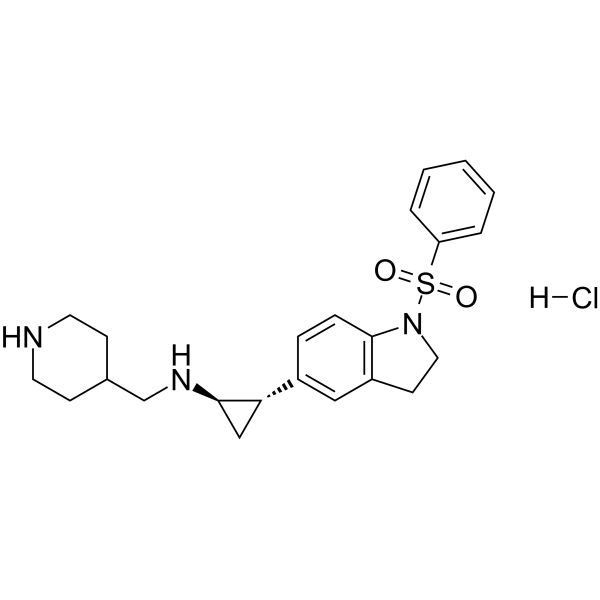 0 ImagesCat. No.: HY-144675ACAS No.: 2170347-90-5
LSD1-IN-13 hydrochloride (compound 7e) is an orally active and potent LSD1 inhibitor, with an IC50 of 24.43 nM. LSD1-IN-13 hydrochloride can activate CD86 expression, with an EC50 of 470 nM. LSD1-IN-13 hydrochloride induces differentiation of AML (acute myeloid leukemia) cell lines.
-
AChE/BuChE-IN-3
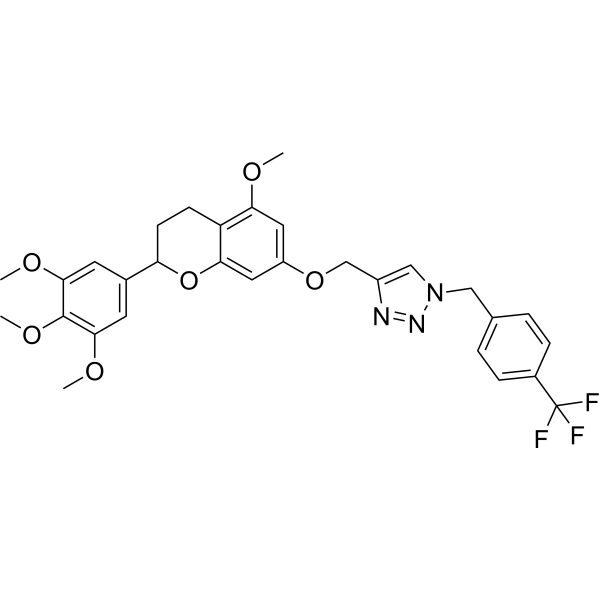 0 ImagesCat. No.: HY-147939CAS No.: 2742707-47-5
AChE/BuChE-IN-3 is a potent and blood-brain barrier (BBB) penetrant AChE and BuChE dual inhibitor with IC50s of 0.65 μM and 5.77 μM for AChE and BuChE. AChE/BuChE-IN-3 also inhibits Aβ1-42 aggregation. AChE/BuChE-IN-3 has effectively neuroprotective activities and nearly no toxicity on SH-SY5Y cells. AChE/BuChE-IN-3 can be used for researching Alzheimer's disease.
-
TPA(bi(Tos))-γ-Glu(PEG23)-Glu-Val-Cit-PAB-PNU-159682
 0 ImagesCat. No.: HY-184514
TPA (bi (Tos))-γ-Glu (PEG23)-Glu-Val-Cit-PAB-PNU-159682 is a cleavable linker-payload conjugate, in which the payload is PNU-159682 (HY-16700) and the linker is TPA (bi (SH))-γ-Glu (PEG23)-Glu-Val-Cit-PAB (HY-184515). TPA (bi (Tos))-γ-Glu (PEG23)-Glu-Val-Cit-PAB-PNU-159682 is used to generate L1CAM-targeted antibody-drug conjugates (ADCs). TPA (bi (Tos))-γ-Glu (PEG23)-Glu-Val-Cit-PAB-PNU-159682 can be used in the research of metastatic triple-negative basal breast cancer and lung adenocarcinoma.



