



Cancer Targeted Therapy
Cancer targeted therapy is the foundation of precision medicine; it uses drugs or other substances to target specific genes and proteins that control cancer cells’ growth, division and spreading. Compared to traditional chemotherapy drugs, targeted-drugs can specifically act on cancer cells with high efficacy without damaging normal cells. Drugs used in cancer targeted therapy mainly includes small molecules and macromolecules (e.g., monoclonal antibodies), which can target cancer cells and constituents in the tumor microenvironment to activate the immune system. Anti-angiogenesis drugs, such as those targeting vascular endothelial growth factor (VEGF), epidermal growth factor receptor (EGFR), transforming growth factor (TGF)-α, TGF-β, Tumor necrosis factor (TNF)-α, and platelet-derived endothelial growth factor (PDGFR) inhibit the proliferation and metastasis of cancer cells. In recent years, the proportion of antibody drugs in cancer treatment has gradually become prominent. Antibody-drug conjugates (ADCs) are a new type of targeted drugs that are composed of monoclonal antibody, cytotoxic drug and linker. ADCs can deliver drugs to tumor cells and minimize the toxicity to normal tissues. Proteolysis-targeting chimera (PROTAC) is a useful technology for targeted protein degradation. PROTAC exploits the ubiquitin-proteasome system and forms a ternary complex with a hijacked E3 ubiquitin ligase and target protein, leading to polyubiquitination and degradation of the target protein.
Targeted therapy is a useful strategy in treatment of cancer either alone or in combination with standard chemotherapy. At present, targeted therapy has proved significant clinical success in the treatment of many types of cancer, including breast cancer, colorectal cancer, leukemia, ovarian cancer and lung cancer.
-
IDO5L (Standard)
 0 ImagesCat. No.: HY-15683RCAS No.: 914471-09-3
IDO5L (Standard) is the analytical standard of IDO5L. This product is intended for research and analytical applications. IDO5L is a potent indoleamine 2,3-dioxygenase (IDO) inhibitor with an IC50 of 67 nM.

-
6-Aminonicotinamide (Standard)
 0 Images
6-Aminonicotinamide, a potent antimetabolite of nicotinamide, is competitive NADP+-dependent enzyme glucose-6-phosphate dehydrogenase (G6PD) inhibitor (Ki=0.46 μM). 6-Aminonicotinamide resultis ATP depletion and synergizes with DNA-crosslinking chemotherapy agents, such as Cisplatin (HY-17394), in killing cancer cells.
-
15-Keto-prostaglandin E2-d4
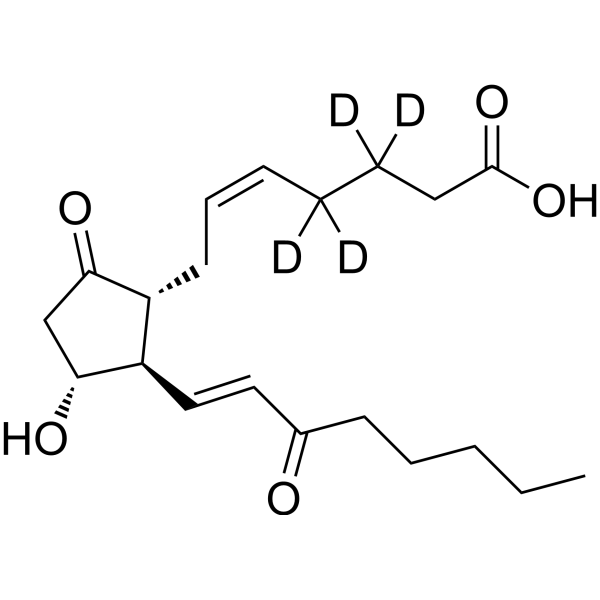 0 ImagesCat. No.: HY-113205S1CAS No.: 2738376-85-5
15-Keto-prostaglandin E2-d4 is the d4 labeled 15-keto-Prostaglandin E2 (HY-113205). 15-keto-Prostaglandin E2 (15-keto-PGE2) is an endogenous PGE2 metabolite. 15-keto-Prostaglandin E2 inhibits STAT3 activation by binding to the Cys259 residue of STAT3. 15-keto-Prostaglandin E2 binds to and stabilizes EP2 and EP4 receptors. 15-keto-Prostaglandin E2 inhibits the growth and progression of breast cancer cells. 15-keto-Prostaglandin E2 activates PPAR-γ and promotes fungal growth. 15-keto-Prostaglandin E2 disrupts glomerular vascularization during zebrafish development and reduces the surface area of the glomerular filtration barrier.
-
AS601245 (Standard)
 0 ImagesCat. No.: HY-11010RCAS No.: 345987-15-7
AS601245 (Standard) is the analytical standard of AS601245 (HY-11010). This product is intended for research and analytical applications. AS601245 is an orally active, selective, ATP competitive JNK (c-Jun NH2-terminal protein Kinase) inhibitor with IC50s of 150, 220, and 70 nM for three JNK human isoforms (hJNK1, hJNK2, and hJNK3), respectively. AS601245 exhibits 10- to 20-fold selectivity over c-src, CDK2, and c-Raf and more than 50- to 100-fold selectivity over a range of Ser/Thr- and Tyr-protein Kinases. Neuroprotective properties.

-
DMU2139 (Standard)
 0 ImagesCat. No.: HY-101285RCAS No.: 1821143-80-9
-
Mps-BAY2b
 0 ImagesCat. No.: HY-120704CAS No.: 1263420-68-3
Mps-BAY2b is a oral active monopolar spindle 1 (MPS1) inhibitor with the IC50 of 14 nM (human MPS1). Mps-BAY2b shows anticancer activity and can be used for study of cancer.
-
AT003
 0 ImagesCat. No.: HY-P991575
AT003 is a humanized monoclonal antibody targeting EpCAM/TROP1/CD326. AT003 can be used for synthesis of ADC.
-
AG-1478 (Standard)
 0 ImagesCat. No.: HY-13524RCAS No.: 153436-53-4Synonyms: Tyrphostin AG-1478 (Standard); NSC 693255 (Standard)
-
Sepantronium bromide (Standard)
 0 ImagesCat. No.: HY-10194RCAS No.: 781661-94-7Synonyms: YM-155 (Standard)
Sepantronium bromide (Standard) is the analytical standard of Sepantronium bromide (HY-10194). This product is intended for research and analytical applications. Sepantronium bromide (YM-155) is a survivin inhibitor with an IC50 of 0.54 nM.
-
(E)-N-(2-Fluorophenyl)cinnamamide
 0 ImagesCat. No.: HY-W1058004CAS No.: 1065481-24-4
-
CRBN ligand-708
 0 ImagesCat. No.: HY-W927727CAS No.: 2925094-42-2
-
Fagaronine chloride
 0 ImagesCat. No.: HY-122532CAS No.: 52259-64-0
Fagaronine chloride is an alkaloid with inhibitory activity against reverse transcriptase and topoisomerase I. Fagaronine chloride can effectively inhibit the reverse transcriptase of RSii tumor virus at a concentration of 6-60 μg/mL. Fagaronine chloride rapidly blocks the synthesis of DNA polymerase by interacting with the template primer. Fagaronine chloride has shown anti-tumor potential, especially in the study of retroviral infection.
-
Cyclobutane-1,3-dicarboxylic acid
 0 ImagesCat. No.: HY-W062484CAS No.: 62184-63-8
-
ST7710AA1
 0 ImagesCat. No.: HY-117423CAS No.: 1542067-20-8
ST7710AA1 (compound 1l) is a potent PARP-1 inhibitor with an IC50 value of 0.07 µM. ST7710AA1 shows an antiproliferative activity. ST7710AA1 shows anticancer activity.
-
Araloside A (Standard)
 0 Images
Araloside A (Standard) (Chikusetsusaponin IV (Standard)), triterpenoid saponins, is an orally active component of Aralia elata. Araloside A (Standard) shows low-renin-inhibitory activity with an IC50 of 77.4 μM. Araloside A (Standard) can inhibit cell proliferation and induce apoptosis. Araloside A (Standard) suppresses inflammatory cytokines IL-1β and IL-6 production. Araloside A (Standard) can be used for the researches of cancer, inflammation and cardiovascular disease, such as renal cell carcinoma and rheumatoid arthritis.
-
Nampt-IN-22
 0 ImagesCat. No.: HY-187336CAS No.: 3087291-80-0
Nampt-IN-22 is a nicotinamide phosphoribosyltransferase (NAMPT) inhibitor. Nampt-IN-22 blocks the NAD+ salvage synthesis pathway by inhibiting nicotinamide phosphoribosyltransferase (NAMPT). Its tertiary alcohol forms hydrogen bonds with His191 of NAMPT and enhances lysosomal stability via intramolecular hydrogen bonds. As an ADC payload, Nampt-IN-22 exhibits low nanomolar cytotoxicity against tumor cells after conjugation to an anti-CD30 antibody, prolongs survival in a disseminated L540 Hodgkin lymphoma mouse model, and suppresses subcutaneous tumor growth. Nampt-IN-22 can be used in studies related to Hodgkin lymphoma.
-
Linifanib (Standard)
 0 ImagesCat. No.: HY-50751RCAS No.: 796967-16-3Synonyms: ABT-869 (Standard); AL-39324 (Standard)
Linifanib (Standard) is the analytical standard of Linifanib. This product is intended for research and analytical applications. Linifanib (ABT-869) is a potent and orally active multi-target inhibitor of VEGFR and PDGFR family with IC50s of 4, 3, 66, and 4 nM for KDR, FLT1, PDGFRβ, and FLT3, respectively. Linifanib shows prominent antitumor activity. Linifanib has much less activity against unrelated RTKs, soluble tyrosine kinases, or serine/threonine kinases. Linifanib is a specific miR-10b inhibitor that blocks miR-10b biogenesis.



