



Cancer Targeted Therapy
Cancer targeted therapy is the foundation of precision medicine; it uses drugs or other substances to target specific genes and proteins that control cancer cells’ growth, division and spreading. Compared to traditional chemotherapy drugs, targeted-drugs can specifically act on cancer cells with high efficacy without damaging normal cells. Drugs used in cancer targeted therapy mainly includes small molecules and macromolecules (e.g., monoclonal antibodies), which can target cancer cells and constituents in the tumor microenvironment to activate the immune system. Anti-angiogenesis drugs, such as those targeting vascular endothelial growth factor (VEGF), epidermal growth factor receptor (EGFR), transforming growth factor (TGF)-α, TGF-β, Tumor necrosis factor (TNF)-α, and platelet-derived endothelial growth factor (PDGFR) inhibit the proliferation and metastasis of cancer cells. In recent years, the proportion of antibody drugs in cancer treatment has gradually become prominent. Antibody-drug conjugates (ADCs) are a new type of targeted drugs that are composed of monoclonal antibody, cytotoxic drug and linker. ADCs can deliver drugs to tumor cells and minimize the toxicity to normal tissues. Proteolysis-targeting chimera (PROTAC) is a useful technology for targeted protein degradation. PROTAC exploits the ubiquitin-proteasome system and forms a ternary complex with a hijacked E3 ubiquitin ligase and target protein, leading to polyubiquitination and degradation of the target protein.
Targeted therapy is a useful strategy in treatment of cancer either alone or in combination with standard chemotherapy. At present, targeted therapy has proved significant clinical success in the treatment of many types of cancer, including breast cancer, colorectal cancer, leukemia, ovarian cancer and lung cancer.
-
PROTAC VEGFR-2 degrader-1
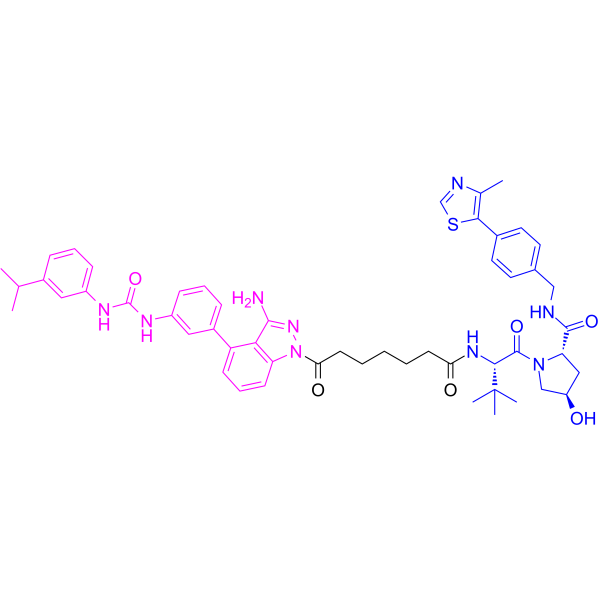 0 ImagesCat. No.: HY-146368CAS No.: 2601594-19-6
-
Multi-target kinase-IN-8
 0 ImagesCat. No.: HY-179098
Multi-target kinase-IN-8 (3d) is an anti-cancer agent. Multi-target kinase-IN-8 exhibits inhibitory activity against various protein kinases (B-Raf V600E (IC50 = 0.078 µg/mL), c-Met (IC50 = 0.405 µg/mL), Pim-1 (IC50 = 1.053 µg/mL), EGFR WT (IC50 = 0.177 µg/mL), VEGFR-2 (IC50 = 0.275 µg/mL)). Multi-target kinase-IN-8 can induce cell cycle arrest and promote early and late apoptosis. Multi-target kinase-IN-8 is commonly used in cancer research.
-
EGFR-IN-62
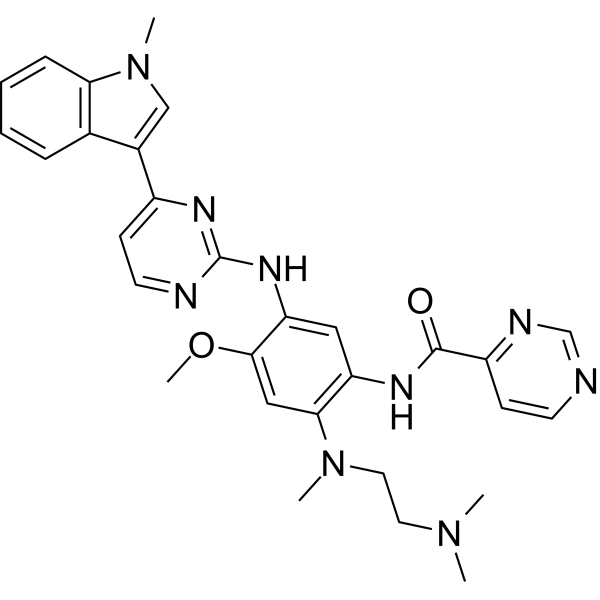 0 ImagesCat. No.: HY-147862CAS No.: 2890261-65-9
EGFR-IN-62 (compound 9h) is a potent and reversible EGFR kinase inhibitor, with IC50 values of 10 nM (L858R/T790 M), 29 nM (WT), and 242 nM (L858R/T790 M/C797S), respectively. EGFR-IN-62 shows antiproliferative activity against A549 and H1975 cell lines, with IC50 values of 2.53 and 1.56 μM, respectively. EGFR-IN-62 induces dose-dependent apoptosis process, G1/G0-phase arrestation, and the inhibition of motility on A549 and/or H1975 cell lines.
-
hsa-miR-3152-3p inhibitor
 0 ImagesCat. No.: HY-RI00600
hsa-miR-3152-3p inhibitors are chemically-modified oligonucleotides that hybridize with mature miRNAs. The miRNA inhibitors have full-length nucleotide 2'-methoxy modification. The miRNA inhibitors strongly compete with mature miRNAs to prevent the complementary pairing of miRNAs and their target genes, thereby inhibiting miRNAs from functioning.
-
hsa-miR-4662b inhibitor
 0 ImagesCat. No.: HY-RI01221
hsa-miR-4662b inhibitors are chemically-modified oligonucleotides that hybridize with mature miRNAs. The miRNA inhibitors have full-length nucleotide 2'-methoxy modification. The miRNA inhibitors strongly compete with mature miRNAs to prevent the complementary pairing of miRNAs and their target genes, thereby inhibiting miRNAs from functioning.
-
ERK5-IN-6
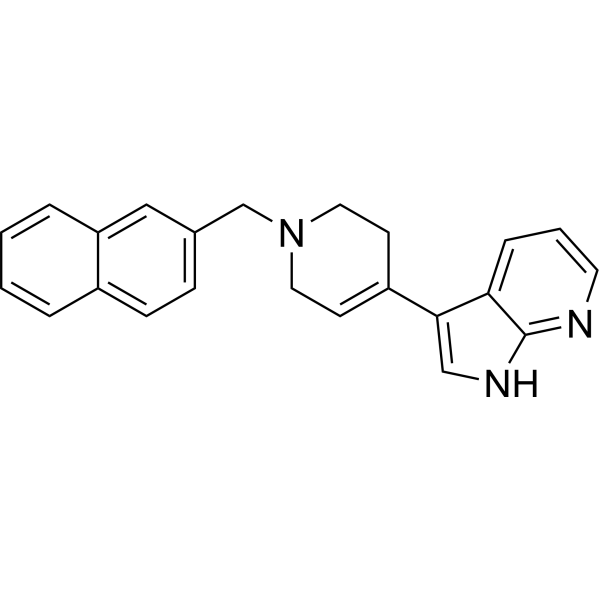 0 ImagesCat. No.: HY-156451CAS No.: 2734916-64-2
ERK5-IN-6 (compound 5J) is an ERK5 kinase inhibitor with anticancer activity. ERK5-IN-6 exhibits good anti-proliferative activity with the IC50 value of 4.56 µg/mL for A549 cells.
-
hsa-miR-653-3p antagomir
 0 ImagesCat. No.: HY-RI01969A
hsa-miR-653-3p antagomirs are chemically-modified oligonucleotides that hybridize with mature miRNAs. The miRNA antagomirs have 2 phosphorothioates at the 5' end, 4 phosphorothioates at the 3' end, 1 cholesterol group at the 3' end, and full-length nucleotide 2'-methoxy modification. The miRNA antagomirs strongly compete with mature miRNAs to prevent the complementary pairing of miRNAs and their target genes, thereby inhibiting miRNAs from functioning. Stability of miRNA antagomirs appears to be significantly higher than miRNA inhibitors, they exhibits enhanced cellular uptake, stability and regulatory activity in vivo.
-
mmu-miR-12178-5p antagomir
 0 ImagesCat. No.: HY-RI02590A
mmu-miR-12178-5p antagomirs are chemically-modified oligonucleotides that hybridize with mature miRNAs. The miRNA antagomirs have 2 phosphorothioates at the 5' end, 4 phosphorothioates at the 3' end, 1 cholesterol group at the 3' end, and full-length nucleotide 2'-methoxy modification. The miRNA antagomirs strongly compete with mature miRNAs to prevent the complementary pairing of miRNAs and their target genes, thereby inhibiting miRNAs from functioning. Stability of miRNA antagomirs appears to be significantly higher than miRNA inhibitors, they exhibits enhanced cellular uptake, stability and regulatory activity in vivo.
-
mmu-miR-471-5p inhibitor
 0 ImagesCat. No.: HY-RI03212
mmu-miR-471-5p inhibitors are chemically-modified oligonucleotides that hybridize with mature miRNAs. The miRNA inhibitors have full-length nucleotide 2'-methoxy modification. The miRNA inhibitors strongly compete with mature miRNAs to prevent the complementary pairing of miRNAs and their target genes, thereby inhibiting miRNAs from functioning.
-
mmu-miR-7047-5p inhibitor
 0 ImagesCat. No.: HY-RI03837
mmu-miR-7047-5p inhibitors are chemically-modified oligonucleotides that hybridize with mature miRNAs. The miRNA inhibitors have full-length nucleotide 2'-methoxy modification. The miRNA inhibitors strongly compete with mature miRNAs to prevent the complementary pairing of miRNAs and their target genes, thereby inhibiting miRNAs from functioning.

-
Phanginin H
 0 ImagesCat. No.: HY-N21627CAS No.: 1011528-65-6
Phanginin H is an Autophagy inducer with an IC50 of 18.13 μM in PANC-1 cells. Phanginin H induces Reactive Oxygen Species accumulation and mitochondrial depolarization, activates AMPK signaling, inhibits mTORC1/ULK signaling and promotes autophagic flux, and simultaneously induces G2/M phase cell cycle arrest, thereby inhibiting PANC-1 cell proliferation, spheroid formation, and migration. Phanginin H can be used in research related to pancreatic ductal adenocarcinoma.

-
PDL-GEX
 0 ImagesCat. No.: HY-P991355
PDL-GEX is a human monoclonal antibody (mAb) targeting B7-H1/PD-L1/CD274. PDL-GEX can be used in cancer research.
-
DMTr-dH2U-amidite
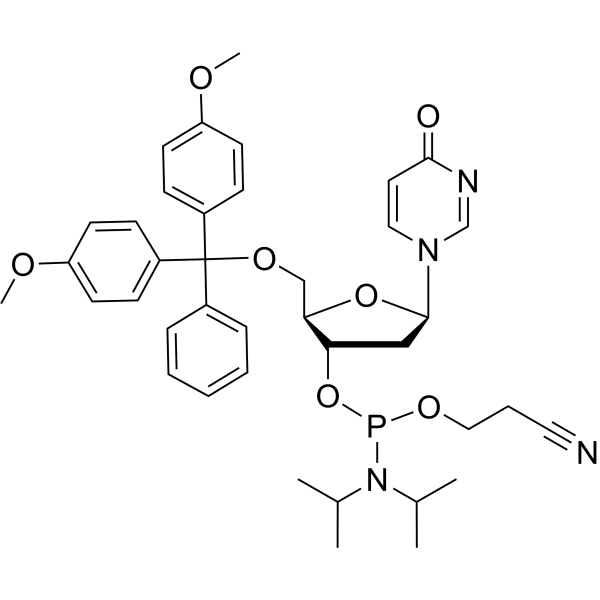 0 ImagesCat. No.: HY-154327CAS No.: 151503-28-5
DMTr-dH2U-amidite is a purine nucleoside analog. Purine nucleoside analogs have broad antitumor activity targeting indolent lymphoid malignancies. Anticancer mechanisms in this process rely on inhibition of DNA synthesis, induction of apoptosis, etc.
-
hsa-miR-5007-3p antagomir
 0 ImagesCat. No.: HY-RI01497A
hsa-miR-5007-3p antagomirs are chemically-modified oligonucleotides that hybridize with mature miRNAs. The miRNA antagomirs have 2 phosphorothioates at the 5' end, 4 phosphorothioates at the 3' end, 1 cholesterol group at the 3' end, and full-length nucleotide 2'-methoxy modification. The miRNA antagomirs strongly compete with mature miRNAs to prevent the complementary pairing of miRNAs and their target genes, thereby inhibiting miRNAs from functioning. Stability of miRNA antagomirs appears to be significantly higher than miRNA inhibitors, they exhibits enhanced cellular uptake, stability and regulatory activity in vivo.
-
SIRT1/2/3-IN-2
 0 ImagesCat. No.: HY-114906CAS No.: 388086-13-3
SIRT1/2/3-IN-2 (compound 9) is a potent SIRT inhibitor, with inhibition rates of 27%, 72%, and 71% targeting SIRT1, SIRT2, and SIRT3, respectively, at 200 μM. SIRT3 is a potential tumor suppressor or promoter, and its increased transcription may be associated with lymph node-positive breast cancer and oral squamous cell carcinoma.
-
hsa-miR-6778-3p inhibitor
 0 ImagesCat. No.: HY-RI02118
hsa-miR-6778-3p inhibitors are chemically-modified oligonucleotides that hybridize with mature miRNAs. The miRNA inhibitors have full-length nucleotide 2'-methoxy modification. The miRNA inhibitors strongly compete with mature miRNAs to prevent the complementary pairing of miRNAs and their target genes, thereby inhibiting miRNAs from functioning.
-
mmu-miR-1927 inhibitor
 0 ImagesCat. No.: HY-RI02739
mmu-miR-1927 inhibitors are chemically-modified oligonucleotides that hybridize with mature miRNAs. The miRNA inhibitors have full-length nucleotide 2'-methoxy modification. The miRNA inhibitors strongly compete with mature miRNAs to prevent the complementary pairing of miRNAs and their target genes, thereby inhibiting miRNAs from functioning.
-
mmu-miR-6354 antagomir
 0 ImagesCat. No.: HY-RI03360A
mmu-miR-6354 antagomirs are chemically-modified oligonucleotides that hybridize with mature miRNAs. The miRNA antagomirs have 2 phosphorothioates at the 5' end, 4 phosphorothioates at the 3' end, 1 cholesterol group at the 3' end, and full-length nucleotide 2'-methoxy modification. The miRNA antagomirs strongly compete with mature miRNAs to prevent the complementary pairing of miRNAs and their target genes, thereby inhibiting miRNAs from functioning. Stability of miRNA antagomirs appears to be significantly higher than miRNA inhibitors, they exhibits enhanced cellular uptake, stability and regulatory activity in vivo.



