



Anaplastic lymphoma kinase (ALK)
Anaplastic lymphoma kinase; ALK tyrosine kinase receptor; CD246; Cluster of differentiation 246
Anaplastic lymphoma kinase (ALK), a receptor tyrosine kinase in the insulin receptor superfamily, is predominantly expressed in the brain and implicated in neuronal development and cognition. ALK catalyzes the transference of a gamma-phosphate group from adenosine triphosphate (ATP) to a tyrosine residue on a substrate protein. Therefore, it catalyzes a tyrosine residue phosphorylation reaction on its substrate proteins. The phosphorylation and dephosphorylation of proteins are critical reactions catalyzed by different enzymes (kinases and phosphatases), which play critical roles in various cellular functions.
ALK gene activation is involved in the carcinogenesis process of several human cancers such as anaplastic large cell lymphoma, lung cancer, inflammatory myofibroblastic tumors and neuroblastoma, as a consequence of fusion with other oncogenes (NPM, EML4, TIM, etc) or gene amplification, mutation or protein overexpression. ALK is a transmembrane tyrosine kinase receptor that, upon ligand binding to its extracellular domain, undergoes dimerization and subsequent autophosphorylation of the intracellular kinase domain. When activated in cancer it represents a target for specific inhibitors, such as Crizotinib, Ceritinib, Alectinib etc. which use has demonstrated significant effectiveness in ALK-positive non-small cell lung cancer particularly.
All Product Categories
-
Anaplastic lymphoma kinase (ALK) Inhibitors
(170)
View all products
-
Anaplastic lymphoma kinase (ALK) Antagonist
(1)
View all products
-
Anaplastic lymphoma kinase (ALK) Activator
(1)
View all products
-
Anaplastic lymphoma kinase (ALK) Modulator
(1)
View all products
-
Anaplastic lymphoma kinase (ALK) Chemical
(1)
View all products
-
Anaplastic lymphoma kinase (ALK) Degraders
(24)
View all products
-
Anaplastic lymphoma kinase (ALK) Ligands
(10)
View all products
-
Anaplastic lymphoma kinase (ALK) Related Products (222)
Related Products (222)

-
Antibodies (4)
-
KRCA-0713
 0 ImagesCat. No.: HY-120663CAS No.: 1884321-89-4KRCA-0713 is an ALK inhibitor with anti-ALK activity. KRCA-0713 showed promising anti-ALK activity in enzyme and cell-based experiments. KRCA-0713 was shown to effectively inhibit ALK-driven tumor growth in H3122 xenograft model studies, similar to the effect of ceritinib.
-
ALK-IN-33
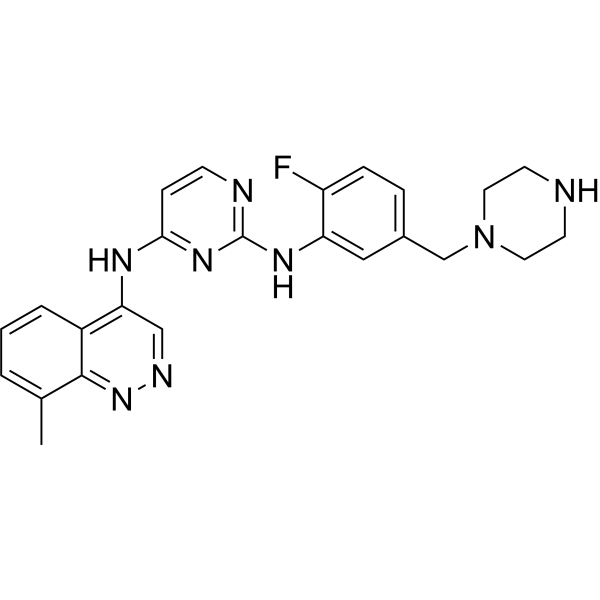
 0 ImagesCat. No.: HY-180818ALK-IN-33 (Compound 8q) is an orally active ALK inhibitor with an IC50 of 1.61 nM. ALK-IN-33 exhibits significant selective killing effect on ALK-positive cancer cells. ALK-IN-33 induces cell cycle arrest and apoptosis, effectively weakening the migration, invasion and long-term survival ability of cancer cells. ALK-IN-33 can be used for research on non-small cell lung cancer
-
WZH-17-002
 0 ImagesCat. No.: HY-174315WZH-17-002 is a CRBN‑recruiting ALK PROTAC degrader. WZH‑17‑002 degrades ALK proteins, including EML4‑ALK and the compound mutants. WZH‑17‑002 inhibits the development of drug resistance in ALK‑fusion non‑small‑cell lung cancer. WZH‑17‑002 can be used for research related to non‑small‑cell lung cancer.
-
WZH-15-125
 0 ImagesCat. No.: HY-174314CAS No.: 2845188-22-7WZH-15-125 is a potent ALK inhibitor. WZH-15-125 can effectively overcome drug resistance, especially compound ALK mutations. WZH-15-125 has an IC50 of 101.7 nM for the highly refractory G1202R/L1196M mutation that is resistant to Lorlatinib (HY-12215). WZH-15-125 can be used as a PROTAC target protein ligand to synthesize PROTAC WZH-17-002 (HY-174315). WZH-15-125 can be used in the research of non-small cell lung cancer.
-
ALK-IN-13
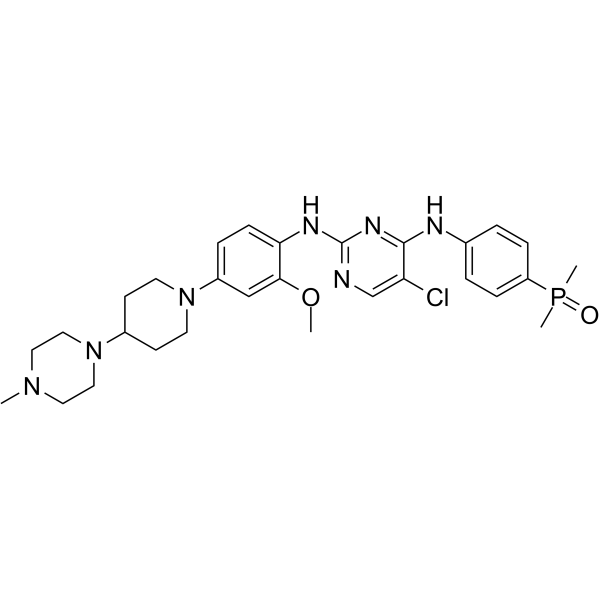 0 ImagesCat. No.: HY-12973CAS No.: 1197953-88-0ALK-IN-13 is an ALK inhibitor, extracted from patent US20130225528A1, example 19.

-
ALK C1156Y Recombinant Human Active Protein Kinase
 0 ImagesCat. No.: HY-E70642Anaplastic lymphoma kinase (ALK) is a receptor tyrosine kinase in the insulin receptor superfamily. ALK can be used for the study of non-small cell lung carcinoma (NSCLC). ALK has multiple mutants. ALK C1156Y Recombinant Human Active Protein Kinase is a recombinant ALK C1156Y protein that can be used to study ALK C1156Y-related functions.
-
F6524-1593
 0 ImagesCat. No.: HY-172958CAS No.: 2034409-47-5F6524-1593 is an ALK inhibitor. F6524-1593 has inhibitory activity against A549 and HepG-2 cells with IC50 values of 161.1 μM and 91.03 μM, respectively. F6524-1593 can be used in the research of ALK-related cancers (such as non-small cell lung cancer, lymphoma and neuroblastoma).
-
KF-20444
 0 ImagesCat. No.: HY-105369CAS No.: 154015-73-3KF-20444 is an orally active ALK inhibitor with blood-brain barrier penetration. KF-20444 exhibits strong inhibitory activity against ALK fusion proteins (EML4-ALK) and ALK resistance mutations (including L1196M, G1202R, and F1174L). KF-20444 effectively suppresses the phosphorylation of ALK in ALK-driven cancer cell lines, thereby inhibiting cancer cell proliferation and inducing apoptosis. KF-20444 demonstrates anti-tumor efficacy in mouse models bearing ALK-positive non-small cell lung cancer (NSCLC) or neuroblastoma. KF-20444 can be used for the study of ALK-driven malignancies.
-
PROTAC ALK degrader-5
 0 ImagesCat. No.: HY-180956CAS No.: 2379672-57-6PROTAC ALK degrader-5 (Compound 17) is an efficient ALK PROTAC degrader, with its inhibitory effects on EML4-ALK and NPM-ALK being 27.4 nM and 116.5 nM respectively. PROTAC ALK degrader-5 exhibits potent anti-proliferative activity against H3122 and Karpas 299. PROTAC ALK degrader-5 effectively inhibits the phosphorylation of ALK and STAT3. PROTAC ALK degrader-5 can be used for the study of ALK-driven malignant tumors, such as human non-small cell lung cancer and anaplastic large cell lymphoma.

-
CDD-1115
 0 ImagesCat. No.: HY-171248CAS No.: 3034215-86-3CDD-1115 is a BMPR2 serine/threonine kinase inhibitor with an IC50 of 1.8 nM against human BMPR2 kinase. CDD-1115 selectively inhibits the catalytic activity of BMPR2, and shows weak inhibitory effects on ALK1 and ALK2.
-
ALK-IN-34
 0 ImagesCat. No.: HY-181113ALK-IN-34 is an Anaplastic Lymphoma Kinase (ALK) inhibitor with an IC50 of 0.26 μM. ALK-IN-34 demonstrates antiproliferative activity against lung cancer cells and gastric adenocarcinoma cells.
-
ALK-IN-21
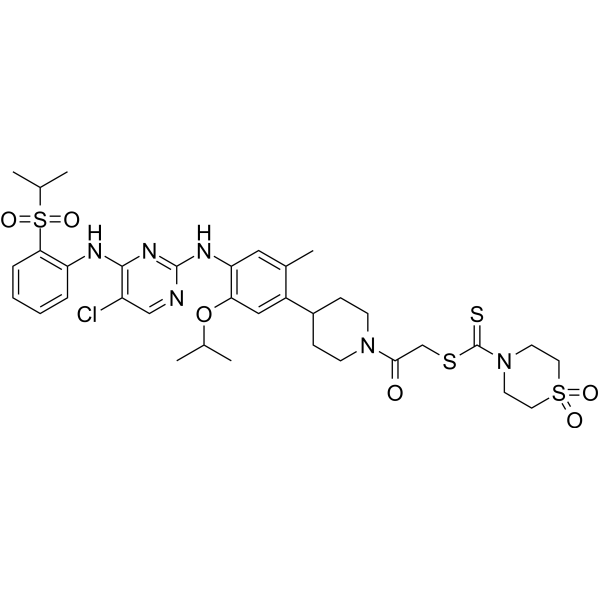 0 ImagesCat. No.: HY-146408CAS No.: 2901889-01-6ALK-IN-21 (Compound B10), a potent ALK inhibitor for ALKG1202R mutation, exhibits remarkable enzymatic inhibitory potency with IC50 values of 4.59 nM, 2.07 nM and 5.95 nM toward ALKWT, ALKL1196M and ALKG1202R, respectively. ALK-IN-21 efficiently inhibits the proliferation of ALK-positive Karpas299 and H2228 cells both with IC50 values of 0.07 μM. ALK-IN-21 can be used for the research of anaplastic large cell lymphoma.
-
TD-004
 0 ImagesCat. No.: HY-180970CAS No.: 2162120-55-8TD-004 is a potent ALK PROTAC degrader. TD-004 exhibits anti-ALK inhibitory activity with an IC50 of 0.11 µM and selectively inhibits the proliferation of SU-DHL-1 and H3122 cells (ALK-positive cancer cells) with IC50s of 0.058 µM and 0.28 µM, respectively. TD-004 induces degradation of ALK fusion proteins (NPM-ALK and EML4-ALK) via recruitment of the VHL E3 ligase and the proteasome pathway. TD-004 demonstrates significant tumor growth inhibition with a favorable safety profile in vivo. TD-004 can be used for the research of anaplastic large cell lymphoma and non-small cell lung cancer.
-
Panulisib
 0 ImagesCat. No.: HY-16769CAS No.: 1356033-60-7Synonyms: P7170; AK151761Panulisib (P7170; AK151761) is an orally active inhibitor of PI3K (IC50 = 2.2 nM) and mTOR (IC50 = 4.4 nM). Panulisib inhibits ALK1 and DNA-PK, two enzymes that respectively participate in angiogenesis and DNA repair, with IC50 values of 47 nM and 1.5 nM respectively. Panulisib inhibits cell proliferation and apoptosis. Panulisib can be used for research on breast cancer and non-small cell lung cancer.
-
PROTAC ALK degrader-4
 0 ImagesCat. No.: HY-179732PROTAC ALK degrader-4 is a ALK PROTAC degrader with a DC50 of 445.25 nM. PROTAC ALK degrader-4 induces concentration- and time-dependent degradation of EML4-ALK, as well as concentration-dependent degradation of ALKF1174L. PROTAC ALK degrader-4 downregulates 390 proteins in NCI-H3122 cells, including the targets of ceritinib (ALK, IGF-1R) and downstream molecules ERK1/2 and STAT3. PROTAC ALK degrader-4 exerts antiproliferative activity in ALK-positive cancer cells. ALK degrader-4 can be used in studies related to lung adenocarcinoma.
-
ALK5-IN-29
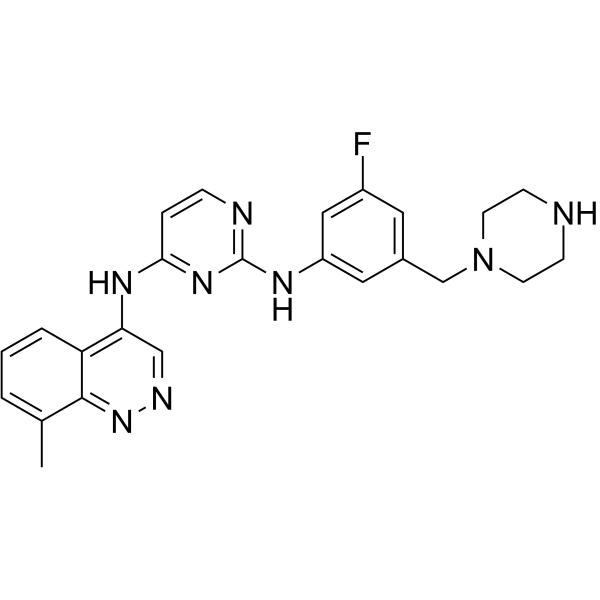 0 ImagesCat. No.: HY-151277CAS No.: 2785430-85-3
-
ALK degrader 3
 0 ImagesCat. No.: HY-182087ALK degrader 3 is a ALK HyT degrader with an IC50 of 1.2 nM. ALK degrader 3 inhibits ALK kinase activity, increases the solvent-accessible surface area of hydrophobic residues near the ALK binding pocket, promotes ALK to form a partially unfolded conformation, and drives ALK degradation via the proteasomal pathway. ALK degrader 3 inhibits the proliferation of tumor cells. ALK degrader 3 can be used for the research of non-small cell lung cancer. (ALK ligand: Brigatinib (HY-12857); hydrophobic tag: Tetraasterane (HY-W1139353)).




