



Anaplastic lymphoma kinase (ALK)
Anaplastic lymphoma kinase; ALK tyrosine kinase receptor; CD246; Cluster of differentiation 246
Anaplastic lymphoma kinase (ALK), a receptor tyrosine kinase in the insulin receptor superfamily, is predominantly expressed in the brain and implicated in neuronal development and cognition. ALK catalyzes the transference of a gamma-phosphate group from adenosine triphosphate (ATP) to a tyrosine residue on a substrate protein. Therefore, it catalyzes a tyrosine residue phosphorylation reaction on its substrate proteins. The phosphorylation and dephosphorylation of proteins are critical reactions catalyzed by different enzymes (kinases and phosphatases), which play critical roles in various cellular functions.
ALK gene activation is involved in the carcinogenesis process of several human cancers such as anaplastic large cell lymphoma, lung cancer, inflammatory myofibroblastic tumors and neuroblastoma, as a consequence of fusion with other oncogenes (NPM, EML4, TIM, etc) or gene amplification, mutation or protein overexpression. ALK is a transmembrane tyrosine kinase receptor that, upon ligand binding to its extracellular domain, undergoes dimerization and subsequent autophosphorylation of the intracellular kinase domain. When activated in cancer it represents a target for specific inhibitors, such as Crizotinib, Ceritinib, Alectinib etc. which use has demonstrated significant effectiveness in ALK-positive non-small cell lung cancer particularly.
All Product Categories
-
Anaplastic lymphoma kinase (ALK) Inhibitors
(170)
View all products
-
Anaplastic lymphoma kinase (ALK) Antagonist
(1)
View all products
-
Anaplastic lymphoma kinase (ALK) Activator
(1)
View all products
-
Anaplastic lymphoma kinase (ALK) Modulator
(1)
View all products
-
Anaplastic lymphoma kinase (ALK) Chemical
(1)
View all products
-
Anaplastic lymphoma kinase (ALK) Degraders
(24)
View all products
-
Anaplastic lymphoma kinase (ALK) Ligands
(10)
View all products
-
Anaplastic lymphoma kinase (ALK) Related Products (222)
Related Products (222)

-
Antibodies (4)
-
ALK-IN-23
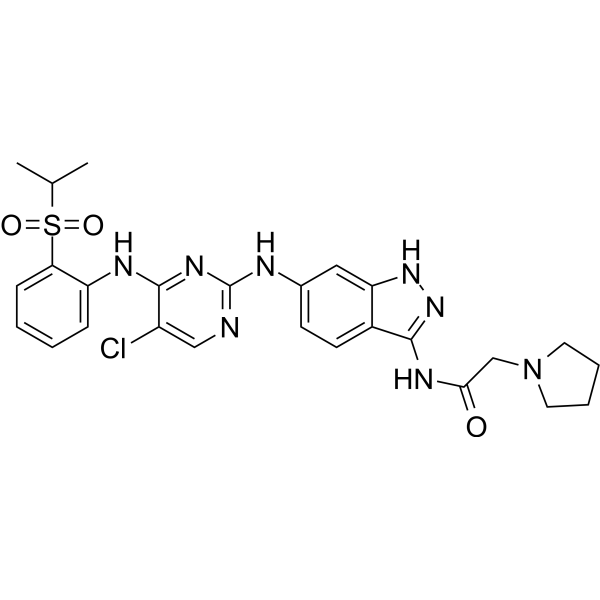 0 ImagesCat. No.: HY-151155CAS No.: 3033549-18-4ALK-IN-23 is a potent ALK inhibitor with IC50 values of 1.6 nM, 0.71 nM and 1.3 nM for ALKWT, ALKL1196M and ALKG1202R. ALK-IN-23 can block cell cycle in G2 phase and induce apoptosis. ALK-IN-23 inhibits cancer cell migration and colony formation in vitro. ALK-IN-23 exhibits antitumor activity in H2228 xenograft nude mice model with hypotoxicity.
-
SIAIS117
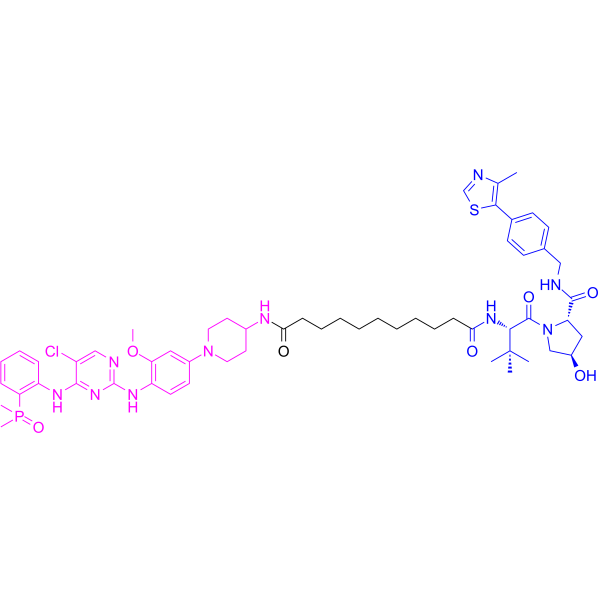 0 ImagesCat. No.: HY-146022CAS No.: 2353494-84-3SIAIS117 is an ALK PROTAC degrader constructed based on Brigatinib (HY-12857) and VHL-1. SIAIS117 exhibits activity not only against wild-type ALK fusion proteins, but also effectively degrades the highly drug-resistant ALK G1202R mutant fusion protein. SIAIS117 significantly inhibits the proliferation of non-small cell lung cancer, small cell lung cancer, anaplastic large cell lymphoma, and drug-resistant cells expressing EML4-ALK G1202R. SIAIS117 can be used in relevant research on the above-mentioned malignant tumors.
-
ALK5-IN-84
 0 ImagesCat. No.: HY-159952ALK5-IN-84 (Compound 23) is an ALK5 inhibitor with a pKi value of 9.35 against hALK5. When administered via inhalation, ALK5-IN-84 exhibits significant ALK5 inhibitory activity. ALK5-IN-84 is promising for the development of inhaled ALK5 inhibitors.
-
CDX-0125-TEI Antibody
 0 ImagesCat. No.: HY-P991862CDX-0125-TEI Antibody is an anti-human ALK antibody. AMG-224 Antibody can generate antibody drug conjugate (ADC) (CDX-0125-TEI) with thienoindole (TEI) DNA minor groove alkylating agent. CDX-0125-TEI Antibody can be used for the study of neuroblastoma.
-
ALK F1174L Recombinant Human Active Protein Kinase
 0 ImagesCat. No.: HY-E70643Anaplastic lymphoma kinase (ALK) is a receptor tyrosine kinase in the insulin receptor superfamily. ALK has multiple mutants. ALK-F1174L is commonly found in neuroblastoma (NB). ALK-F1174L Recombinant Human Active Protein Kinase is a recombinant ALK-F1174L protein that can be used to study ALK-F1174L-related functions.
-
SMU-B
 0 ImagesCat. No.: HY-120387CAS No.: 1253286-90-6
-
Con B-1
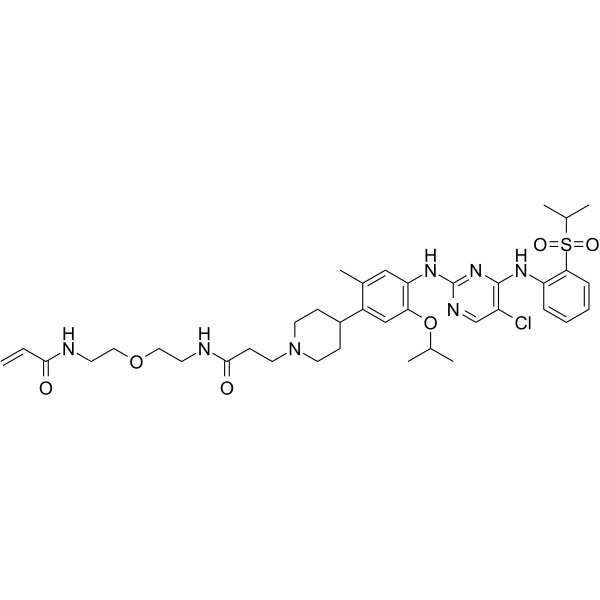 0 ImagesCat. No.: HY-142287CAS No.: 2415537-51-6ConB-1 is a potent and selective ALK inhibitor with low toxicity to normal cells.
-
ALK/HDAC-IN-2
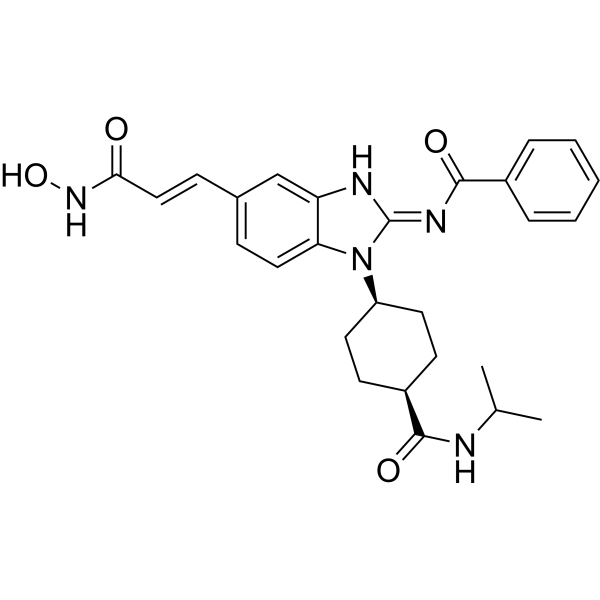
 0 ImagesCat. No.: HY-180811ALK/HDAC-IN-2 (Compound 19b) is an ALK/HDAC inhibitor with IC₅₀ values for ALK WT and total HDACs of 8 nM and 1.18 μM, respectively. ALK/HDAC-IN-2 exhibits inhibitory activity against ALK mutants G1202R, F1174L, and L1196M, with IC₅₀ values of 2.74, 9.23, and 34.28 nM, respectively. ALK/HDAC-IN-2 shows potent and selective inhibition against HDAC1 (IC₅₀ = 0.24 μM), while its inhibitory activity against HDAC7, HDAC6, and HDAC11 is weak (IC₅₀ > 10 μM). ALK/HDAC-IN-2 has broad-spectrum anti-proliferative activity against various cancer cells, inducing cell cycle arrest and apoptosis. ALK/HDAC-IN-2 can be used for the study of neuroblastoma.
-
(E)-Belizatinib
 0 ImagesCat. No.: HY-17603ACAS No.: 1388225-72-6Synonyms: (E)-TSR-011(E)-Belizatinib ((E)-TSR-011)) (compound 36), the (E)-isomer of Belizatinib (HY-17603), is a potent, selective and orally active anaplastic lymphoma kinase (ALK) Inhibitor with an enzymatic IC50 of 0.005 μM and a cellular IC50 of 0.048 μM. (E)-Belizatinib shows >61-fold selectivity over JAK2, SRC, and IGF1R. (E)-Belizatinib shows favorable potency and PK characteristics in rats and dogs. (E)-Belizatinib can be used for ALK-driven cancer research.
-
ALK degrader 2
 0 ImagesCat. No.: HY-175527ALK degrader 2 is an orally active ALK HyT degrader that degrades EML4-ALK levels (DC50 = 8 nM) and nucleophosmin (NPM)-ALK protein levels (DC50 = 102 nM). ALK degrader 2 mediates ALK degradation via the Hsp70 chaperone system and ubiquitin-proteasome pathway. ALK degrader 2 induces significant S-phase cell cycle arrest and apoptosis in H3122 cells. ALK degrader 2 shows anti-tumor activity in mice bearing H3122 xenografts. ALK degrader 2 can be used for the study of non-small cell lung cancer (NSCLC). (Pink: ALK ligand (HY-W754809), Blue: Hyt (HY-W013021), Black: Linker (HY-Y1760), ALK ligand-linker conjugate (HY-175528)).

-
ALK F1174S Recombinant Human Active Protein Kinase
 0 ImagesCat. No.: HY-E70644Anaplastic lymphoma kinase (ALK) is a receptor tyrosine kinase in the insulin receptor superfamily. ALK can be used for the study of non-small cell lung carcinoma (NSCLC). ALK has multiple mutants. ALK F1174S Recombinant Human Active Protein Kinase is a recombinant ALK F1174S protein that can be used to study ALK F1174S-related functions.
-
PROTAC ALK degrader-2
 0 ImagesCat. No.: HY-161750PROTAC ALK degrader-2 (B1-PEG) is an ALK degrader based on PROTACs, with the DC50 of 45 nM in H3122 EML4-ALK DC50 (GSH+). PROTAC ALK degrader-2, through PEGylation, is engineered to self-organize into micelles in water and releases its active form in response to the tumor-specific high GSH environment.
-
ALK degrader 1
 0 ImagesCat. No.: HY-175849ALK degrader 1 is a potent, hydrophobic tag (HyT)-based degrader that induces ubiquitin-proteasome system (UPS)-dependent EML4-ALK degradation (DC50 = 0.13 μM). ALK degrader 1 demonstrates potent ALK degradation and antiproliferative effects in ALK-dependent cell lines, while showing minimal cytotoxicity in ALK fusion-negative cells. ALK degrader 1 triggers cell cycle arrest at the G0/G1 phase and stimulates apoptosis. ALK degrader 1 not only facilitates efficient degradation of the ALK protein but also disrupts key downstream effectors, including the STAT3 signaling axis. ALK degrader 1 mediates robust EML4-ALK degradation in vivo. ALK degrader 1 can be used for ALK-related diseases research.
-
Aurora kinase/ALK-IN-1
 0 ImagesCat. No.: HY-183767Aurora kinase/ALK-IN-1 is a dual Aurora A kinase and ALK inhibitor with IC50 values of 0.296 μM and 0.332 μM, respectively. Aurora kinase/ALK-IN-1 induces G2/M cell cycle arrest, triggers mitochondrial apoptosis, elevates intracellular reactive oxygen species (ROS) levels, and inhibits ALDH1 activity. Aurora kinase/ALK-IN-1 demonstrates cytotoxicity and tumor selectivity. Aurora kinase/ALK-IN-1 can be used for the research of anaplastic large cell lymphoma.
-
NPM1 ALK F1174L Recombinant Human Active Protein Kinase
 0 ImagesCat. No.: HY-E70761The NPM1-ALK protein contains the NPM1 oligomerization motif and the ALK catalytic domain, is constitutively activated through autophosphorylation, and mediates malignant cell transformation by activating downstream effectors including STAT3. NPM1 ALK F1174L Recombinant Human Active Protein Kinase is a recombinant NPM1 ALK F1174L protein that can be used to study NPM1 ALK F1174L-related functions.

-
ALK5-IN-79
 0 ImagesCat. No.: HY-163507CAS No.: 2725056-38-0ALK5-IN-79 (compound 57) is an ALK inhibitor with anticancer activity, by blocking TGF-β1/SMAD signaling pathway. ALK5-IN-79 attenuates the production of extracellular matrix (ECM) and deposition of collagen. ALK5-IN-79 exhibits adequate pharmacokinetic (PK) properties and good in vivo tolerance.
-
2-Keto Crizotinib
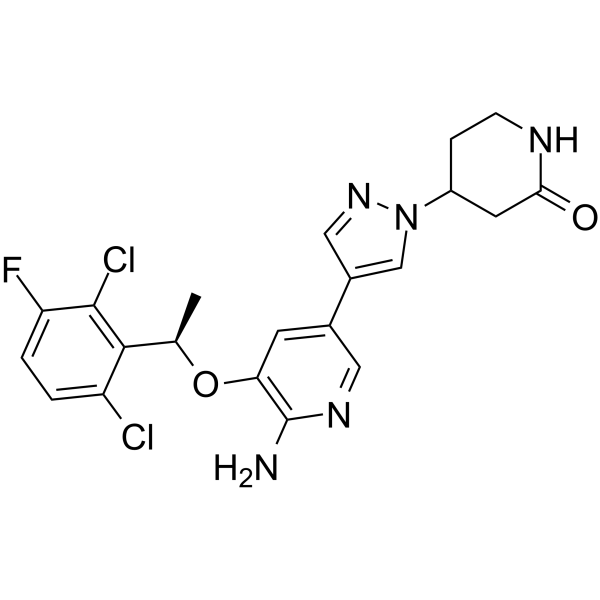 0 ImagesCat. No.: HY-13320CAS No.: 1415558-82-5Synonyms: PF-062601822-Keto Crizotinib (PF-06260182) is an active lactam metabolite of crizotinib.




