



Eukaryotic Initiation Factor (eIF)
Eukaryotic initiation factors (eIFs) are proteins involved in the initiation phase of eukaryotic translation. These proteins help stabilize the formation of the functional ribosome around the start codon and also provide regulatory mechanisms in translation initiation.
Eukaryotic initiation factor 2B (eIF2B) is a guanine nucleotide-exchange factor which mediates the exchange of GDP (bound to initiation factor eIF2) for GTP, thus regenerating the active [eIF2.GTP] complex that is required for peptide-chain initiation. The activity of eIF2B is a key control point for eukaryotic protein synthesis and is altered in response to viral infection, hormones, nutrients, growth factors and certain stresses.
Eukaryotic translation initiation factor 4E (eIF4E) is best known for its function in the initiation of protein synthesis on capped mRNAs in the cytoplasm. Eukaryotic initiation factor (elF) 4A functions as a subunit of the initiation factor complex elF4F, which mediates the binding of mRNA to the ribosome.
All Product Categories
-
Eukaryotic Initiation Factor (eIF) Inhibitors
(78)
View all products
-
Eukaryotic Initiation Factor (eIF) Antagonist
(1)
View all products
-
Eukaryotic Initiation Factor (eIF) Activators
(34)
View all products
-
Eukaryotic Initiation Factor (eIF) Modulators
(13)
View all products
-
Eukaryotic Initiation Factor (eIF) Chemicals
(3)
View all products
-
Eukaryotic Initiation Factor (eIF) Degraders
(2)
View all products
-
Eukaryotic Initiation Factor (eIF) Control
(1)
View all products
-
Eukaryotic Initiation Factor (eIF) Ligands
(3)
View all products
-
Eukaryotic Initiation Factor (eIF) Related Products (145)
Related Products (145)

-
Antibodies (15)
-
eIF4A3-IN-6
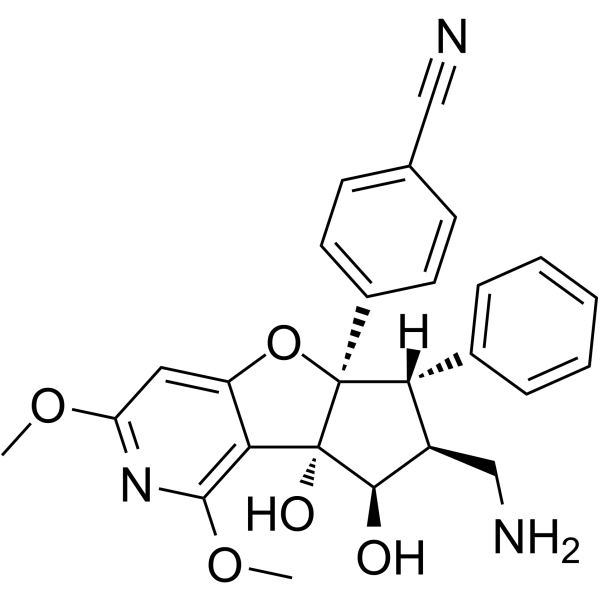 0 ImagesCat. No.: HY-145360CAS No.: 2100133-77-3eIF4A3-IN-6 is a potent inhibitor of eukaryotic initiation factor 4A (eIF4A), such as eIF4AI and eIF4AII. eIF4A3-IN-6 has the potential for the research of eIF4A dependent diseases, including the research of cancer (extracted from patent US20170145026A1).

-
ISR activator-5
 0 ImagesCat. No.: HY-183704ISR activator-5 is an eIF2B modulator and integrated stress response (ISR) activator. ISR activator-5 stabilises the inactive I-state of eIF2B, inhibits protein synthesis, and activates canonical ISR pathways without inducing eIF2α phosphorylation. ISR activator-5 can be used for the research of cancer, neurologic and metabolic disorders.
-
AMG-34
 0 ImagesCat. No.: HY-175880CAS No.: 1644664-11-8AMG-34 is a GCN2-targeting agent with IC50 values of 0.395 μM, 0.010 μM, 1.07 μM and > 10 μM for GCN2, PERK, HRland PKR, respectively.
-
ISRACT-01
 0 ImagesCat. No.: HY-186309ISRACT-01 is an integrated stress response (ISR) activator. ISRACT-01 has a Kd of 557 nM for eIF2BΔ-latch. ISRACT-01 cooperates with eIF2-P to inhibit guanine nucleotide exchange factor (GEF) activity by specifically binding to and stabilizing the inactive conformation (I-state) of eIF2B. ISRACT-01 can be used in studies related to amyotrophic lateral sclerosis.
-
Briciclib sodium
 0 ImagesCat. No.: HY-16366ACAS No.: 865784-01-6Synonyms: ON 014185 sodiumBriciclib (ON 014185) sodium is a eukaryotic translation initiation factor 4E (eIF4E) inhibitor. Briciclib sodium exhibits broad-spectrum anti-cancer activity, including in mantle cell leukemia, breast cancer, gastric cancer, and esophageal cancer cells. Briciclib sodium reduces the expression of cyclin D1 and c-Myc, and enhances the expression of P53 and Cleaved Caspase 3 pro-apoptotic proteins. Briciclib sodium can be used for the study of hematological system tumors and solid tumors.
-
MNK/PIM-IN-2
 0 ImagesCat. No.: HY-182957CAS No.: 3081482-46-1MNK/PIM-IN-2 is a Mnk/Pim kinase inhibitor with an IC50 of 32 nM for Mnk1, 3 nM for Mnk2, and 37 nM for Pim1. MNK/PIM-IN-2 reduces the levels of p-eIF4E and p-4EBP1. MNK/PIM-IN-2 induces cell cycle arrest, apoptosis (apoptosis) and exerts antiproliferative effects in leukemia cells. MNK/PIM-IN-2 can be used in studies related to leukemia.
-
MNK1/2-IN-7
 0 ImagesCat. No.: HY-163479CAS No.: 2548283-27-6MNK1/2-IN-7 (compound 20j) is an orally available inhibitor of MNK1/2 with anticancer activity and hERG safety. MNK1/2-IN-7 also inhibits the phosphorylation of eIF4E, inhibiting the MNK/eIF4E signaling pathway and cancer cell proliferation. MNK1/2-IN-7 is synergistic with Ibrutinib (HY-109970).
-
NUCC-0231068
 0 ImagesCat. No.: HY-184004NUCC-0231068 is a MNK1 and MNK2 inhibitor with IC50 values of 8 nM and 7 nM, respectively. NUCC-0231068 inhibits the phosphorylation of eukaryotic translation initiation factor 4E (eIF4E) at Ser209, with an IC50 of 23 nM in its purified form and 17 nM in its D2B form. NUCC-0231068 can be used in studies related to glioblastoma.
-
L-Azetidine-2-carboxylic acid (Standard)
 0 ImagesL-Azetidine-2-carboxylic acid is a proline analog. L-Azetidine-2-carboxylic acid upregulates the lipid autophagy marker LC3-II via activation of the PERK pathway. L-Azetidine-2-carboxylic acid increases pro-apoptotic BAX protein. L-Azetidine-2-carboxylic acid induces ATF6 cleavage and upregulates phosphorylated eIF2α levels. L-Azetidine-2-carboxylic acid induces ER stress, inducing protein misfolding and aggregation. L-Azetidine-2-carboxylic acid shows teratogenic, pro-inflammatory and pro-apoptotic effects.
-
GCN2iB (Standard)
 0 ImagesCat. No.: HY-112654RCAS No.: 2183470-12-2GCN2iB (Standard) is the analytical standard of GCN2iB (HY-112654). This product is intended for research and analytical applications. GCN2iB is an ATP-competitive, selective GCN2 inhibitor with an IC50 of 2.4 nM. GCN2iB inhibits the activation of the GCN2 pathway and upregulates GPX4. GCN2iB enhances the anticancer effect of ASNase against acute lymphoblastic leukemia. GCN2iB increases left ventricular ejection fraction, while reducing fasting blood glucose and myocardial fibrosis. GCN2iB can be used in research related to acute lymphoblastic leukemia, acute myeloid leukemia and diabetic cardiomyopathy.
-
ML291 (Standard)
 0 ImagesCat. No.: HY-101991RCAS No.: 1523437-16-2ML291 (Standard) is the analytical standard of ML291 (HY-101991). This product is intended for research and analytical applications. ML291 is a UPR (unfolded protein response)-inducing sulfonamidebenzamide. ML291 overwhelms the adaptive capacity of the UPR and induces apoptosis in a variety of solid cancer models. ML291 can activate the PERK/eIF2a/CHOP (apoptotic) arm of the UPR and reduce leukemic cell burden.
-
Lard oil
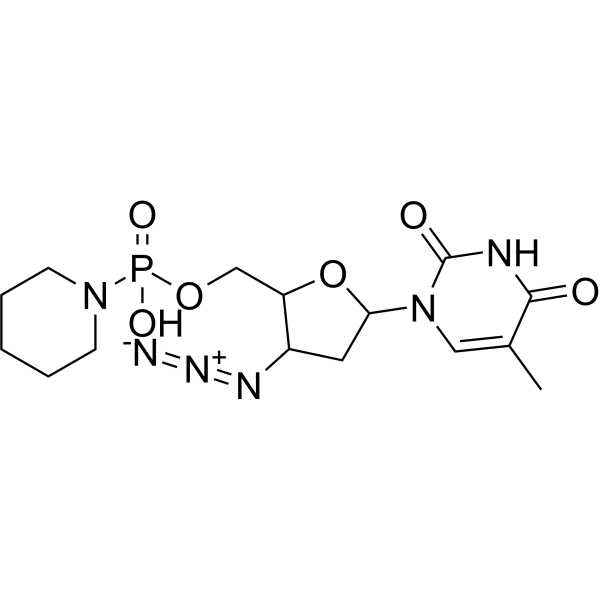 0 ImagesCat. No.: HY-W127601CAS No.: 8016-28-2Lard oil is an orally active biochemical reagent. Lard oil upregulates PERK, eIF2a, CHOP, OPN, TLR2, TLR4, TNF-α, and downregulates GRP78 and IRE1a. Lard oil induces responses such as body fat accumulation, elevated serum insulin levels, increased HOMA-IR, hepatic ectopic lipid deposition, hepatic endoplasmic reticulum stress, and hepatic inflammation. Lard oil can be used in studies related to diet-induced obesity, insulin resistance, and non-alcoholic fatty liver disease.
-
SBI-5844
 0 ImagesCat. No.: HY-182704CAS No.: 832680-32-7Synonyms: SBI-1275844SBI-5844 (SBI-1275844) is a eIF4F complex inhibitor and antiviral agent. SBI-5844 disrupts the assembly of the eIF4F complex and blocks the interaction between eIF4E and eIF4G. SBI-5844 inhibits the synthesis of HCoV-OC43 nucleocapsid protein and reduces the levels of HCoV-OC43 RNA and total protein. SBI-5844 can be used in studies related to human coronavirus OC43 (HCoV-OC43) infection.
-
eIF4A3-IN-2 (Standard)
 0 ImagesCat. No.: HY-101785RCAS No.: 2095677-20-4eIF4A3-IN-2 (Standard) is the analytical standard of eIF4A3-IN-2 (HY-101785). This product is intended for research and analytical applications. eIF4A3-IN-2 is a highly selective and noncompetitive eukaryotic initiation factor 4A-3 (eIF4A3) inhibitor with an IC50 of 110 nM.
-
eIF4A3-IN-1 (Standard)
 0 ImagesCat. No.: HY-101513RCAS No.: 2095486-67-0eIF4A3-IN-1 (Standard) is the analytical standard of eIF4A3-IN-1 (HY-101513). This product is intended for research and analytical applications. eIF4A3-IN-1 is a selective eIF4A3 inhibitor (IC50: 0.26 μM; Kd: 0.043 μM) with cellular nonsense-mediated RNA decay (NMD) inhibitory activity. eIF4A3-IN-1 can specifically bind to the non-ATP binding site of eIF4A3. eIF4A3-IN-1 has anti-tumor and analgesic activities.
-
GCN2-IN-8
 0 ImagesCat. No.: HY-208758ACAS No.: 1627177-37-0(S)-GCN2-IN-8 is a general control nonderepressible 2 (GCN2, EIF2AK4) inhibitor. (S)-GCN2-IN-8 inhibits signal transduction by the stress response kinase GCN2. (S)-GCN2-IN-8 can be used for the research of cancer.
-
MG-002
 0 ImagesCat. No.: HY-173172CAS No.: 3076503-34-6MG-002 is an orally active eIF4A1 and eIF4A2 inhibitor with a human eIF4A1 IC50 of 43 nM. MG-002 prevents competent ribosome recruitment to mRNA, inhibits cap-dependent mRNA translation, and engages eIF4A2 via the same RNA clamping mechanism to inhibit mRNA translation. MG-002 induces G2/M cell cycle delay, induces apoptosis, suppresses synthesis of c-MYC and cyclin D1, and shows minimal overt toxicity in mice. MG-002 inhibits primary triple-negative breast cancer tumor growth, attenuates metastatic spread, and enhances anti-neoplastic activity of Doxorubicin (HY-15142A) in pre-clinical models.
-
3-AP-Me
 0 ImagesCat. No.: HY-138844CAS No.: 1184391-57-83-AP-Me is a dimethyl derivative of the nucleotide reductase inhibitor 3-AP (SML0568). 3-AP-Me can activate the endoplasmic reticulum (ER) stress pathway by promoting the phosphorylation of eIF2α and increasing the gene expression of transcription factors ATF4 and ATF6, leading to cell apoptosis. Additionally, 3-AP-Me can activate the stress kinases c-Jun N-terminal kinase (JNK) and p38 mitogen-activated protein kinases. 3-AP-Me also leads to the upregulation of the spliced mRNA variant XBP1, can be used in cancer research.
-
ATPγS tetralithium salt (Standard)
 0 ImagesCat. No.: HY-108666RCAS No.: 93839-89-5Synonyms: Adenosine-5'-O-(3-thiotriphosphate) tetralithium salt (Standard); Adenosine 5'-[γ-thio]triphosphate tetralithium salt (Standard)ATPγS tetralithium salt (Standard) is the analytical standard of ATPγS (tetralithium salt) (HY-108666). This product is intended for research and analytical applications. ATPγS (tetralithium salt) is a P2Y11 receptor agonist, an antioxidant and a neuroprotective agent. ATPγS (tetralithium salt) can be used as a substrate for the nucleotide hydrolysis and RNA unwinding activities of eukaryotic translation initiation factor eIF4A. ATPγS (tetralithium salt) is active in ATP hydrolysis.




