



JAK
Janus kinase
Janus kinase (JAK) is a family of intracellular, nonreceptor tyrosine kinases that transduce cytokine-mediated signals via the JAK-STAT pathway. Since members of the type I and type II cytokine receptor families possess no catalytic kinase activity, they rely on the JAK family of tyrosine kinases to phosphorylate and activate downstream proteins involved in their signal transduction pathways. The receptors exist as paired polypeptides, thus exhibiting two intracellular signal-transducing domains. JAKs associate with a proline-rich region in each intracellular domain, which is adjacent to the cell membrane and called a box1/box2 region. After the receptor associates with its respective cytokine/ligand, it goes through a conformational change, bringing the two JAKs close enough to phosphorylate each other. The JAK autophosphorylation induces a conformational change within itself, enabling it to transduce the intracellular signal by further phosphorylating and activating transcription factors called STATs. The activated STATs dissociate from the receptor and form dimers before translocating to the cell nucleus, where they regulate transcription of selected genes.
JAK Isoform Specific Products
All Product Categories
-
JAK Inhibitors
(553)
View all products
-
JAK Agonists
(2)
View all products
-
JAK Antagonists
(4)
View all products
-
JAK Activators
(26)
View all products
-
JAK Modulators
(8)
View all products
-
JAK Degraders
(14)
View all products
-
JAK Control
(1)
View all products
-
JAK Substrate
(1)
View all products
-
JAK Ligands
(5)
View all products
-
Janus Kinase 1 (JAK1) Proteins
(4)
View all products
-
JAK Related Products (648)
Related Products (648)

-
Recombinant Proteins (4)
-
Antibodies (7)
-
JAK Isoform Comparison
-
JAK1-IN-22
 0 ImagesCat. No.: HY-187103CAS No.: 2241039-80-3JAK1-IN-22 is a JAK1-selective inhibitor with an IC50 of 1.84 μM. JAK1-IN-22 exerts no significant inhibitory effect on JAK2 and JAK3. JAK1-IN-22 can be used in the research of JAK1-related diseases such as asthma, alopecia areata, and type 1 diabetes.
-
CS12192
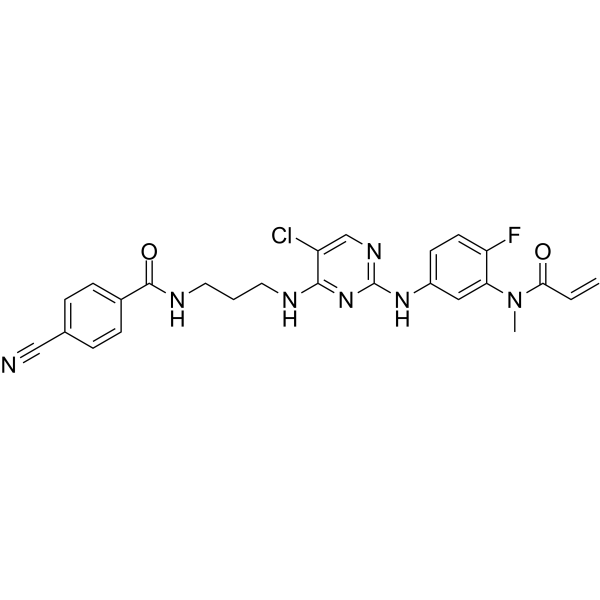 0 ImagesCat. No.: HY-145995CAS No.: 1888318-68-0CS12192 is a compound improving survival and weight gain. CS12192 has the potential for the research of graft-versus-host disease (GVHD) (extracted from the patent CN112773802A).
-
JAK2-IN-15
 0 ImagesCat. No.: HY-178936CAS No.: 3094174-82-7JAK2-IN-15 is an orally active, potent, selective JAK2 inhibitor (IC50 = 1.17 nM). JAK2-IN-15 can inhibit the AK2-STAT signaling pathway. JAK2-IN-15 significantly improves key pathological indicators such as hematocrit and splenomegaly in an Epoetin beta (HY-114134) (rhEPO)-induced mouse model. JAK2-IN-15 can be used for the study of Polycythemia Vera (PV).
-
EC-70124
 0 ImagesCat. No.: HY-124067CAS No.: 1185908-92-2EC-70124 is an orally active multikinase inhibitor targeting IKKβ and JAK2. EC-70124 blocks IkB phosphorylation and STAT3 (Tyr705) activation, suppressing NF-κB nuclear translocation and STAT3 transcriptional activity. EC-70124 reduces tumor growth and cancer stem cell (CSC) populations in prostate cancer cells and xenograft models. EC-70124 is promising for research of prostate cancer.
-
JAK-IN-30
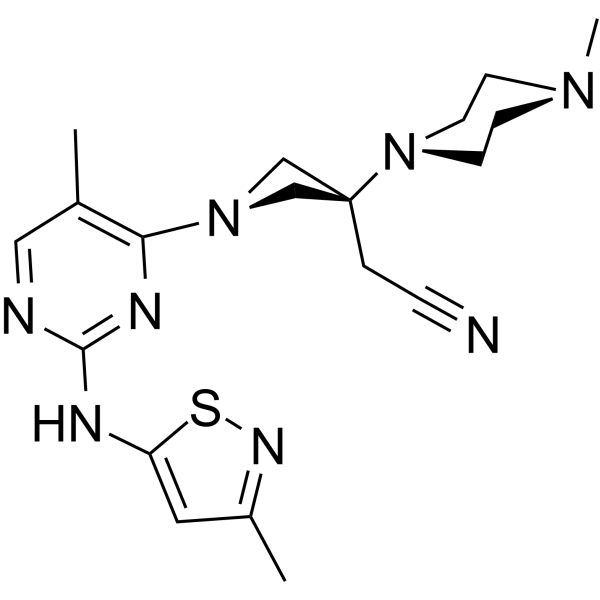 0 ImagesCat. No.: HY-154994CAS No.: 2891469-99-9
-
JAK1/STAT3-IN-1
 0 ImagesCat. No.: HY-170977JAK1/STAT3-IN-1 (compound 4f) is an anti-AD (atopic dermatitis) agent by inhibiting JAK1/STAT3 signaling pathway. JAK1/STAT3-IN-1 inhibits NO generation with an IC50 of 2.17 μM. JAK1/STAT3-IN-1 improves the skin condition of AD-like mice, reduces inflammatory infiltration, inhibits the expressions of p-JAK1/JAK1 and p-STAT3/STAT3, and mitigates the excessive immune response on Calcipotriol (HY-10001) (MC903)-induced AD-like mice.
-
FAK-IN-22
 0 ImagesCat. No.: HY-168718CAS No.: 2703920-02-7FAK-IN-22 (Compound 26) is an inhibitor of FAK, JAK3, and Aurora B, with IC50 values of 50.94 nM, 9.99 nM, and 0.49 nM, respectively, effectively inhibiting tumor occurrence and metastasis in pancreatic ductal adenocarcinoma (PDAC). FAK-IN-22 effectively inhibits the proliferation of PANC-1 cells, with an IC50 value of 0.15 μM. FAK-IN-22 induces apoptosis and G2/M phase arrest in PANC-1 cells by inhibiting the FAK/PI3K/Akt signaling pathway.
-
JAK-IN-40
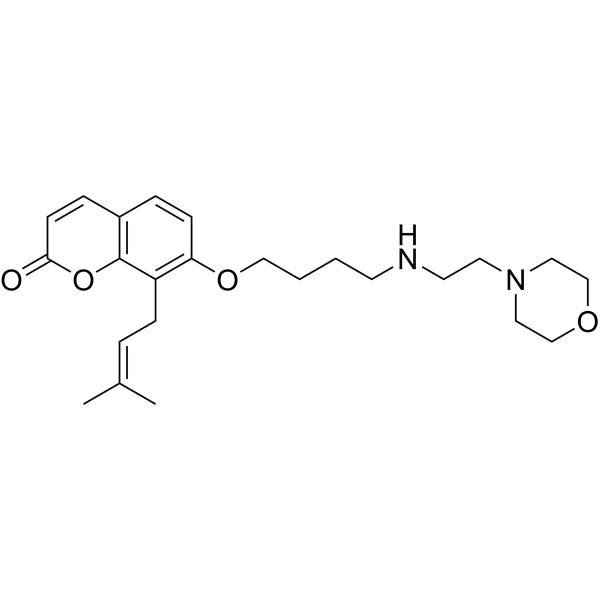
 0 ImagesCat. No.: HY-170927JAK-IN-40 (Compound 46) is the inhibitor for JAK that inhibits JAK1, JAK2 and JAK3 with IC50s of 0.022, 0.759 and 1.601 μM, respectively. JAK-IN-40 inhibits the phosphorylation of STAT3. JAK-IN-40 inhibits the proliferation of cancer cell Ba/F3 and JAK1-TEL Ba/F3 with GI50 of 0.614 μM and 0.193 μM. JAK-IN-40 arrests cell cycle of H1975 and H2087 at G2/M phase, induces apoptosis. JAK-IN-40 exhibits a synergistic antitumor effect with Osimertinib (HY-15772).

-
BRD4-IN-41
 0 ImagesCat. No.: HY-115541CAS No.: 1877286-69-5BRD4-IN-41 is a BRD4 inhibitor with an IC50 of 34 nM. BRD4-IN-41 also inhibits JAK2, FLT3, RET, ROS1, NTRK3, PDGFRb, and FGFR1 kinases with IC50 values ranging from 0.9 nM to 43 nM. BRD4-IN-41 inhibits acetyl-lysine binding site of BRD4, downregulates c-MYC, reduces phosphorylated STAT3 levels, induces G1 cell cycle arrest and apoptosis, thereby inhibiting cancer cells growth. BRD4-IN-41 can be used for the research of cancer, such as multiple myeloma and acute myeloid leukemia.
-
JAK1/CDK7-IN-1
 0 ImagesCat. No.: HY-181528JAK1/CDK7-IN-1 is a JAK1/CDK7 inhibitor. JAK1/CDK7-IN-1 forms a stable and tightly bound complex with JAK1. JAK1/CDK7-IN-1 disrupts the cell cycle, induces G2/M phase arrest, and increases the proportion of pre-G1 phase cells. JAK1/CDK7-IN-1 induces cellular apoptosis (apoptosis) and necrosis. JAK1/CDK7-IN-1 is applicable to research related to breast cancer and prostate cancer.
-
TYK2 ligand 1
 0 ImagesCat. No.: HY-158340CAS No.: 2770471-05-9
-
JAK1-IN-20
 0 ImagesCat. No.: HY-181872CAS No.: 3106963-85-0JAK1-IN-20 (Compound 38) is a gut-restricted, orally active, selective JAK1 inhibitor with an IC50 of <0.5 nM. JAK1-IN-20 inhibits the enzymatic activity of JAK1, reduces the production of proinflammatory cytokines (TNF-α, IL-6), and suppresses the phosphorylation of STAT3. JAK1-IN-20 ameliorates ulcerative colitis. JAK1-IN-20 can be used for the research of inflammatory bowel disease.
-
EGFR-IN-178
 0 ImagesCat. No.: HY-178448EGFR-IN-178 is an orally active EGFR mutant inhibitor, exhibits highly selective inhibitory activity against mutants of the EGFR enzyme, including Del19 (IC50 = 3.4 nM), L858R/T790 M (IC50 = 2.9 nM), and Del19/T790 M (IC50 = 2.5 nM). EGFR-IN-178 has good activity against JAK2 (IC50 = 55.6 nM) and JAK3 (IC50 = 46.1 nM) kinases. EGFR-IN-178 can increase cellular lipid oxide MDA, meanwhile decrease GSH content, causing ferroptosis in cancer cells. EGFR-IN-178 promotes apoptosis by increasing cleaved caspase-3 expression. EGFR-IN-178 can inhibit the phosphorylation of EGFR protein and decrease the active form p-JAK2 for JAK2, induce an increase in intracellular ROS. EGFR-IN-178 can be used for the study of non-small cell lung cancer (NSCLC).
-
Zotiraciclib hydrochloride
 0 ImagesCat. No.: HY-15163ACAS No.: 1354567-82-0Zotiraciclib hydrochloride is a novel small molecule multi-target enzyme inhibitor with activity in inhibiting tumor growth. Zotiraciclib hydrochloride exerts its anti-tumor effect by reducing the level of Myc through inhibiting cyclin-dependent kinase 9 (CDK9). Zotiraciclib hydrochloride may be useful for inhibiting cancers that cross the blood-brain barrier. The high protein level of MCL-1 of Zotiraciclib hydrochloride is associated with survival, suggesting that it may serve as a prognostic factor and inhibitory target in further studies.
-
WP1193
 0 ImagesCat. No.: HY-129341CAS No.: 951693-87-1WP1193 is a novel JAK2/STAT3 pathway inhibitor. WP1193 suppresses phosphorylation of JAK2 and STAT3. WP1193 decreases expression of stem cell markers including CD133 and c-myc. WP1193 can be used in the research of glioblastoma.
-
Povorcitinib-d6
 0 ImagesCat. No.: HY-145588SCAS No.: 3029304-24-0Synonyms: INCB54707-d6Povorcitinib-d6 (INCB54707-d6) is the deuterium labeled Povorcitinib (HY-145588). Povorcitinib (INCB54707) is a potent and selective JAK1 inhibitor that effectively reduces abscesses and inflammatory nodules. Povorcitinib is used to study cutaneous lupus erythematosus (CLE) and lichen planus (LP).
-
Delphinidin chloride (Standard)
 0 ImagesDelphinidin (chloride) (Standard) is the analytical standard of Delphinidin (chloride). This product is intended for research and analytical applications. Delphinidin chloride is an anthocyanin isolated from berries and red wine. Delphinidin chloride exhibits endothelium-dependent vasodilation and anticancer activity. Delphinidin chloride also modulates JAK/STAT3 and MAPK signaling, thereby inducing apoptosis in HCT116 cells. Delphinidin chloride is also a potent inhibitor of EGFR (IC50: 1.3 μM), shutting down downstream signaling cascades.
-
Momelotinib dihydrochloride
 0 ImagesMomelotinib (dihydrochloride) is a JAK1/JAK2 inhibitor that also antagonizes ACVR1, leading to downregulation of Hepcidin expression and increased availability of iron for erythropoiesis. Momelotinib (dihydrochloride) can reduce transfusion burden and spleen enlargement caused by myelofibrosis, showing potential value in research and application within the field of myelofibrosis.




