



Dry Eye Disease
-
Dry Eye Disease (13)

- 1
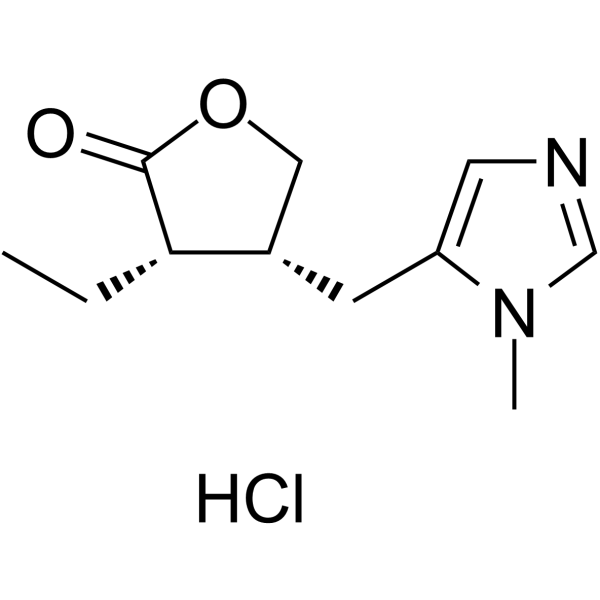
- Formula: C11H17ClN2O2
- Molecular Weight: 244.72
Pilocarpine Hydrochloride is an orally active, selective M3 muscarinic acetylcholine receptor agonist. Pilocarpine Hydrochloride can induce seizures and is used in research on conditions such as epilepsy, dry mouth (xerostomia), and elevated intraocular pressure.
- Formula: C361H411N141O262Na36P36
- Molecular Weight: 12068.3 (free acid)
Tivanisiran sodium (SYL1001 sodium) is a small interfering RNA (siRNA) targeting TRPV1 . Tivanisiran sodium induces the degradation of TRPV1 mRNA, thereby inhibiting protein synthesis. Tivanisiran sodium alleviates ocular discomfort and pain, and improves ocular hyperemia and tear quality. Tivanisiran sodium is applicable to research related to dry eye disease.

- Molecular Weight: 12068.30 (AS: 5294.6 + SS: 6125.7)
Tivanisiran (SYL1001) is a small interfering RNA (siRNA) targeting TRPV1 . Tivanisiran induces the degradation of TRPV1 mRNA, thereby inhibiting protein synthesis. Tivanisiran alleviates ocular discomfort and pain, and improves ocular hyperemia and tear quality. Tivanisiran is applicable to research related to dry eye disease.

- Formula: C15H20BrN3O4
- Molecular Weight: 386.24
Rezuforimod (AGN-232411; AG-80308) is an ophthalmic solution targeting the formyl peptide receptor (FPR) pathway. Rezuforimod exerts anti-inflammatory effects by targeting the formyl peptide receptor pathway. Administered topically, Rezuforimod significantly reduces the corneal conjunctival staining score and improves ocular discomfort symptoms, with no serious adverse events reported and favorable overall safety profile. Rezuforimod shows remarkable potential to serve as a novel therapeutic option for dry eye disease.


- Formula: C15H20N2O18P4
- Molecular Weight: 640.22
MRS2768 is a potent, selective, and metabolically stable P2Y2 receptor agonist with an EC50 of 1.89 μM for the human P2Y2 receptor. MRS2768 activates Gq/PLC/PKC signaling, leading to downstream phosphorylation of Akt, eNOS, and ERK, with effects varying by cell type. MRS2768 inhibits ENaC via Gq/PKC/Src/Akt to promote natriuresis and lower blood pressure in the kidney. MRS2768 activates eNOS to increase NO secretion in endothelial cells. MRS2768 drives proliferation via PI3K/Akt in fibroblasts and cancer cells. MRS2768 exerts anti-apoptotic effects through PKC/Src/Akt in cardiomyocytes. MRS2768 can be applied to investigate P2Y2-dependent pathological processes, including acute kidney injury, chronic kidney disease and renal fibrosis, DOCA-salt induced hypertension, myocardial infarction, pulmonary arterial hypertension, pancreatic cancer, cardiac fibrosis, dry eye disease, as well as shear stress-mediated vascular remodeling and atherosclerosis.
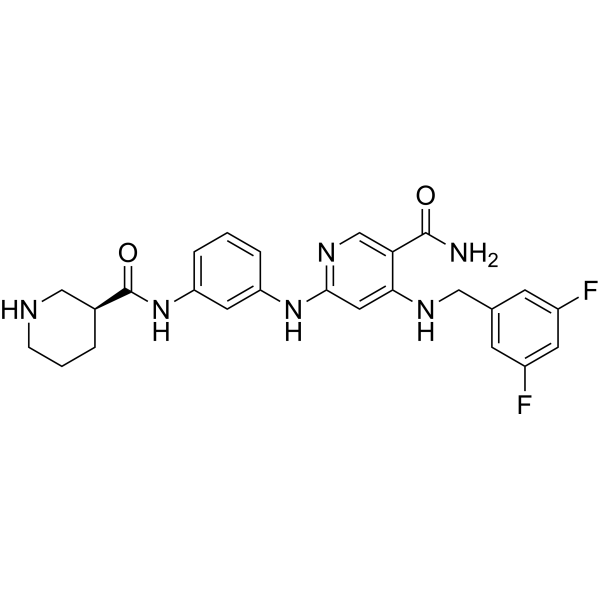
- Formula: C25H26F2N6O2
- Molecular Weight: 480.51
Nimucitinib is a selective JAK inhibitor with potent tear secretion-promoting activity. Nimucitinib downregulates relevant signal transduction pathways by inhibiting the catalytic activity of JAK family tyrosine kinases. Nimucitinib promotes tear secretion in rabbits and inhibits corneal injury in rats. Nimucitinib can be used in dry eye-related research.
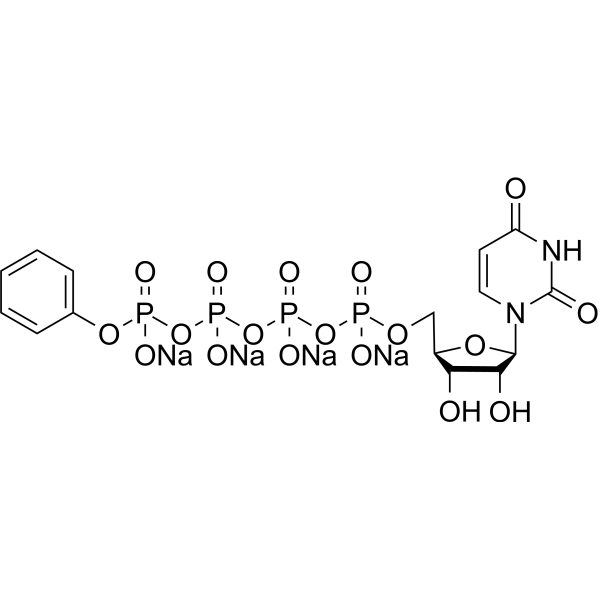
- Formula: C15H16N2Na4O18P4
- Molecular Weight: 728.14
MRS2768 tetrasodium salt is a potent, selective, and metabolically stable P2Y2 receptor agonist with an EC50 of 1.89 μM for the human P2Y2 receptor. MRS2768 tetrasodium salt activates Gq/PLC/PKC signaling, leading to downstream phosphorylation of Akt, eNOS, and ERK, with effects varying by cell type. MRS2768 tetrasodium salt inhibits ENaC via Gq/PKC/Src/Akt to promote natriuresis and lower blood pressure in the kidney. MRS2768 tetrasodium salt activates eNOS to increase NO secretion in endothelial cells. MRS2768 tetrasodium salt drives proliferation via PI3K/Akt in fibroblasts and cancer cells. MRS2768 tetrasodium salt exerts anti-apoptotic effects through PKC/Src/Akt in cardiomyocytes. MRS2768 tetrasodium salt can be applied to investigate P2Y2-dependent pathological processes, including acute kidney injury, chronic kidney disease and renal fibrosis, DOCA-salt induced hypertension, myocardial infarction, pulmonary arterial hypertension, pancreatic cancer, cardiac fibrosis, dry eye disease, as well as shear stress-mediated vascular remodeling and atherosclerosis.

- Formula: C31H40N4O8
- Molecular Weight: 596.67
GW559090 is a selective, competitive, and high-affinity α4 integrin antagonist with a Kd of 0.19 nM for α4β1. GW559090 can effectively block the binding of α4β1 to vascular cell adhesion molecule 1 (VCAM-1) and fibronectin with IC50 values of 7.72 and 8.04 nM. GW559090 also inhibits the interaction between α4β7 and mucosal addressin cell adhesion molecule 1 (MAdCAM-1) (IC50 = 23 nM). GW559090 can inhibit inflammatory infiltration in the eyes, repair the corneal barrier and restore the function of goblet cells. GW559090 can be used for research of Sjögren's syndrome associated dry eye.

- Formula: C26H24Cl2N2O5
- Molecular Weight: 515.39
LFA-1-IN-2 (Compound 25) is a potent LFA-1 inhibitor with a Kd of 21.46 μM. LFA-1-IN-2 inhibits ICAM-1-mediated cell adhesion. LFA-1-IN-2 protects cells from inflammatory hyperosmotic stress. LFA-1-IN-2 improves dry eye disease.

- Formula: C33H35N6O7P
- Molecular Weight: 658.64
UAMC-00050 free base is a potent trypsin-like serine protease inhibitor. UAMC-00050 free base can be used in research of dry eye syndrome and ocular inflammation.

- Formula: C43H51N7O8S
- Molecular Weight: 825.97
TOP1362 is a narrow spectrum kinase inhibitor. TOP1362 is a potent inhibitor of P38-α and Syk kinases with Kd values of 26 and 18 nM, respectively and an IC50 of 14 nM in the Src kinase activity assay. TOP1362 potently inhibits P38-α, Src and Syk. TOP1362 can be used in the research of dry eye syndrome.

- Formula: C24H29Cl2F3N4O4S
- Molecular Weight: 597.48
KR-67607 is a selective 11β-HSD1 inhibitor, with an IC50 value of 4.8 nM against h11β-HSD1 and 7.1 nM against mouse 11β-HSD1. KR-67607 inhibits stress-induced Glucocorticoid receptor nuclear translocation, reduces cortisol levels, suppresses the expression of ROS and proinflammatory cytokines, and enhances Nrf-2-mediated antioxidant gene transcription. KR-67607 maintains trabecular meshwork structure and reverses elevated intraocular pressure. KR-67607 improves ocular antioxidant activity and mucus secretion, reverses ocular surface damage, and prevents ischemia-reperfusion induced ocular injury. KR-67607 can be used in research related to glaucoma and dry eye disease.
- 1



