



Arrestin
Arrestin is a key protein that regulates G protein-coupled receptor (GPCR) signaling. Upon ligand activation, GPCRs undergo C-terminal phosphorylation by specific kinases (such as GRK, G protein-coupled receptor kinase), which recruits Arrestin, thereby preventing further coupling between GPCRs and G proteins while triggering receptor internalization and downstream signal transduction. Arrestin plays a crucial role in signal transduction, receptor desensitization and endocytosis, as well as multiprotein signaling complex assembly.
Arrestin is mainly classified into four types: Visual Arrestin (Arrestin-1), Cone Arrestin (Arrestin-4), β-Arrestin 1 (Arrestin-2), and β-Arrestin 2 (Arrestin-3). Among them, Arrestin-1 and Arrestin-4 are primarily involved in retinal phototransduction, whereas β-Arrestin 1 and β-Arrestin 2 are widely expressed in multiple tissues, regulating most GPCR-related signaling pathways. Structurally, Arrestin consists of N-terminal and C-terminal β-strand domains, stabilized by a polar core, and undergoes conformational changes upon receptor binding, thereby initiating signal transmission.
In the nervous system, Arrestin regulates dopamine receptor (e.g., D2 receptor) signaling, affecting Parkinson’s disease and Schizophrenia. In cancer, Arrestin integrates ERK, JNK, and Akt signaling pathways to regulate tumor cell growth and migration, for example, β-Arrestin 2-mediated GPCR signaling promotes cancer cell survival and drug resistance. Additionally, Arrestin is involved in inflammatory responses and immune regulation, playing important roles in diabetes, asthma, and inflammatory diseases[1][2].
Arrestin Isoform Specific Products
All Product Categories
-
Arrestin Related Products (81)
Related Products (81)

-
Antibodies (2)
-
Arrestin Isoform Comparison
-
AT1R-agonist-1
 0 ImagesCat. No.: HY-P11847CAS No.: 3124030-35-6AT1R-agonist-1 is an angiotensin II type 1 receptor (AT1R) agonist with a Ki value of 1.4 nM. AT1R-agonist-1 exhibits low Gαq activity, retains β-arrestin recruitment function, and accesses the deep allosteric pocket inside AT1R via its flexible side chain. AT1R-agonist-1 possesses positive inotropic effects (enhancing cardiac contractile function) and causes almost no increase in blood pressure. AT1R-agonist-1 can be used for research on conditions such as refractory cardiogenic shock.
-
3-Ethoxy-5,6-dibromosalicylaldehyde
 0 Images3-Ethoxy-5,6-dibromosalicylaldehyde is an IRE1/ERN1 inhibitor, with an IC50 of 0.12 μM, a Ki of 71-88 nM, and a Kd of 100 nM against the ribonuclease activity of hIRE1α, as well as an IC50 of 4.8 μM against yeast Ire1. It shows selectivity toward IRE1 ribonuclease. 3-Ethoxy-5,6-dibromosalicylaldehyde blocks the IRE1/ERN1-mediated unfolded protein response (UPR) signaling pathway, including XBP-1 mRNA splicing, induction of XBP1 target genes, and activation of MAPK8/9/10, but does not alter the phosphorylation level of IRE1α or the PERK/ATF6 pathway. 3-Ethoxy-5,6-dibromosalicylaldehyde inhibits chikungunya virus replication, induces growth arrest, apoptosis and clonogenic inhibition in pancreatic cancer cells, reduces FB1 (Fumonisin B1) (HY-N6719)-induced autophagy and cell death, regulates PGG-induced senescence and apoptosis, and alleviates Sorafenib (HY-10201)-induced vacuolization and damage in hepatic stellate cells. 3-Ethoxy-5,6-dibromosalicylaldehyde can be used in research related to chikungunya virus infection, pancreatic cancer, FB1-induced nephrotoxicity, liver cancer, breast cancer, lung cancer and liver fibrosis.
-
NLX-219
 0 ImagesCat. No.: HY-182389CAS No.: 2170404-93-8NLX-219 is a selective agonist of the 5-HT1A with a pKi of 10.21. NLX-219 activates ERK1/2 phosphorylation, inhibits adenylyl cyclase activity, promotes β-arrestin recruitment. NLX-219 can be used for the research of neurological disease.
-
ML138
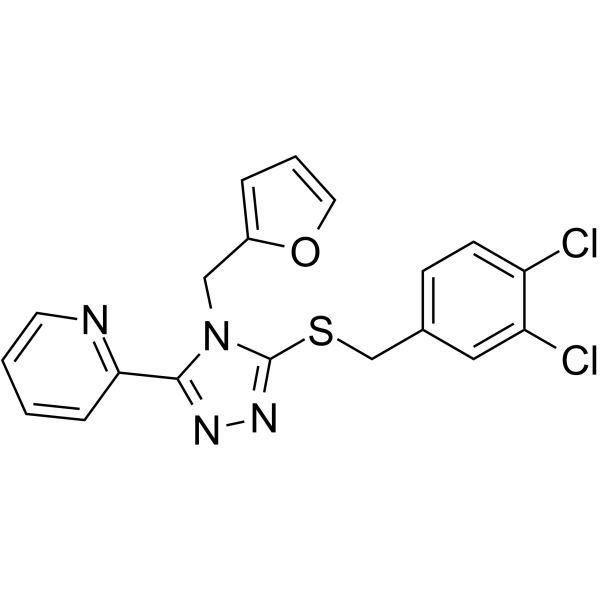 0 ImagesCat. No.: HY-121800CAS No.: 1355243-24-1ML138 is a blood-brain barrier-permeable κ-opioid receptor (KOR) agonist, with an EC50 value of 0.87 μM and a human Ki value of 2.4 nM for human receptors; it exhibits high selectivity for KOR over μ, δ and other receptors. ML138 activates β-arrestin (beta-arrestin)-mediated signaling pathways, stimulates G protein coupling, and activates the downstream extracellular regulated protein kinase 1/2 (ERK1/2) mitogen-activated protein kinase (MAP kinase) signaling pathway. ML138 is applicable to research related to addictive behaviors.
-
D1R antagonist 2
 0 ImagesCat. No.: HY-178103D1R antagonist 2 (Compound 13a) is a BBB-penetrable D1R antagonist with IC50s of 35.6 and 70 nM for cAMP-based D1R and β-arrestin-based D1R, respectively. D1R antagonist 2 effectively antagonizes D1R-mediated cAMP and β-arrestin recruitment. D1R antagonist 2 can be used for neurodegenerative and neuropsychiatric diseases such as schizophrenia, Parkinson’s disease and Alzheimer’s disease research.
-
B-007
 0 ImagesCat. No.: HY-183777B-007 is an AplnR agonist with G protein-biased signaling (EC50 = 11.6 nM). B-007 activates the G protein pathway while abolishing β-arrestin1 and β-arrestin2 signaling. B-007 serves as a scaffold for development of G protein-biased apelin receptor agonists. B-007 can be used for the research of heart failure.
-
AZ13581837
 0 ImagesCat. No.: HY-115643CAS No.: 2896777-27-6AZ13581837 is an orally active GPR120 agonist with an EC50 of 5.2 nM for human GPR120. AZ13581837 signals through Gαq, Gαs, and β-arrestin pathways, reduces cAMP production, stimulates GLP-1 secretion, induces glucose lowering, and increases insulin secretion. AZ13581837 can be used for the research of type 2 diabetes.
-
ID110460002
 0 ImagesCat. No.: HY-W414109CAS No.: 1172882-21-1ID110460002 possesses both full agonist activity at the μ-opioid receptor (OPRM) and agonist activity at the δ-opioid receptor (OPRD). ID110460002 acts as a potent agonist for the G protein pathways of both receptors, but exhibits only very weak partial agonist activity towards the β-arrestin-2 pathway. The agonistic potency of ID110460002 at OPRM has extremely high intrinsic activity and is unaffected by reduced receptor expression levels, while its potency at OPRD depends on receptor expression levels. ID110460002 displays tissue- or organ-dependent properties, and serves as a critical compound for investigating pain mechanisms and analgesia.
-
GPR183 inverse agonist-1
 0 ImagesCat. No.: HY-175306CAS No.: 2380033-51-0GPR183 inverse agonist-1 (Compound 78) is a GPR183 inverse agonist. GPR183 inverse agonist-1 inhibits the GPR183-mediated Gi activation and β-arrestin2 recruitment, and blocks PBMC migration. GPR183 inverse agonist-1 can be used for inflammatory, autoimmune and neoplastic disorders research.
-
FGH31
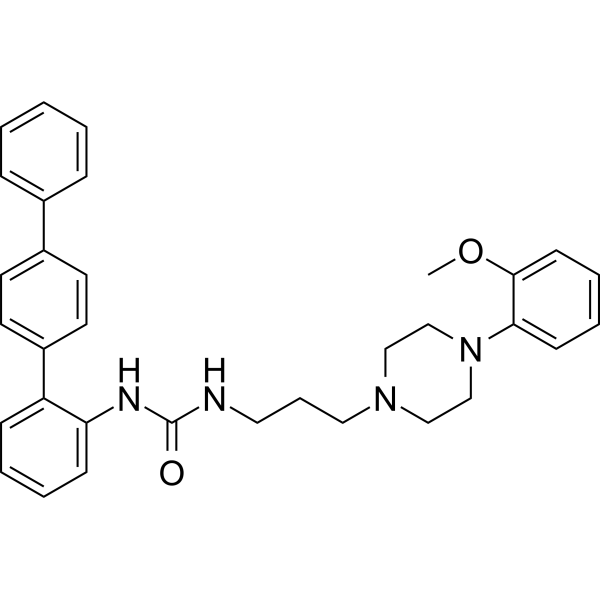 0 ImagesCat. No.: HY-155099CAS No.: 3033813-47-4FGH31 (Compound 24) is a potent, selective, GRK2 dependency dopamine D4 agonist, with the Ki of 1.6 nM. FGH31 partial activates β- arrestin.
-
Arrestin-3 modulator-1
 0 ImagesCat. No.: HY-175178CAS No.: 1214645-87-0Arrestin-3 modulator-1 (Compound LSH-3) is an arrestin-3 modulator. Arrestin-3 modulator-1 binds arrestin-3 at the interdomain interface. Arrestin-3 modulator-1 enhances recruitment of arrestin-3 to phosphorylation-deficient β2AR in cells with increase of FRET levels. Arrestin-3 modulator-1 can be used for congenital disorders like retinal degeneration, hyperthyroidism and obesity research.
-
SLW131
 0 ImagesSLW131 is a CCR7 antagonist with a Ki value of 9.85 nM. SLW131 inhibits CCL19-induced Go protein activation with an IC50 of 29.4 μM, and suppresses β-arrestin2 recruitment with an IC50 of 6.0 μM. SLW131 serves as a probe for investigating the biological functions of CCR7 in cells. SLW131 is applicable to research related to rheumatoid arthritis.
-
ID110460001
 0 ImagesCat. No.: HY-W399025CAS No.: 1110883-26-5ID110460001 is a full agonist of μ-opioid receptor and an agonist of δ-opioid receptor. ID110460001 exhibits high intrinsic efficacy for G protein pathway activation of μ-opioid receptor, and this property is not affected by the reduction in receptor quantity. ID110460001 acts only as a very weak partial agonist in the β-arrestin-2 pathway of both receptors, and binds to μ-opioid receptor via a specific mode. The efficacy of ID110460001 in the G protein pathway of δ-opioid receptor is sensitive to changes in receptor quantity. ID110460001 can be used in pain-related research.
-
SKL1223
 0 ImagesSKL1223 is an orally effective thioredoxin-interacting protein (TXNIP) inhibitor with an IC50 of 0.64 µM. SKL1223 interacts with the E-box region of the TXNIP promoter to inhibit TXNIP transcription and related signaling pathways. SKL1223 reduces hepatic glucose output. SKL1223 exerts hypoglycemic effects by regulating the action of glucagon, and modulates blood glucose levels in Streptozotocin (HY-13753)-induced and obesity-induced diabetic mice. SKL1223 can be used in the research of type 1 diabetes and type 2 diabetes.
-
BMS-986331
 0 ImagesBMS-986331 is an orally active selective N-Formyl Peptide Receptor 2 (FPR2) agonist with an EC50 of 0.5 nM in humans and 1 nM in rats. BMS-986331 activates Gαi2, GαoA, Gα12, Gα13 signaling pathways, recruits β-arrestin1 and β-arrestin2, and inhibits downstream cAMP. BMS-986331 induces the expression and release of the pro-resolution cytokine IL-10. BMS-986331 improves cardiac structure and function in a rat model of heart failure induced by permanent coronary artery occlusion. BMS-986331 can be used for the research of heart failure.
-
RKN5755
 0 ImagesCat. No.: HY-187689CAS No.: 1005056-10-9RKN5755 is a β-arrestin1 inhibitor and a selective inhibitor of activated fibroblasts. RKN5755 binds to β-arrestin1 and interferes with the cofilin signaling pathway mediated by this protein to block its function. RKN5755 not only inhibits the enhanced migratory effect of fibroblasts co-cultured with cancer cells, but also prevents the inhibitory effect of EP3 agonists on the EP2 receptor-induced elevation of tetrodotoxin-resistant sodium currents in mouse dorsal root ganglion neurons. RKN5755 is widely used in research on related diseases such as cancer metastasis and pain.
-
GPR35 agonist 6
 0 ImagesCat. No.: HY-W1058476CAS No.: 1443367-20-1GPR35 agonist 6 is a potent and selective agonist targeting GPR35, with an EC50 of 12.1 nM against human GPR35. GPR35 agonist 6 activates the human splice variant GPR35b with comparable efficacy, showing an EC50 of 22.1 nM. GPR35 agonist 6 also exhibits weak GPR55 antagonistic activity, with an IC50 of 21.7 μM, and its agonistic activity towards GPR35 is significantly stronger than its antagonistic activity towards GPR55. GPR35 agonist 6 initiates GPR35 downstream signaling by inducing β-arrestin recruitment. GPR35 agonist 6 is used to investigate GPR35-mediated diseases, such as gastrointestinal lesions and gastric cancer.
-
W2476
 0 ImagesCat. No.: HY-124483CAS No.: 432016-77-8
-
ML221 (Standard)
 0 ImagesCat. No.: HY-103254RCAS No.: 877636-42-5ML221 (Standard) is the analytical standard of ML221 (HY-103254). This product is intended for research and analytical applications. ML221 is a potent apelin (APJ) functional antagonist, inhibiting apelin-13-mediated activation of APJ, with IC50s of 0.70 μM in the cAMP assay, and 1.75 μM in the β-arrestin assay, and EC80 of 10 nM in both assays.
-
Forsythoside I (Standard)
 0 ImagesForsythoside I (Standard) is the analytical standard of Forsythoside I (HY-N5042). This product is intended for research and analytical applications. Forsythoside I is an orally active caffeoyl phenylethanoid glycoside (CPG) that can be isolated from Forsythia suspense (Thunb.) Vahl. Forsythoside I has anti-inflammatory activity and can exert a protective effect in a mouse model of acute lung injury.




