



c-Myc
Myc
The transcription factor c-Myc is a member of the basic helix-loop-helix leucinezipper (bHLHZip) protein family. The target genes of the c-MYC protein participate in different cellular functions, including cell cycle, survival, protein synthesis, cell adhesion, and micro-RNA expression. c-Myc is also one of the four factors used in reprogramming somatic cells to induce pluripotent stem (iPS) cells and is implicated in maintaining cancer stem-like cells (CSCs). Most biological functions of c-Myc require heterodimerization with its activation partner Max.
c-Myc is also part of a dynamic network whose members interact selectively with one another and with various transcriptional coregulators and histone-modifying enzymes. Deregulated expression of c-MYC caused by gene amplification, retroviral insertion, or chromosomal translocation is associated with tumorigenesis. c-Myc has been identified as a highly promising target for cancer therapy.
All Product Categories
-
c-Myc Related Products (290)
Related Products (290)

-
Antibodies (12)
-
c-Myc NLS TFA
 0 ImagesCat. No.: HY-P11948APurity: 99.10%c-Myc NLS TFA is a non-canonical nuclear localization signal (NLS) derived from the oncoprotein c-Myc, with the sequence PAAKRVKLD and containing 3 basic amino acids. c-Myc NLS TFA mediates the nuclear localization of fusion proteins, and all its regions are essential or play important roles in nuclear import. c-Myc NLS TFA can target fused pyruvate kinase to the nuclei of transfected cells.
-
PROTAC AURKA degrader-4
 0 ImagesCat. No.: HY-187470CAS No.: 3135155-78-8PROTAC AURKA degrader-4 is a AURKA PROTAC degrader with a DC50 of 25.62 nM (Jurkat cells). PROTAC AURKA degrader-4 recruits the CRBN E3 ubiquitin ligase via the ubiquitin-proteasome system. PROTAC AURKA degrader-4 disrupts both the catalytic and non-catalytic functions of AURKA, including its interactions with TPX2 and c-Myc. PROTAC AURKA degrader-4 induces G2/M phase arrest and apoptosis. PROTAC AURKA degrader-4 exhibits enhanced antiproliferative activity and in vivo antitumor efficacy in models with high CRBN and AURKA expression. PROTAC AURKA degrader-4 can be used for the research of acute lymphoblastic leukemia.

-
Inosine-5'-diphosphate-15N4 dilithium
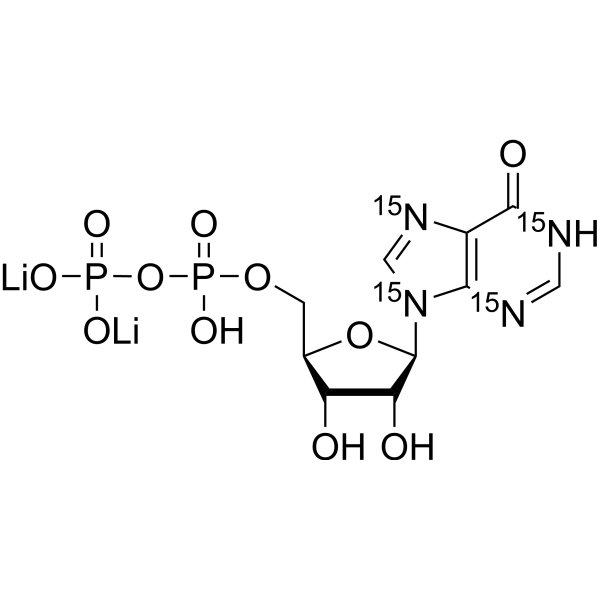 0 ImagesCat. No.: HY-W013724SSynonyms: IDP-15N4 dilithium; Inosine-5'-diphosphoric acid-15N4 disodiumInosine-5'-diphosphate-15N4 dilithium (IDP-15N4 dilithium) is 15N labeled Inosine-5'-diphosphate dilithium. Inosine-5'-diphosphate (IDP) is a decoy substrate of NM23-H2. Inosine-5'-diphosphate has a superior bond capacity on GDP-binding pocket of NM23-H2 (KD: 5.0 μM). Inosine-5'-diphosphate abrogates c-MYC transcription, induces apoptosis and G2/M cell cycle arrest by disrupting NM23-H2-Pu27-GQ interactions without affecting NM23-H2-mediated kinase properties. Inosine-5'-diphosphate has antihypoxic, antihyperthermic and antiarrhythmic activity and protects animals against the noxious effects of γ-irradiation. Inosine-5'-diphosphate can be used for cancers like Burkitt's lymphoma and cardiovascular diseases research.
-
MYC-IN-4
 0 ImagesCat. No.: HY-178045CAS No.: 3109265-41-7MYC-IN-4 is a MYC inhibitor. MYC-IN-4 impairs MYC/MAX protein-protein interaction (IC50 = 3.06 μM). MYC-IN-4 inhibits MYC-aberrant PC-3 prostate cancer cells with an IC50 of 0.440 μM. MYC-IN-4 demonstrates potent antitumor efficacy in FVB mice bearing Myc-CaP prostate tumor allografts. MYC-IN-4 can be used for the study of prostate cancer.
-
β-catenin-IN-8
 0 ImagesCat. No.: HY-169348CAS No.: 259130-14-8β-catenin-IN-8 (Compound 25) is a β-catenin inhibitor. β-catenin-IN-8 inhibits β-catenin and c-Myc protein levels, and inhibits Wnt-target genes level (Fgf20 and Sall4). β-catenin-IN-8 has colorectal cancer anticancer activities, and has metabolic stability.
-
STAT3-IN-46
 0 ImagesCat. No.: HY-175771STAT3-IN-46 is a selective and orally active inhibitor of signal transducer and activator of transcription 3 (STAT3) (KD = 323.3 nM). STAT3-IN-46 directly binds to the SH2 domain of the STAT3 and inhibits IL-6/JAK/STAT3 signaling pathway (IC50 = 0.87 μM) and downregulates c-Myc and Bcl-2 levels. STAT3-IN-46 can be used for the research of cancer, such as triple-negative breast cancer.
-
MLS-2384 free base
 0 ImagesCat. No.: HY-125718CAS No.: 1067884-45-0MLS-2384 free base is a dual JAK/Src kinase inhibitor. MLS-2384 free base downregulates STAT3 downstream proteins c-Myc and Mcl-1. MLS-2384 free base induces Apoptosis. MLS-2384 free base exhibits anticancer activity against prostate cancer, breast cancer, skin cancer, ovarian cancer, lung cancer, and liver cancer.

-
COG449
 0 ImagesCat. No.: HY-P12219Synonyms: OP449COG449 (OP449) is a cell-penetrating peptide that binds to SET, prevents the formation of the SET-PP2A complex, and restores PP2A phosphatase activity. COG449 decreases the phosphorylation levels of AKT308, ERK1/2, NFkB p65, and c-MYC S62, and reduces c-MYC stability and target gene expression. COG449 induces apoptosis, autophagy, and histone H3 hyperacetylation, and decreases the levels of SET, CIP2A, SETBP1, and Mcl-1. COG449 reduces cancer cell viability and decreases tumor mass in xenograft models. COG449 can be used for research on various cancers such as oral squamous cell carcinoma, T-cell acute lymphoblastic leukemia, B-CLL, non-Hodgkin lymphoma, and breast cancer.
-
PROTAC LZK degrader 1
 0 ImagesCat. No.: HY-170595CAS No.: 2763268-64-8PROTAC LZK degrader 1 is an LZK (MAP3K13) PROTAC degrader. PROTAC LZK degrader 1 binds LZK with a Kd of 35 nM and recruits VHL E3 ubiquitin ligase to induce ubiquitin-proteasome dependent degradation of LZK in MAP3K13-amplified HNSCC cells. PROTAC LZK degrader 1 eliminates both kinase-dependent c-MYC stabilization and kinase-independent GOF p53 accumulation downstream of LZK, suppresses colony formation of LZK-amplified head and neck squamous cell carcinoma (HNSCC) cells. PROTAC LZK degrader 1 can be used for research on LZK-driven HNSCC.
-
c-Myc inhibitor 15
 0 ImagesCat. No.: HY-169921c-Myc inhibitor 15 (Compound A5) is a selective c-Myc inhibitor that exerts anticancer effects by disrupting the interaction between c-Myc and Max, leading to the degradation of c-Myc protein and the induction of apoptosis. Its IC50 values are 4.08 μM and 7.86 μM in A549 and NCI-H1299 lung cancer cell lines, respectively, demonstrating strong cytotoxic activity. In a syngeneic tumor model, c-Myc inhibitor 15 exhibited outstanding antitumor efficacy, achieving a tumor growth inhibition rate of 76.4% and significantly reducing c-Myc protein expression levels. c-Myc inhibitor 15 holds promise for research related to c-Myc-driven lung cancers.
-
MTP3
 0 ImagesCat. No.: HY-173467MTP3 is a MYC PROTAC Degrator. MTP3 facilitates ternary complex formation with CRBN, driving proteasome-dependent full-length MYC degradation and partially proteasome-independent N-terminal truncated MYC (tMYC) generation. MTP3 induces tMYC formation across multiple cancer cell lines with context-dependent response variability. MTP3 can be used for the research of prostate cancer, breast cancer.
-
PHA-680626
 0 ImagesCat. No.: HY-125090CAS No.: 398493-74-8PHA-680626 is an effective inhibitor of the interaction between Aurora-A and N-Myc. PHA-680626 inhibits kinase activity of AURKA and Bcr-Abl, and induces N-Myc degradation. PHA-680626 decreases phosphorylation of CrkL and histone H3. PHA-680626 shows anti-proliferative and pro-apoptotic activity on Imatinib (HY-15463)-resistant chronic myeloid leukemia cell lines and primary CD34+ cells.
-
WNY0824
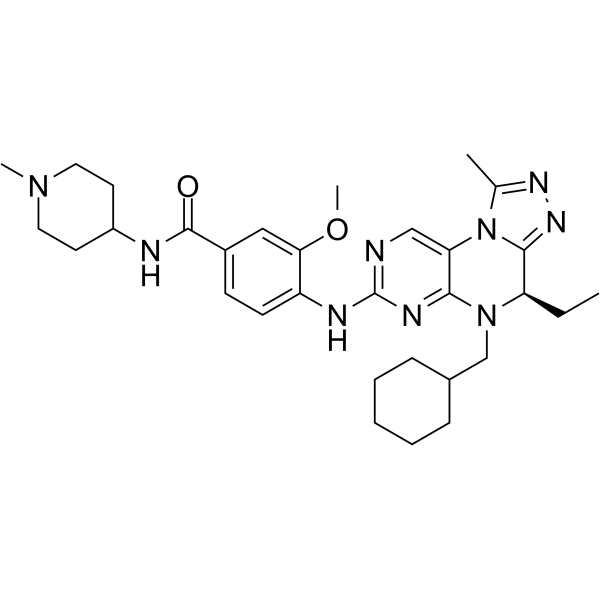 0 ImagesCat. No.: HY-143471CAS No.: 2412707-81-2Synonyms: PLK1/BRD4-IN-1WNY0824 (PLK1/BRD4-IN-1) is an orally active dual inhibitor of PLK1 and BET protein families, with IC50 values of 22, 402.5, 150.7, 103.9, and 311.9 nmol/L for PLK1, BRD2, BRD3, BRD4, and BRDT, respectively. WNY0824 induces cell cycle arrest and apoptosis by inhibiting AR- and MYC-mediated transcriptional processes. In addition, WNY0824 also inhibits tumor growth in Enzalutamide (HY-70002) resistant CRPC xenograft tumor models.
-
c-Myc inhibitor 10
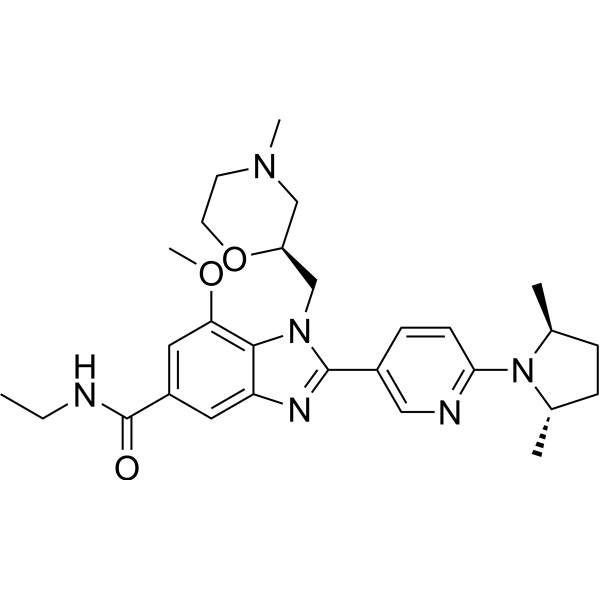 0 ImagesCat. No.: HY-154839CAS No.: 2299227-75-9

-
PROTAC BET Degrader-15
 0 ImagesCat. No.: HY-181729PROTAC BET Degrader-15 is a BET PROTAC degrader with DC50 values of <0.10 nM, <0.01 nM, and <0.01 nM against BRD2, BRD3, and BRD4, respectively. PROTAC BET Degrader-15 induces significant G2/M phase cell cycle arrest and triggers apoptosis. PROTAC BET Degrader-15 causes marked downregulation of c-Myc, accompanied by upregulation of the cell cycle inhibitory protein p21, downregulation of CDK6, and an increase in the apoptosis marker cleaved PARP. PROTAC BET Degrader-15 is applicable to the research of hematologic malignancies and lung cancer.
-
CDK8-IN-20
 0 ImagesCat. No.: HY-180124CDK8-IN-20 (Compound 67j) is a selective, potent and orally active type I CDK8 inhibitor with an IC50 of 70.5 nM. CDK8-IN-20 shows IC50 values of 147.8, 726.9 and 217.4 nM for homologous kinase CDK19, CDK7 and CDK9. CDK8-IN-20 can inhibit the Wnt/β-catenin pathway and downregulate the expression of β-catenin, Cyclin D1, and c-Myc. CDK8-IN-20 can induce ROS production and cause G2/M and S phase arrest. CDK8-IN-20can be used for the research of cancer, such as colon cancer.




