



MHC
Major Histocompatibility Complex; MHC
MHC is a group of genes encoding proteins which are transferred to the cell surfaces to present the intracellular or extracellular, self or non-self antigens to the cells of the immune system, thereby helping T cells in differentiating self from non-self proteins, and initiating adaptive immune responses. MHC can be divided into 3 subtypes, MHC I, MHC II and MHC III, in which MHC I presents endogenous antigens (such as antigens produced by virus-infected cells or tumor cells) to activate cytotoxic T cells (CD8+ T cells); MHC II presents exogenous antigens (such as bacteria or parasites) to activate helper T cells (CD4+ T cells); MHC III does not directly participate in antigen presentation, but involves in immune regulation, inflammatory response and cell signaling. MHC is crucial for stem cell transplant (SCT), and could lead to graft-versus-host disease (GVHD)[1][2].
References:
- [1]. Deakin JE, et al., Evolution and comparative analysis of the MHC Class III inflammatory region. BMC Genomics. 2006 Nov 2;7:281. [Content Brief]
- [2]. Sharma S K. Major Histocompatibility Complex[M]//Basics of Hematopoietic Stem Cell Transplant. Singapore: Springer Nature Singapore, 2023: 903-913.
MHC Isoform Specific Products
All Product Categories
-
MHC Related Products (124)
Related Products (124)

-
MHC Isoform Comparison
-
Albaconol
 0 ImagesCat. No.: HY-N20661CAS No.: 338405-64-4Albaconol is a prenylresorcinol compound. Albaconol is isolated from the mushroom A. confluens. Albaconol inhibits NF-κB and DNA topoisomerase II, and induces Apoptosis. Albaconol inhibits IκB-α phosphorylation and p65 nuclear translocation, enhances SOCS1 expression, reduces the production of proinflammatory cytokines and NO, and suppresses the expression of iNOS, MHC-II and co-stimulatory molecules. Albaconol acts as a weak antagonist of hVR1 and rVR1, with IC50 values of 17 µM and 5.5 µM, respectively. Albaconol induces tracheal contraction and desensitization. Albaconol inhibits the growth of tumor cells. Albaconol can be used in pain-related research.
-
GRWD5769
 0 ImagesCat. No.: HY-184499CAS No.: 2420554-24-9GRWD5769 is an orally potent ERAP1 inhibitor. GRWD5769 regulates the peptide repertoire presented by MHC-I, alters TCR diversity/clonality, reprograms antigen-experienced T cells, induces novel T cell responses, drives tumor cell killing, and alleviates T cell exhaustion. GRWD5769 can be used in the research of advanced solid malignancies, microsatellite-stable colorectal cancer, non-small cell lung cancer, bladder cancer, hepatocellular carcinoma, head and neck squamous cell carcinoma, and cervical cancer.
-
Anti-Mouse MHC Class I (H-2Kd) Antibody (HB-159)
 0 ImagesCat. No.: HY-P990194Anti-Mouse MHC Class I (H-2Kd) Antibody (HB-159) is a mouse-derived IgG2a κ type antibody inhibitor, targeting to mouse MHC Class I. Anti-Mouse MHC Class I (H-2Kd) Antibody (HB-159) reacts with the mouse H-2Kd MHC class I alloantigen. Anti-Mouse MHC Class I (H-2Kd) Antibody (HB-159) can be used for immunology research, such as cardiac graft.
-
Hemoglobin (64-76)
 0 ImagesCat. No.: HY-P10246CAS No.: 139644-18-1Hemoglobin 64-76 is a T cell inducing determinant, that binds to two different MHC class II molecules in distinct registers and lengths.
-
AS2677131
 0 ImagesCat. No.: HY-123876CAS No.: 2171502-44-4AS2677131 is a potent and orally active PIKfyve inhibitor. AS2677131 inhibits f IL-12p40, IL-6 and IL-1β through a PIKfyve-c-Rel pathway. AS2677131 selectively inhibits DNA-binding activity of c-Rel to IL-12p40 and IL-1β promoter. AS2677131 inhibits MHC class II expression on B cells. AS2677131 can be used for the researches of inflammation and immunology, such as arthritis.
-
Anti-Rat β-2-Microglobulin Antibody (4C9)
 0 ImagesCat. No.: HY-P990140Anti-Rat β-2-Microglobulin Antibody (4C9) is an anti-rat β-2-Microglobulin IgG1 monoclonal antibody. Anti-Rat β-2-Microglobulin Antibody (4C9) reduces pJNK nuclear translocation and restore SMAD nuclear localization. Anti-Rat β-2-Microglobulin Antibody (4C9) is often used in immunoprecipitation experiments.
-
H2-D b restricted epitopes VSV Nucleoprotein (52-59)
 0 ImagesH2-D b restricted epitopes VSV Nucleoprotein (52-59) is a 9-mer peptide derived from the nucleoprotein of Vesicular Stomatitis Virus (VSV). H2-D b restricted epitopes VSV Nucleoprotein (52-59) binds to MHC class I molecules and presents itself to CD8+ T cells, thereby activating cytotoxic T lymphocytes (CTLs), which can recognize and kill cells expressing the corresponding antigen. H2-D b restricted epitopes VSV Nucleoprotein (52-59) can be used in the development of CTL vaccines against Ebola virus.
-
EBNA3B 399-408
 0 ImagesCat. No.: HY-P11713CAS No.: 179815-06-6
-
Anti-Mouse MHC Class I (H-2Kk, H-2Dk) Antibody (15-3-1S (HB-13))
 0 ImagesCat. No.: HY-P990191Anti-Mouse MHC Class I (H-2Kk, H-2Dk) Antibody (15-3-1S (HB-13)) is a mouse-derived IgG2a κ type antibody inhibitor, targeting to mouse MHC Class I. Anti-Mouse MHC Class I (H-2Kk, H-2Dk) Antibody (15-3-1S (HB-13)) reacts with the mouse H-2Kk and H-2Dk MHC class I alloantigens. Anti-Mouse MHC Class I (H-2Kk, H-2Dk) Antibody (15-3-1S (HB-13)) can be used for immunology research.
-
EBNA3 246-254
 0 ImagesCat. No.: HY-P11714CAS No.: 457881-09-3EBNA3 246-254 (RYSIFFDYM) is an EBV peptide. EBNA3 246-254 is submitted by HLA-A24. EBNA3 246-254 is amplified in vitro, followed by HLA multimer staining to measure EBV-specific CTLs. EBNA3 246-254 can be used for the research of lung cancer.
-
AS2795440
 0 ImagesCat. No.: HY-177091CAS No.: 2171506-45-7AS2795440 is a PIKfyve inhibitor. AS2795440 selectively inhibits proinflammatory cytokine such as IL-12p40 and IL-6 production and B cell activation without affecting Ca2+ signaling. AS2795440 significantly reduces joint inflammation and bone loss in adjuvant-induced arthritis (AIA) mice model. AS2795440 can be used for inflammatory and autoimmune diseases like rheumatoid arthritis, psoriasis and inflammatory bowel disease research.
-
Anti-HLA-G Antibody
 0 ImagesCat. No.: HY-P992018
-
AIM2-derived decapeptide
 0 ImagesCat. No.: HY-P11383CAS No.: 406478-23-7
-
MBP (111-129)
 0 ImagesCat. No.: HY-P11127CAS No.: 178328-64-8MBP (111-129) is a polypeptide that constitutes an immunodominant epitope cluster restricted by HLA-DRB1*0401. MBP (111-129) is an antagonist for the clone HD4-1C2 TCR and an agonist for clone MS2-3C8 TCR. MBP (111-129) can be used for on multiple sclerosis and T cell biology.
-
VMAPRTLFL
 0 ImagesCat. No.: HY-P11340CAS No.: 202657-61-2VMAPRTLFL is a 9-mer peptide derived from the signal peptide of HLA-G and can serve as a peptide ligand for HLA-E. VMAPRTLFL plays a crucial role in regulating the functions of adaptive natural killer (NK) cells. Specifically, VMAPRTLFL enriches FcεRγ- adaptive NK cells, upregulates the expression of CD25, and enhances their proliferative activity, antibody-dependent cellular cytotoxicity (ADCC), and IFN-γ release. VMAPRTLFL can be used in research related to human cytomegalovirus (HCMV) infection, transplant rejection, and pregnancy immunity.
-
HLA-B*0801-binding EBV peptide
 0 ImagesCat. No.: HY-P10662CAS No.: 139143-28-5
-
Allotrap 07
 0 ImagesCat. No.: HY-106156CAS No.: 151232-75-6Allotrap 07 is a synthetic peptide composed of residues 75-84 of HLA-B7, a class I MHC molecule. Allotrap 07 combined with Cyclosporin A (HY-B0579) induces donor-specific tolerance in rat cardiac allografts, significantly prolonging graft survival.
-
TYVPANASL TFA
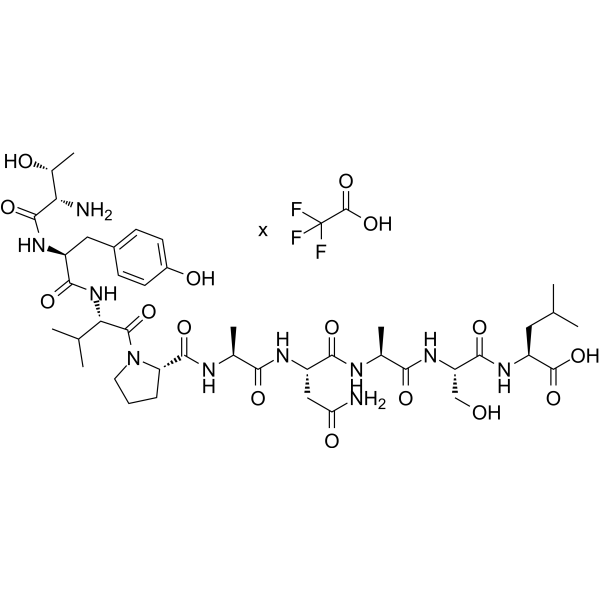 0 ImagesCat. No.: HY-P5745ATYVPANASL TFA is a MHC I-binding CD8 T cell epitope of nine amino acids from HER2/neu. TYVPANASL TFA can be used to prepare J-LEAPS vaccine.
-
BI-5756
 0 ImagesCat. No.: HY-171883CAS No.: 1332485-18-3BI-5756 is a CETP inhibitor and cannabinoid receptor 1 (CB1) agonist. BI-5756 can significantly increase HDL-C levels and reduce LDL-C levels. BI-5756 can also enhance the function of regulatory T cells while maintaining T cell-mediated anti-tumor activity. BI-5756 can directly inhibit the growth of tumor cells and upregulate the expression of MHC I, MHC II, and CD80 on tumor cells. BI-5756 has a protective effect in graft-versus-host disease models. BI-5756 can be used in research on tumors, graft-versus-host disease, and metabolic diseases.



