



Tomatidine hydrochloride
Based on 10 publication(s) in Google Scholar
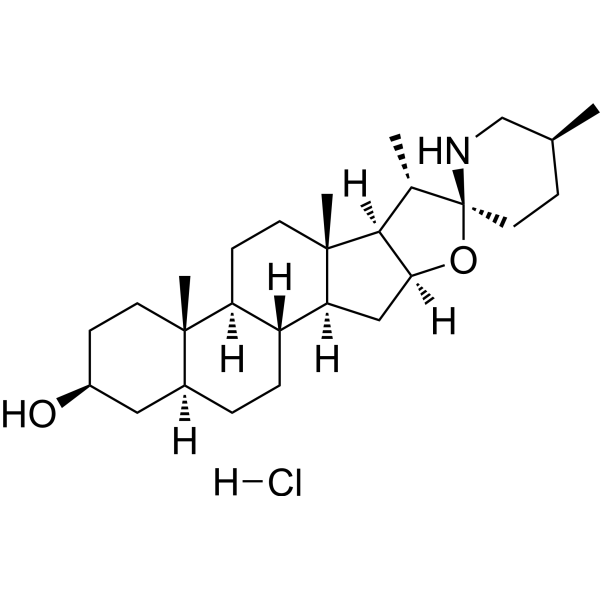
Tomatidine hydrochloride acts as an anti-inflammatory agent by blocking NF-κB and JNK signaling. Tomatidine hydrochloride activates autophagy either in mammal cells or C elegans.
For research use only. We do not sell to patients.
- Purity : 99.70%
- CAS No.: 6192-62-7
- Formula: C27H46ClNO2
- Molecular Weight:452.11
-
Storage:
4°C, sealed storage, away from moisture and light
* In solvent : -80°C, 6 months; -20°C, 1 month (sealed storage, away from moisture and light)

To place orders, for customer services and technical support, please contact: MedChemExpress USA
Tel: 609-228-6898 E-mail: [email protected] [email protected]


-
 Biological Activity
-
Chemical Information
-
Solvent & Solubility
- Protocols
- Purity & Documentation
- References
-
 Help & FAQs


-
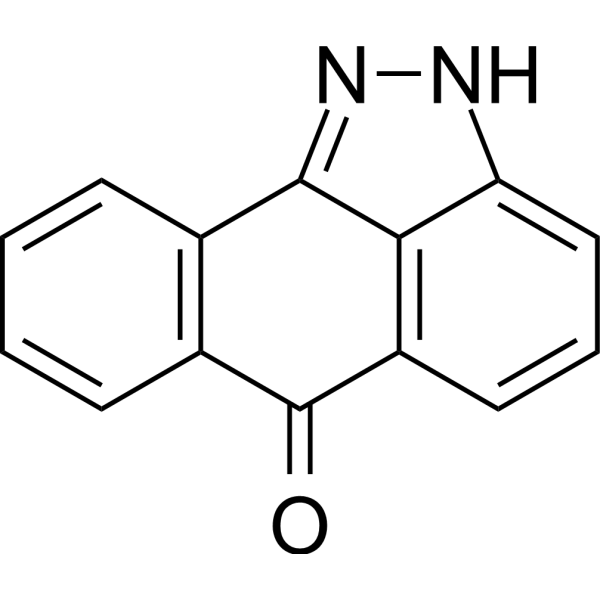
HY-12041
SP600125JNK Inhibitor -
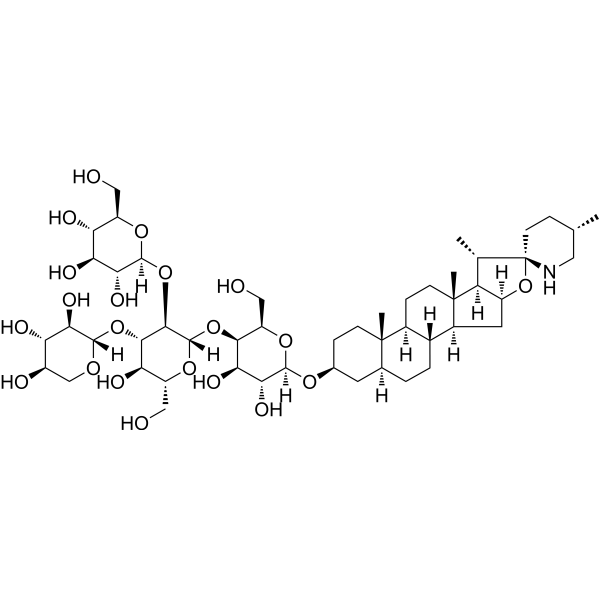
HY-N2166
TomatineGlycoalkaloid -
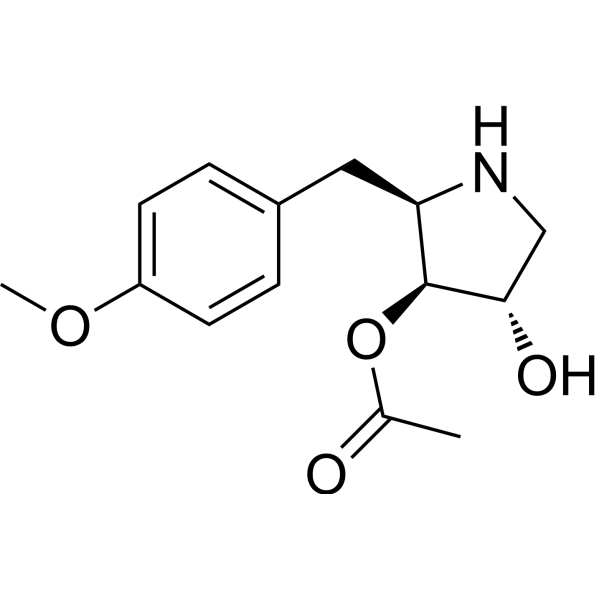
HY-18982
AnisomycinProtein Synthesis Inhibitor -

HY-18982R
Anisomycin (Standard)Protein Synthesis Inhibitor -
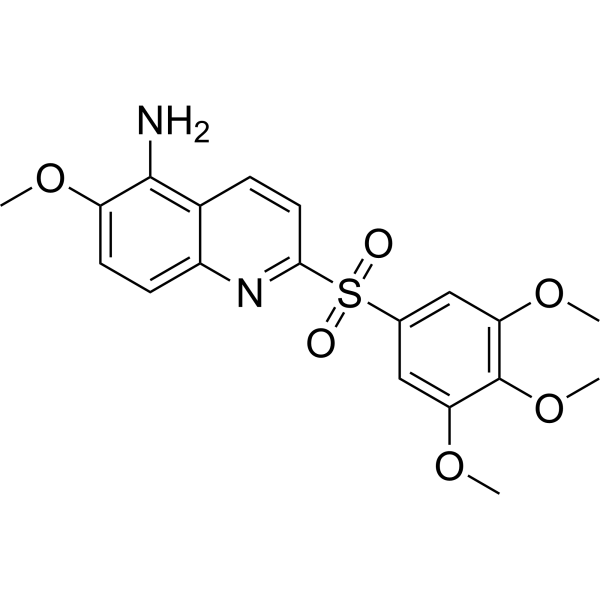
HY-101287
MPT0B392Microtubule-Depolymerizing Agent -
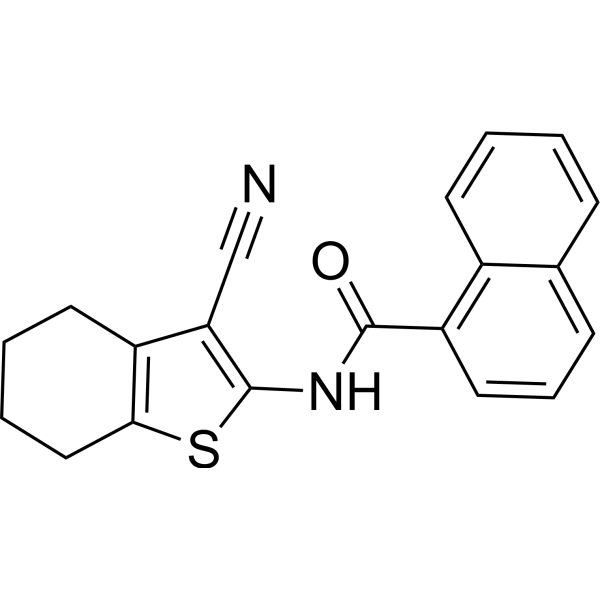
HY-15881
TCS JNK 5aApoptosis Inducer -
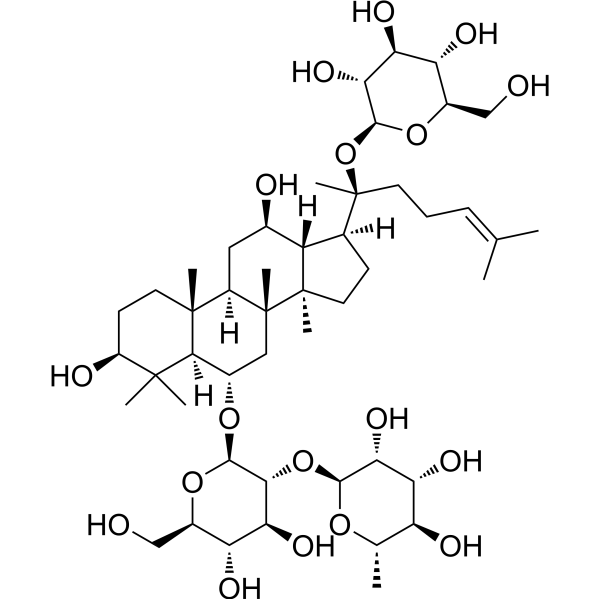
HY-N0044
Ginsenoside ReEndogenous Metabolite -

HY-12041R
SP600125 (Standard)JNK Inhibitor -

HY-12041G
SP600125 (GMP)JNK Inhibitor -
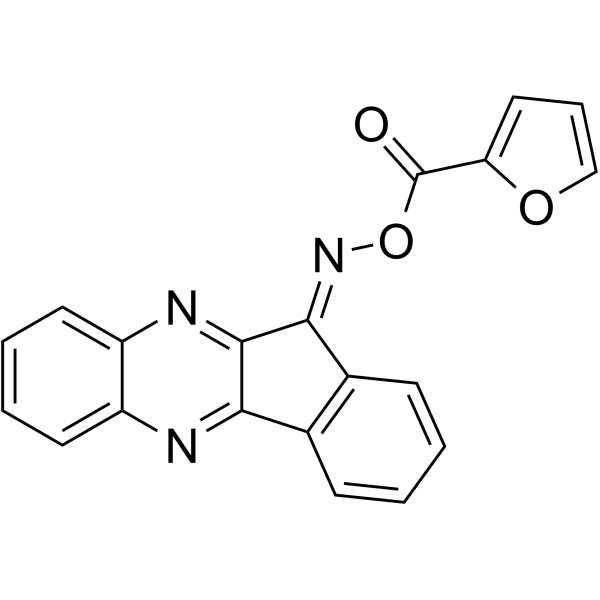
HY-107600
IQ-3c-JNK Inhibitor -

HY-101287R
MPT0B392 (Standard)Microtubule-Depolymerizing Agent -
HY-10366
BI-78D3JNK Inhibitor
Publications Citing Use of MedChemExpress (MCE) Tomatidine hydrochloride
More- Drug Des Devel Ther. 2024 Dec 27:18:6313-6329. [Abstract]
- Eur J Pharmacol. 2020 Sep 5:882:173280. [Abstract]
- Sci Rep. 2026 May 8;16(1):21171. [Abstract]
- PLoS Pathog. 2025 Jan 2;21(1):e1012800. [Abstract]
- J Neurochem. 2025 May;169(5):e70087. [Abstract]
- iScience. 2023 Jul 17;26(8):107408. [Abstract]
- FASEB J. 2019 Feb;33(2):2574-2586. [Abstract]
- Res Sq. 2025 Jul 13.
- Research Square Preprint. 2023 Apr 27.
- Aging (Albany NY). 2020 Jul 5;12(13):12799-12811. [Abstract]
 Customer Validation & Images

-
Cell Proliferation/Viability Assay

-
RT-PCR

-
Flow Cytometry

-
IF

-
ELISA

All Endogenous Metabolite Isoforms
More

Biological Activity
Description
IC50 & Target
[1]|
p65 |
JNK |
In Vitro
Tomatidine decreases inducible NO synthase and COX-2 expression through suppression of I-κBα phosphorylation, NF-κB nuclear translocation and JNK activation, which in turn inhibits c-jun phosphorylation and Oct-2 expression. Tomatidine, solasodine and diosgenin (40 μM) show 66%, 22% and 41% inhibition of nitrite production, respectively. The iNOS protein is barely detectable in unstimulated cells but markedly increases after LPS treatment, and Tomatidine causes dose-dependent inhibition of LPS-induced iNOS expression. p65 is the major component of NF-κB in LPS-stimulated macrophages, the effect of Tomatidine on p65 DNA-binding activity is determined. In the presence of Tomatidine at 10-40 μM, the binding activity of NF-κB is suppressed in a dose-dependent manner. Tomatidine inhibits the phosphorylation of I-κB, blocks the I-κB production, and furthermore suppresses p65 NF-κB translocation to the nucleus and modulated binding activity[1].
MedChemExpress (MCE) has not independently confirmed the accuracy of these methods. They are for reference only. Further protocols information, click here.


Chemical Information
-
CAS No. 6192-62-7
-
Appearance Solid
-
Molecular Weight 452.11
-
Formula C27H46ClNO2
-
Color White to yellow
-
SMILES
[H][C@]1(O[C@]2(NC[C@@H](C)CC2)[C@H]3C)C[C@@]4([H])[C@]5([H])CC[C@@]6([H])C[C@@H](O)CC[C@]6(C)[C@@]5([H])CC[C@]4(C)[C@]13[H].Cl[H]
-
Structure Classification
-
Initial Source
-
Shipping
Room temperature in continental US; may vary elsewhere.
-
Storage
4°C, sealed storage, away from moisture and light
* In solvent : -80°C, 6 months; -20°C, 1 month (sealed storage, away from moisture and light)


Publications (10)
-
Journal Impact Factor
-
Most Recent
-
Drug Des Devel Ther
Tomatidine Alleviates Intervertebral Disc Degeneration by Activating the Nrf2/HO-1/GPX4 Signaling Pathway. [Abstract]2024 Dec 27:18:6313-6329. PMID: 39741916
Tomatidine hydrochloride purchased from MedChemExpress. Usage Cited in: Drug Des Devel Ther. 2024 Dec 27:18:6313-6329. [Abstract]
Cell counting Kit-8 assay results of NPCs stimulated with Tomatidine (Td) at different concentrations (0,1,2,4,8,16,32,64,128,256) μM at 24 and 48 h.
Tomatidine hydrochloride purchased from MedChemExpress. Usage Cited in: Drug Des Devel Ther. 2024 Dec 27:18:6313-6329. [Abstract]
The gene expression ADAMTS-4, Col-2 and MMP3 were detected by qPCR in the NPCs treated with Tomatidine (Td) (1, 2, 4 μM) for 24 h.
Tomatidine hydrochloride purchased from MedChemExpress. Usage Cited in: Drug Des Devel Ther. 2024 Dec 27:18:6313-6329. [Abstract]
The intracellular ROS levels in NPCs were measured by flow cytometry assay treated with Tomatidine (Td) (1, 2, 4 μM).
Tomatidine hydrochloride purchased from MedChemExpress. Usage Cited in: Drug Des Devel Ther. 2024 Dec 27:18:6313-6329. [Abstract]
The protein expression of TFR was evaluated by cell immunofluorescence treated with Tomatidine (Td) (1, 2, 4 μM).
Tomatidine hydrochloride purchased from MedChemExpress. Usage Cited in: Drug Des Devel Ther. 2024 Dec 27:18:6313-6329. [Abstract]
The levels of GSH and MDA in NPCs were determined by ELISA treated with Tomatidine (Td) (1, 2, 4 μM).
-
Eur J Pharmacol
2020 Sep 5:882:173280. PMID: 32580039 -
Sci Rep
Tomatidine modulatesfibrosis-related markers by promoting autophagy in hepatic stellate cells via the ERK/MAPK-mTOR-ULK1 signaling pathway. [Abstract]2026 May 8;16(1):21171. PMID: 42103827 -
PLoS Pathog
2025 Jan 2;21(1):e1012800. PMID: 39746094 -
J Neurochem
Tomatidine Ameliorates Diabetes-Induced Cognitive Impairment and Tau Hyperphosphorylation Through the AMPK-TFEB Pathway. [Abstract]2025 May;169(5):e70087. PMID: 40387453 -
iScience
Tomatidine targets ATF4-dependent signaling and induces ferroptosis to limit pancreatic cancer progression. [Abstract]2023 Jul 17;26(8):107408. PMID: 37554459 -
FASEB J
Tomatidine suppresses osteoclastogenesis and mitigates estrogen deficiency-induced bone mass loss by modulating TRAF6-mediated signaling. [Abstract]2019 Feb;33(2):2574-2586. PMID: 30285579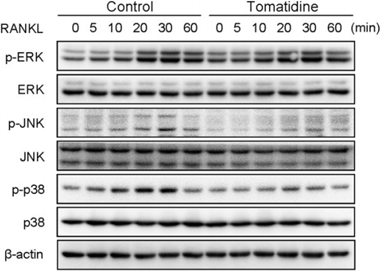
Tomatidine hydrochloride purchased from MedChemExpress. Usage Cited in: FASEB J. 2019 Feb;33(2):2574-2586. [Abstract]
Tomatidine attenuates osteoclastogenesis by inhibiting the MAPK, NF-kB, and PI3K/Akt signaling pathways in vitro.
-
-
-
Aging (Albany NY)
Tomatidine suppresses inflammation in primary articular chondrocytes and attenuates cartilage degradation in osteoarthritic rats. [Abstract]2020 Jul 5;12(13):12799-12811. PMID: 32628132


Solvent & Solubility
In Vitro:
Methanol : 12.5 mg/mL (27.65 mM; Need ultrasonic)
Ethanol : 3.33 mg/mL (7.37 mM; Need ultrasonic)
DMSO : < 1 mg/mL (insoluble or slightly soluble)
H2O : < 0.1 mg/mL (insoluble)
Please refer to the solubility information to select the appropriate solvent. Once prepared, please aliquot and store the solution to prevent product inactivation from repeated freeze-thaw cycles.
Storage method and period of stock solution: -80°C, 6 months; -20°C, 1 month (sealed storage, away from moisture and light). When stored at -80°C, please use it within 6 months. When stored at -20°C, please use it within 1 month.
Please refer to the solubility information to select the appropriate solvent. Once prepared, please aliquot and store the solution to prevent product inactivation from repeated freeze-thaw cycles.
Storage method and period of stock solution: -80°C, 6 months; -20°C, 1 month (sealed storage, away from moisture and light). When stored at -80°C, please use it within 6 months. When stored at -20°C, please use it within 1 month.
Concentration (start) × Volume (start) = Concentration (final) × Volume (final)

Protocols
-
Autophagy
Autophagy is a process in which eukaryotic cells use lysosomes to degrade their own cytoplasmic proteins and damaged organelles under the regulation of autophagy related gene (Atg). Microtubule-associated proteins light chain 3 (LC3) is recognized as autophagy marker, which transfers from cytoplasmic LC3 (LC3-I) to membrane type (LC3-II). LC3-II/I ratio could be detected by Western Blot and fluorescence microscopy.
-
Research Protocol for Inflammation-related Diseases
The NLRP3 inflammasome is a cytosolic innate immune signaling platform that integrates priming signals and danger-signal activation to promote caspase-1 activation, maturation of IL-1β and IL-18, and gasdermin D-mediated pyroptotic cell death. The core experimental logic is to determine whether inflammatory disease phenotypes are driven by increased NLRP3 expression, ASC-containing inflammasome assembly, caspase-1 cleavage, GSDMD cleavage, and extracellular release of IL-1β/IL-18 rather than by nonspecific cell injury alone. The pathway is strongly linked to inflammation-related disease phenotypes because monosodium urate crystals activate NALP3/NLRP3 inflammasome signaling in gout-like crystal inflammation, cholesterol crystals activate NLRP3 inflammasomes in atherogenesis models, and DSS-induced intestinal inflammation has been reported to involve NLRP3 inflammasome activity. However, experimental colitis studies also show context-dependent protective effects of NLRP3 inflammasome co
-
Lysosome and acidic-vesicle live-cell staining
Lysosome and acidic-vesicle live-cell staining detects acidic intracellular compartments by using membrane-permeant acidotropic probes that accumulate in low-pH vesicles, including lysosomes, late endosomes, autolysosomes, and acidic phagosomes. LysoTracker staining is commonly used as an intensity-based readout of acidic lysosomal compartment abundance or enlargement, while acridine orange produces green fluorescence in less concentrated compartments and red fluorescence after concentration-dependent accumulation in acidic vesicular organelles. Loss or reduction of acridine-orange red signal can be used as a readout of lysosomal membrane permeabilization or reduced acidic-vesicle integrity. This protocol is designed for live cultured cells and can be adapted for fluorescence microscopy, high-content imaging, plate-reader readout, or flow cytometry when the selected literature supports the readout. Because these dyes report acidotropic accumulation rather than lysosome identity alone,
-
Macroautophagy Solutions
Macroautophagy is a conserved lysosome-dependent degradation pathway in which cytoplasmic material is sequestered into double-membrane autophagosomes and delivered to lysosomes for degradation and recycling. The pathway supports cellular homeostasis during nutrient limitation, organelle stress, protein-aggregate accumulation, infection, differentiation, and tissue remodeling by coupling cargo sequestration, autophagosome maturation, lysosomal fusion, and degradation of cargo-derived macromolecules. The core molecular sequence includes initiation by nutrient- and stress-regulated autophagy machinery, autophagosome nucleation, LC3/ATG8-family conjugation to autophagosomal membranes, cargo selection through receptors such as SQSTM1/p62, autophagosome-lysosome fusion, and lysosomal degradation. LC3 was identified as a mammalian homolog of yeast Atg8 that localizes to autophagosomal membranes after processing, and p62/SQSTM1 was shown to connect ubiquitinated cargo with autophagic degradati


Purity & Documentation
-
Data Sheet (278 KB)
-
SDS (393 KB)
- English - EN (393 KB)
- Français - FR (393 KB)
- Deutsch - DE (393 KB)
- Norwegian - NO (393 KB)
- Español - ES (393 KB)
- Swedish - SV (393 KB)
- Italian - IT (393 KB)
- Korean - KR (393 KB)
- Portuguese - PT (393 KB)
-
Handling Instructions (2659 KB)
References
[1]. Chiu FL, et al. Tomatidine inhibits iNOS and COX-2 through suppression of NF-kappaB and JNK pathways in LPS-stimulated mouse macrophages. FEBS Lett. 2008 Jul 9;582(16):2407-12. [Content Brief]
[2]. Anil Ahsan, et al. Tomatidine Protects Against Ischemic Neuronal Injury by Improving Lysosomal Function. Eur J Pharmacol. 2020 Jun 21;173280. [Content Brief]


Complete Stock Solution Preparation Table
Please refer to the solubility information to select the appropriate solvent. Once prepared, please aliquot and store the solution to prevent product inactivation from repeated freeze-thaw cycles.
Storage method and period of stock solution: -80°C, 6 months; -20°C, 1 month (sealed storage, away from moisture and light). When stored at -80°C, please use it within 6 months. When stored at -20°C, please use it within 1 month.
| Optional Solvent | Concentration Solvent Mass | 1 mg | 5 mg | 10 mg | 25 mg |
|---|---|---|---|---|---|
| Ethanol / Methanol | 1 mM | 2.2119 mL | 11.0593 mL | 22.1185 mL | 55.2963 mL |
| 5 mM | 0.4424 mL | 2.2119 mL | 4.4237 mL | 11.0593 mL | |
| Methanol | 10 mM | 0.2212 mL | 1.1059 mL | 2.2119 mL | 5.5296 mL |
| 15 mM | 0.1475 mL | 0.7373 mL | 1.4746 mL | 3.6864 mL | |
| 20 mM | 0.1106 mL | 0.5530 mL | 1.1059 mL | 2.7648 mL | |
| 25 mM | 0.0885 mL | 0.4424 mL | 0.8847 mL | 2.2119 mL |


Tomatidine hydrochloride Related Classifications
HY-N2149A Related Classifications
 Powered by Bioz