



USP7-IN-1
Based on 7 publication(s) in Google Scholar
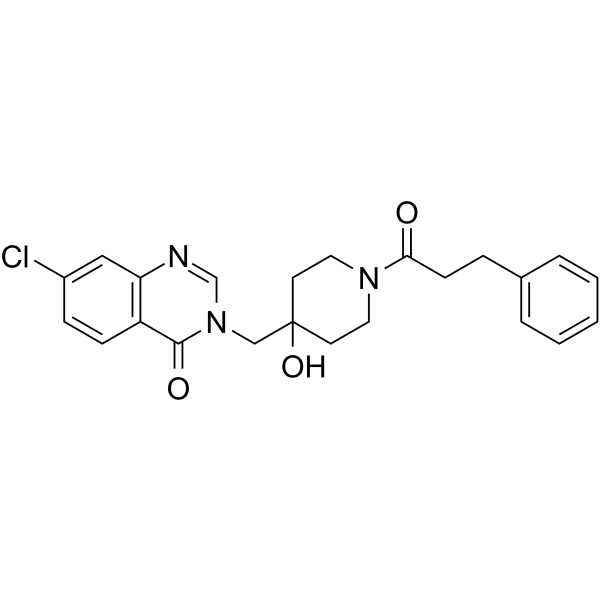
USP7-IN-1 is a selective and reversible inhibitor of ubiquitin-specific protease 7 (USP7), with an IC50 of 77 μM, and can be used for the research of cancer.
For research use only. We do not sell to patients.
- Purity : 99.18%
- CAS No.: 1381291-36-6
- Formula: C23H24ClN3O3
- Molecular Weight:425.91
-
Storage:Powder -20°C, 3 years , 4°C, 2 years ; In solvent -80°C, 2 years , -20°C, 1 year

To place orders, for customer services and technical support, please contact: MedChemExpress USA
Tel: 609-228-6898 E-mail: [email protected] [email protected]


-
 Biological Activity
-
Chemical Information
-
Solvent & Solubility
- Protocols
- Purity & Documentation
- References
-
 Help & FAQs


-
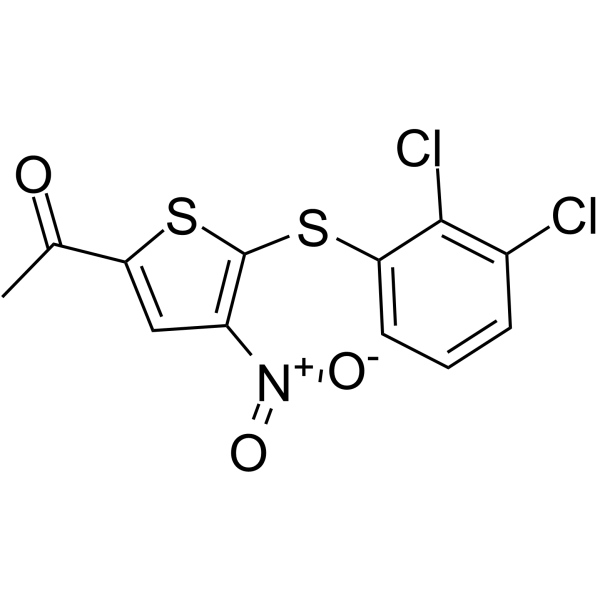
HY-15667
P005091USP7 Inhibitor -
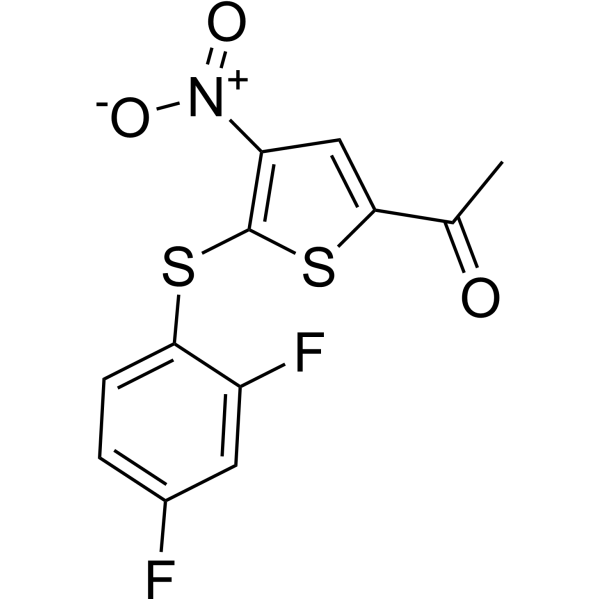
HY-13865
P 22077USP7/47 Inhibitor -
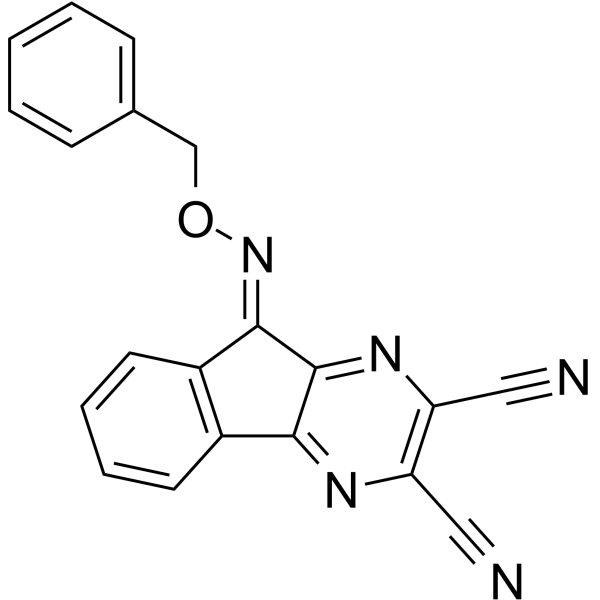
HY-50736
DUB-IN-1USP8 Inhibitor -
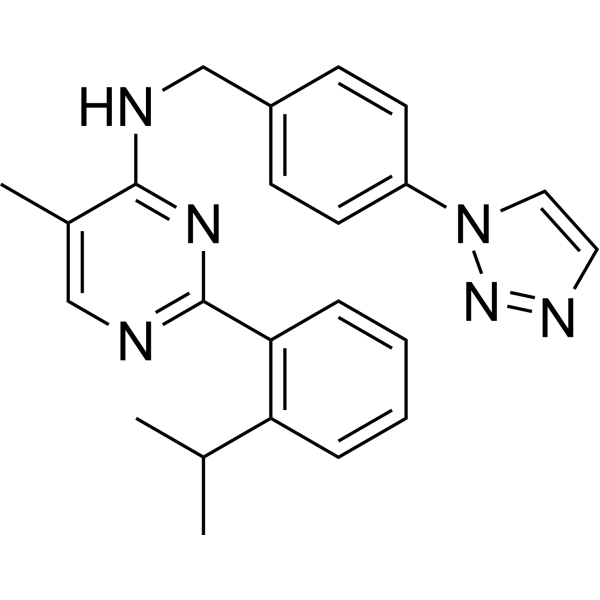
HY-17543
ML-323USP1-UAF1 Inhibitor -
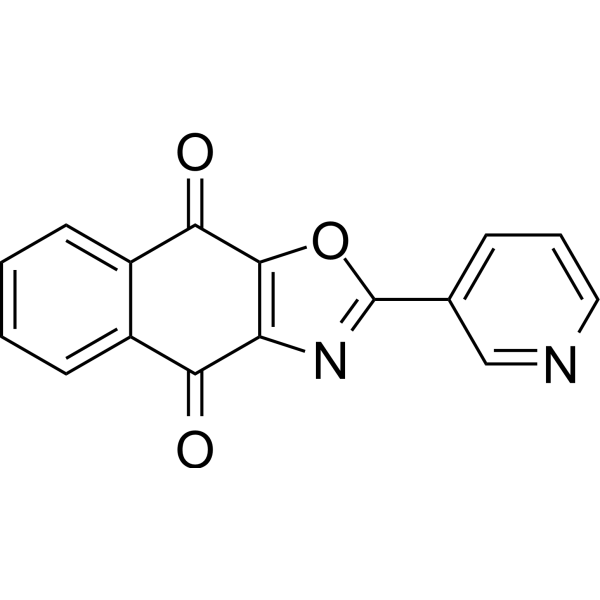
HY-80012
SJB3-019AUSP1 Inhibitor -
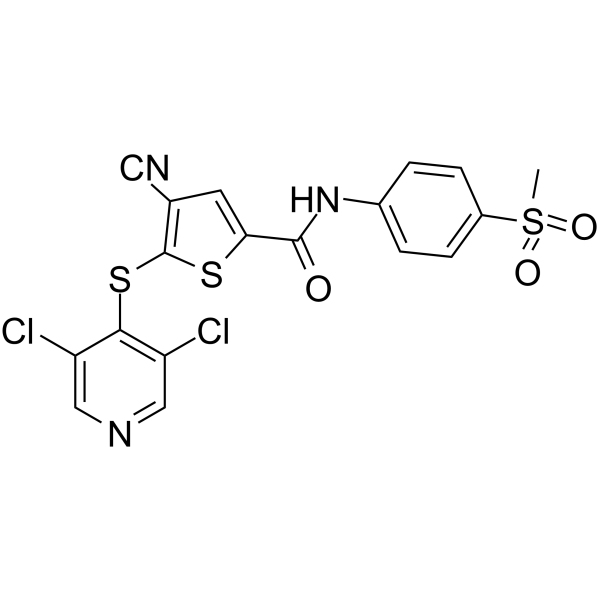
HY-13487
USP7/USP47 inhibitorUSP7/USP47 Inhibitor -
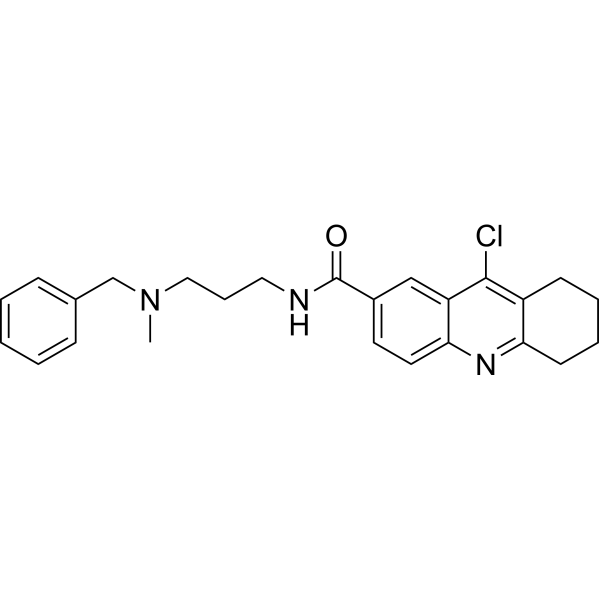
HY-17540
HBX 19818USP7 Inhibitor -
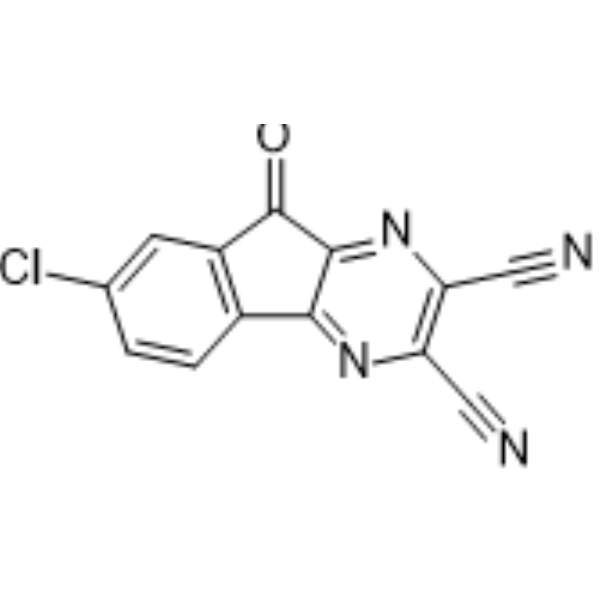
HY-101666
HBX 41108USP7 Inhibitor -
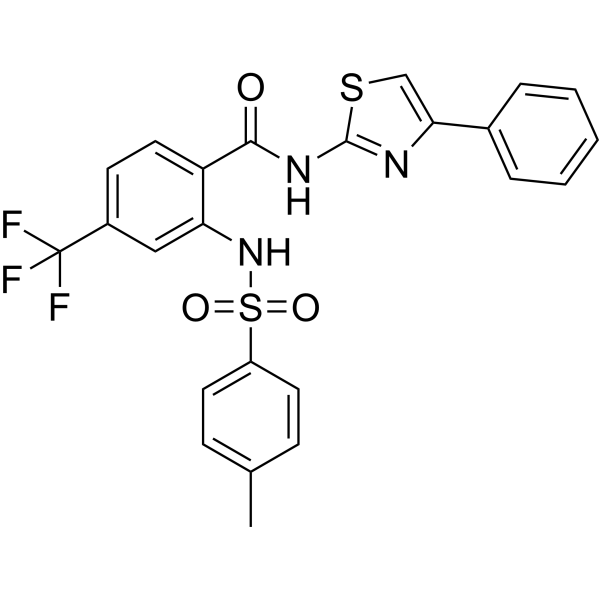
HY-100900
ML364USP2 Inhibitor -
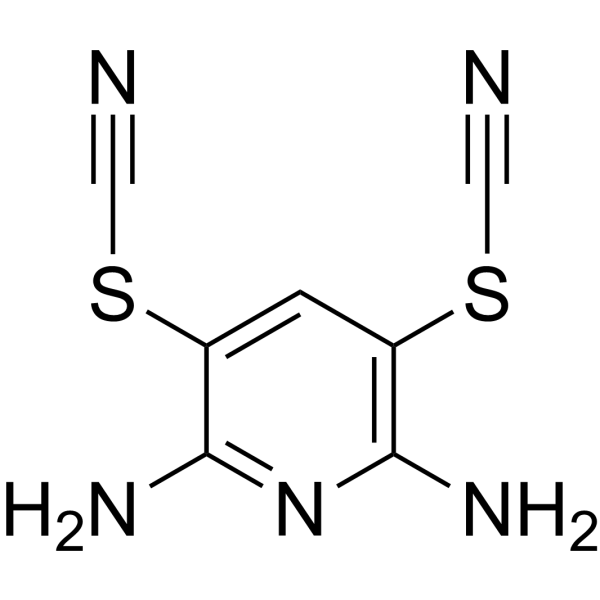
HY-13814
PR-619DUB Inhibitor -
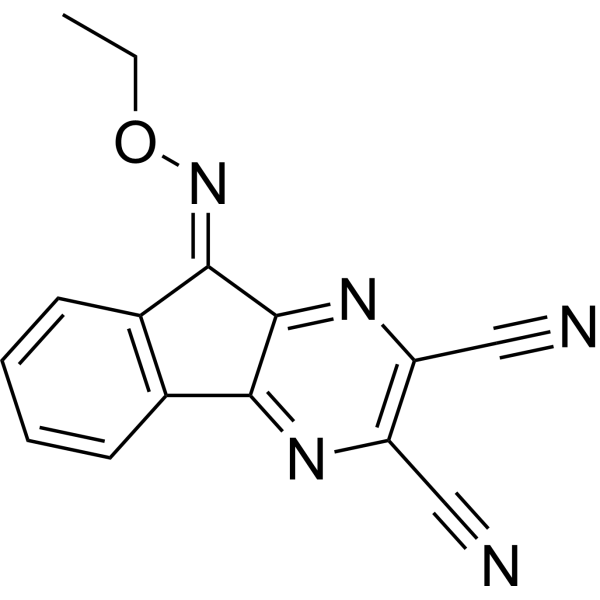
HY-50737A
DUB-IN-2Deubiquitinase Inhibitor -
HY-107986
GNE-6776USP7 Inhibitor
Publications Citing Use of MedChemExpress (MCE) USP7-IN-1
More- Nat Commun. 2019 Jan 24;10(1):411. [Abstract]
- Cell Death Dis. 2025 Dec 24. [Abstract]
- Cell Rep. 2024 Aug 5;43(8):114584. [Abstract]
- J Med Chem. 2022 Oct 27;65(20):13645-13659. [Abstract]
- Anim Cells Syst. 2024 May 11;28(1):237-250. [Abstract]
- Arch Pharm (Weinheim). 2023 Jul;356(7):e2200661. [Abstract]
- Cell Press Blue. 2026 Jul 3.
 Customer Validation & Images

-
WB


Biological Activity
Description
IC50 & Target
IC50: 77 μM (USP7)[1]
In Vitro
USP7-IN-1 (Example 2) is a selective and reversible inhibitor of USP7, with an IC50 of 77 μM, and shows no inhibition of USP8, USP5, Uch-L1, Uch-L3 or caspase 3. USP7-IN-1 inhibits the proliferation of HCT116 cells, with a GI50 of 67 μM[1].
MedChemExpress (MCE) has not independently confirmed the accuracy of these methods. They are for reference only. Further protocols information, click here.


Chemical Information
-
CAS No. 1381291-36-6
-
Appearance Solid
-
Molecular Weight 425.91
-
Formula C23H24ClN3O3
-
Color White to off-white
-
SMILES
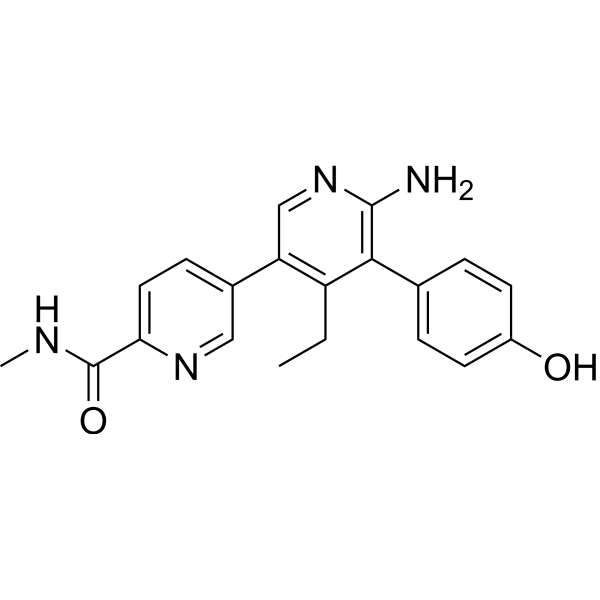
O=C1N(CC2(O)CCN(C(CCC3=CC=CC=C3)=O)CC2)C=NC4=C1C=CC(Cl)=C4
-
Shipping
Room temperature in continental US; may vary elsewhere.
-
Storage
Powder -20°C 3 years 4°C 2 years In solvent -80°C 2 years -20°C 1 year


Publications (7)
-
Journal Impact Factor
-
Most Recent
-
Nat Commun
Usp7 regulates Hippo pathway through deubiquitinating the transcriptional coactivator Yorkie. [Abstract]2019 Jan 24;10(1):411. PMID: 30679505
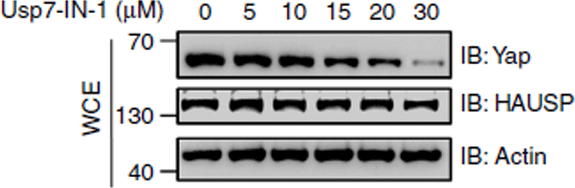
USP7-IN-1 purchased from MedChemExpress. Usage Cited in: Nat Commun. 2019 Jan 24;10(1):411. [Abstract]
Immunoblot analysis of lysates from Huh7 cells treated with Usp7-IN-1 at indicated concentrations for 24 h.
-
Cell Death Dis
SPOP and HAUSP bidirectionally regulate LZTS2 ubiquitination to modulate the Wnt pathway. [Abstract]2025 Dec 24. PMID: 41436424 -
Cell Rep
Oxidative stress reprograms the transcriptional coactivator Yki to suppress cell proliferation. [Abstract]2024 Aug 5;43(8):114584. PMID: 39106181 -
J Med Chem
Discovery of Potent OTUB1/USP8 Dual Inhibitors Targeting Proteostasis in Non-Small-Cell Lung Cancer. [Abstract]2022 Oct 27;65(20):13645-13659. PMID: 36221183 -
Anim Cells Syst
Blocking SLC7A11 attenuates the proliferation of esophageal squamous cell carcinoma cells. [Abstract]2024 May 11;28(1):237-250. PMID: 38741950 -
Arch Pharm (Weinheim)
2023 Jul;356(7):e2200661. PMID: 37196427 -


Solvent & Solubility
In Vitro:
DMSO : 100 mg/mL (234.79 mM; Need ultrasonic; Hygroscopic DMSO has a significant impact on the solubility of product, please use newly opened DMSO)
Please refer to the solubility information to select the appropriate solvent. Once prepared, please aliquot and store the solution to prevent product inactivation from repeated freeze-thaw cycles.
Storage method and period of stock solution: -80°C, 2 years; -20°C, 1 year. When stored at -80°C, please use it within 2 years. When stored at -20°C, please use it within 1 year.
Please refer to the solubility information to select the appropriate solvent. Once prepared, please aliquot and store the solution to prevent product inactivation from repeated freeze-thaw cycles.
Storage method and period of stock solution: -80°C, 2 years; -20°C, 1 year. When stored at -80°C, please use it within 2 years. When stored at -20°C, please use it within 1 year.
Concentration (start) × Volume (start) = Concentration (final) × Volume (final)
In Vivo:
Select the appropriate dissolution method based on your experimental animal and administration route.
- For the following dissolution methods, please ensure to first prepare a clear stock solution using an In Vitro approach and then sequentially add co-solvents:
- To ensure reliable experimental results, the clarified stock solution can be appropriately stored based on storage conditions. As for the working solution for In Vivo experiments, it is recommended to prepare freshly and use it on the same day.
- The percentages shown for the solvents indicate their volumetric ratio in the final prepared solution. If precipitation or phase separation occurs during preparation, heat and/or sonication can be used to aid dissolution.
Add each solvent one by one: 10% DMSO 40% PEG300 5% Tween-80 45% Saline
Solubility: ≥ 2.5 mg/mL (5.87 mM); Clear solution
This protocol yields a clear solution of ≥ 2.5 mg/mL (saturation unknown).
Taking 1 mL working solution as an example, add 100 μL DMSO stock solution (25.0 mg/mL) to 400 μL PEG300, and mix evenly; then add 50 μL Tween-80 and mix evenly; then add 450 μL Saline to adjust the volume to 1 mL.
Preparation of Saline: Dissolve 0.9 g sodium chloride in ddH₂O and dilute to 100 mL to obtain a clear Saline solution.
Add each solvent one by one: 10% DMSO 90% (20% SBE-β-CD in Saline)
Solubility: ≥ 2.5 mg/mL (5.87 mM); Clear solution
This protocol yields a clear solution of ≥ 2.5 mg/mL (saturation unknown).
Taking 1 mL working solution as an example, add 100 μL DMSO stock solution (25.0 mg/mL) to 900 μL 20% SBE-β-CD in Saline, and mix evenly.
Preparation of 20% SBE-β-CD in Saline (4°C, storage for one week): 2 g SBE-β-CD powder is dissolved in 10 mL Saline, completely dissolve until clear.
In Vivo Dissolution Calculator
Please enter the basic information of animal experiments:
-
-
-
-
Recommended: Prepare an additional quantity of animals to account for potential losses during experiments.
Please enter your animal formula composition:
-
%DMSO +
Recommended: Keep the proportion of DMSO in working solution below 2% if your animal is weak.
-
%+
-
+%Tween-80 + +
-
%Saline +
The co-solvents required include: DMSO, . All of co-solvents are available by MedChemExpress (MCE). , Tween 80. All of co-solvents are available by MedChemExpress (MCE).
Working solution concentration: 0.22 mg/mL
Method for preparing stock solution: mg drug dissolved in μL DMSO. Stock solution concentration: mg/mL.
1. Take μL DMSO stock solution;
2. Add μL .
μL , mix evenly;
3. Then add μL Tween 80, mix evenly;
4. Then add μL
Please ensure that the stock solution in the first step is dissolved to a clear state, and add co-solvents in sequence. You can use ultrasonic heating (ultrasonic cleaner, recommended frequency 20-40 kHz), vortexing, etc. to assist dissolution.

Protocols
-
Cell Cytotoxicity Assay
Cytotoxicity assays are usually based on the assessment of cell membrane damage, which can also be indirectly detected by measuring cell viability. Detection methods include MTT assay, CKK-8 assay, LDH assay and ATP assay, etc.


Purity & Documentation
-
Data Sheet (274 KB)
-
SDS (251 KB)
- English - EN (251 KB)
- Français - FR (251 KB)
- Deutsch - DE (251 KB)
- Norwegian - NO (251 KB)
- Español - ES (251 KB)
- Swedish - SV (251 KB)
- Italian - IT (251 KB)
- Korean - KR (251 KB)
- Portuguese - PT (251 KB)
-
Handling Instructions (2659 KB)
References


Complete Stock Solution Preparation Table
Please refer to the solubility information to select the appropriate solvent. Once prepared, please aliquot and store the solution to prevent product inactivation from repeated freeze-thaw cycles.
Storage method and period of stock solution: -80°C, 2 years; -20°C, 1 year. When stored at -80°C, please use it within 2 years. When stored at -20°C, please use it within 1 year.
| Optional Solvent | Concentration Solvent Mass | 1 mg | 5 mg | 10 mg | 25 mg |
|---|---|---|---|---|---|
| DMSO | 1 mM | 2.3479 mL | 11.7396 mL | 23.4791 mL | 58.6978 mL |
| 5 mM | 0.4696 mL | 2.3479 mL | 4.6958 mL | 11.7396 mL | |
| 10 mM | 0.2348 mL | 1.1740 mL | 2.3479 mL | 5.8698 mL | |
| 15 mM | 0.1565 mL | 0.7826 mL | 1.5653 mL | 3.9132 mL | |
| 20 mM | 0.1174 mL | 0.5870 mL | 1.1740 mL | 2.9349 mL | |
| 25 mM | 0.0939 mL | 0.4696 mL | 0.9392 mL | 2.3479 mL | |
| 30 mM | 0.0783 mL | 0.3913 mL | 0.7826 mL | 1.9566 mL | |
| 40 mM | 0.0587 mL | 0.2935 mL | 0.5870 mL | 1.4674 mL | |
| 50 mM | 0.0470 mL | 0.2348 mL | 0.4696 mL | 1.1740 mL | |
| 60 mM | 0.0391 mL | 0.1957 mL | 0.3913 mL | 0.9783 mL | |
| 80 mM | 0.0293 mL | 0.1467 mL | 0.2935 mL | 0.7337 mL | |
| 100 mM | 0.0235 mL | 0.1174 mL | 0.2348 mL | 0.5870 mL |


USP7-IN-1 Related Classifications
HY-16709 Related Classifications
 Powered by Bioz