



Corynoxine
Based on 4 publication(s) in Google Scholar
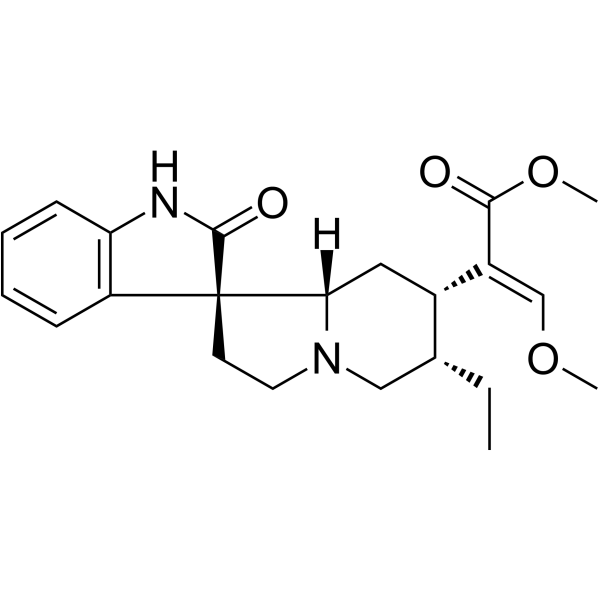
Corynoxine, a tetracyclic oxindole alkaloid, is isolated from the hooks of Uncaria rhynchophylla. Corynoxine is a natural autophagy enhancer that promotes the clearance of alpha-synuclein via Akt/mTOR pathway.
Nur für Forschungszwecke. Wir verkaufen nicht an Patienten.
- Reinheit: 99.89%
- CAS. Nr.: 6877-32-3
- Formel: C22H28N2O4
- Molecular Weight:384.47
-
Speicherung:Powder -20°C, 3 years , 4°C, 2 years ; In solvent -80°C, 2 years , -20°C, 1 year

To place orders, for customer services and technical support, please contact: MedChemExpress USA
Tel: 609-228-6898 E-mail: [email protected] [email protected]


-
 Biologische Aktivität
-
Chemical Information
-
Lösungsmittel & Löslichkeit
- Reinheit & Dokumentation
- Verweise
-
 Help & FAQs


Publications Citing Use of MedChemExpress (MCE) Corynoxine
More

Biologische Aktivität
Beschreibung
Cellular Effect
|
Cell Line

|
Type | Value | Description | References |
|---|---|---|---|---|
| HL-60 | IC50 |
>40 μM
Compound: 7
|
Cytotoxicity against human HL60 cells after 48 hrs by MTT assay
Cytotoxicity against human HL60 cells after 48 hrs by MTT assay
|
[PMID: 21070010] |
| SW480 | IC50 |
>40 μM
Compound: 7
|
Cytotoxicity against human SW480 cells after 48 hrs by MTT assay
Cytotoxicity against human SW480 cells after 48 hrs by MTT assay
|
[PMID: 21070010] |
In Vitro
Corynoxine (6.25-25 μM; 6-12 h) increases the expression of LC3-II, an autophagy specific marker, in N2a and SH-SY5Y cells in a dose-dependent manner[1].
Corynoxine (25 μM; 48 h) promotes the degradation of wild type (WT) and mutant (A53T) α-syn in inducible PC12 cells via autophagy induction[1].
MedChemExpress (MCE) has not independently confirmed the accuracy of these methods. They are for reference only.
-
Cell Line:N2a and SH-SY5Y cells
-
Concentration:6.25, 12.5, 25 μM
-
Incubation Time:6, 12 hours
-
Result:Induced autophagy in neuronal cell lines.
In Vivo


Chemical Information
-
CAS. Nr. 6877-32-3
-
Appearance Solid
-
Molecular Weight 384.47
-
Formel C22H28N2O4
-
Color White to off-white
-
SMILES
O=C(NC1=C2C=CC=C1)[C@@]32[C@@](C[C@H](/C(C(OC)=O)=C\OC)[C@H](CC)C4)([H])N4CC3
-
Structure Classification
-
Initial Source
-
Versand
Room temperature in continental US; may vary elsewhere.
-
Speicherung
Powder -20°C 3 years 4°C 2 years In solvent -80°C 2 years -20°C 1 year


Publications (4)
-
Journal Impact Factor
-
Most Recent
-
Toxicol Appl Pharmacol
Corynoxine suppresses hepatocellular carcinoma progression by forming the ROS-STAT3 cycle. [Abstract]2026 Jun 16:514:117917. PMID: 42303055 -
Transl Vis Sci Technol
Pathogenicity and Functional Analysis of Multi-Variant Allele of RPE65 Causing Retinitis Pigmentosa. [Abstract]2026 Feb 2;15(2):1. PMID: 41626883 -
Hereditas
Corynoxine suppresses lung adenocarcinoma proliferation and metastasis via inhibiting PI3K/AKT pathway and suppressing Cyclooxygenase-2 expression. [Abstract]2024 Nov 7;161(1):41. PMID: 39511658 -
Plant Biotechnol (Tokyo)
A sterile plant culture system of Uncaria rhynchophylla as a biosynthetic model of monoterpenoid indole alkaloids. [Abstract]2025 Jun 25;42(2):145-154. PMID: 40636431


Lösungsmittel & Löslichkeit
In Vitro:
DMSO : 100 mg/mL (260.10 mM; Need ultrasonic; Hygroscopic DMSO has a significant impact on the solubility of product, please use newly opened DMSO)
Please refer to the solubility information to select the appropriate solvent. Once prepared, please aliquot and store the solution to prevent product inactivation from repeated freeze-thaw cycles.
Storage method and period of stock solution: -80°C, 2 years; -20°C, 1 year. When stored at -80°C, please use it within 2 years. When stored at -20°C, please use it within 1 year.
Please refer to the solubility information to select the appropriate solvent. Once prepared, please aliquot and store the solution to prevent product inactivation from repeated freeze-thaw cycles.
Storage method and period of stock solution: -80°C, 2 years; -20°C, 1 year. When stored at -80°C, please use it within 2 years. When stored at -20°C, please use it within 1 year.
Konzentration (Stammlösung) × Volumen (Stammlösung) = Konzentration (Ziellösung) × Volumen (Ziellösung)
In Vivo:
Select the appropriate dissolution method based on your experimental animal and administration route.
- For the following dissolution methods, please ensure to first prepare a clear stock solution using an In Vitro approach and then sequentially add co-solvents:
- To ensure reliable experimental results, the clarified stock solution can be appropriately stored based on storage conditions. As for the working solution for In Vivo experiments, it is recommended to prepare freshly and use it on the same day.
- The percentages shown for the solvents indicate their volumetric ratio in the final prepared solution. If precipitation or phase separation occurs during preparation, heat and/or sonication can be used to aid dissolution.
Add each solvent one by one: 10% DMSO 40% PEG300 5% Tween-80 45% Saline
Solubility: ≥ 2.5 mg/mL (6.50 mM); Clear solution
This protocol yields a clear solution of ≥ 2.5 mg/mL (saturation unknown).
Taking 1 mL working solution as an example, add 100 μL DMSO stock solution (25.0 mg/mL) to 400 μL PEG300, and mix evenly; then add 50 μL Tween-80 and mix evenly; then add 450 μL Saline to adjust the volume to 1 mL.
Preparation of Saline: Dissolve 0.9 g sodium chloride in ddH₂O and dilute to 100 mL to obtain a clear Saline solution.
For the following dissolution methods, please prepare the working solution directly:
It is recommended to prepare fresh solutions and use them promptly within a short period of time.
The percentages shown for the solvents indicate their volumetric ratio in the final prepared solution. If precipitation or phase separation occurs during preparation, heat and/or sonication can be used to aid dissolution.
Add each solvent one by one: 0.5% CMC-Na/saline water
Solubility: 30 mg/mL (78.03 mM); Suspended solution; Need ultrasonic
In Vivo Dissolution Calculator
Please enter the basic information of animal experiments:
-
-
-
-
Recommended: Prepare an additional quantity of animals to account for potential losses during experiments.
Please enter your animal formula composition:
-
%DMSO +
Recommended: Keep the proportion of DMSO in working solution below 2% if your animal is weak.
-
%+
-
+%Tween-80 + +
-
%Saline +
The co-solvents required include: DMSO, . All of co-solvents are available by MedChemExpress (MCE). , Tween 80. All of co-solvents are available by MedChemExpress (MCE).
Working solution concentration: 0.22 mg/mL
Method for preparing stock solution: mg drug dissolved in μL DMSO. Stock solution concentration: mg/mL.
1. Take μL DMSO stock solution;
2. Add μL .
μL , mix evenly;
3. Then add μL Tween 80, mix evenly;
4. Then add μL
Please ensure that the stock solution in the first step is dissolved to a clear state, and add co-solvents in sequence. You can use ultrasonic heating (ultrasonic cleaner, recommended frequency 20-40 kHz), vortexing, etc. to assist dissolution.


Reinheit & Dokumentation
-
Data Sheet (276 KB)
-
SDS (479 KB)
- English - EN (479 KB)
- Français - FR (479 KB)
- Deutsch - DE (479 KB)
- Norwegian - NO (479 KB)
- Español - ES (479 KB)
- Swedish - SV (479 KB)
- Italian - IT (479 KB)
- Korean - KR (479 KB)
- Portuguese - PT (479 KB)
-
Handling Instructions (2659 KB)
Verweise
[1]. Chen LL, et al. Corynoxine, a natural autophagy enhancer, promotes the clearance of alpha-synuclein via Akt/mTOR pathway. J Neuroimmune Pharmacol. 2014 Jun;9(3):380-7. [Content Brief]
[2]. Sakakibara I, et, al. Effect of oxindole alkaloids from the hooks of Uncaria macrophylla on thiopental-induced hypnosis. Phytomedicine. 1998 Apr;5(2):83-6. [Content Brief]


Complete Stock Solution Preparation Table
Please refer to the solubility information to select the appropriate solvent. Once prepared, please aliquot and store the solution to prevent product inactivation from repeated freeze-thaw cycles.
Storage method and period of stock solution: -80°C, 2 years; -20°C, 1 year. When stored at -80°C, please use it within 2 years. When stored at -20°C, please use it within 1 year.
| Optional Solvent | Concentration Solvent Mass | 1 mg | 5 mg | 10 mg | 25 mg |
|---|---|---|---|---|---|
| DMSO | 1 mM | 2.6010 mL | 13.0049 mL | 26.0098 mL | 65.0246 mL |
| 5 mM | 0.5202 mL | 2.6010 mL | 5.2020 mL | 13.0049 mL | |
| 10 mM | 0.2601 mL | 1.3005 mL | 2.6010 mL | 6.5025 mL | |
| 15 mM | 0.1734 mL | 0.8670 mL | 1.7340 mL | 4.3350 mL | |
| 20 mM | 0.1300 mL | 0.6502 mL | 1.3005 mL | 3.2512 mL | |
| 25 mM | 0.1040 mL | 0.5202 mL | 1.0404 mL | 2.6010 mL | |
| 30 mM | 0.0867 mL | 0.4335 mL | 0.8670 mL | 2.1675 mL | |
| 40 mM | 0.0650 mL | 0.3251 mL | 0.6502 mL | 1.6256 mL | |
| 50 mM | 0.0520 mL | 0.2601 mL | 0.5202 mL | 1.3005 mL | |
| 60 mM | 0.0433 mL | 0.2167 mL | 0.4335 mL | 1.0837 mL | |
| 80 mM | 0.0325 mL | 0.1626 mL | 0.3251 mL | 0.8128 mL | |
| 100 mM | 0.0260 mL | 0.1300 mL | 0.2601 mL | 0.6502 mL |


Corynoxine Related Classifications
HY-N0901 Related Classifications
 Powered by Bioz