



aTAG 4531

Based on 1 Customer Validation
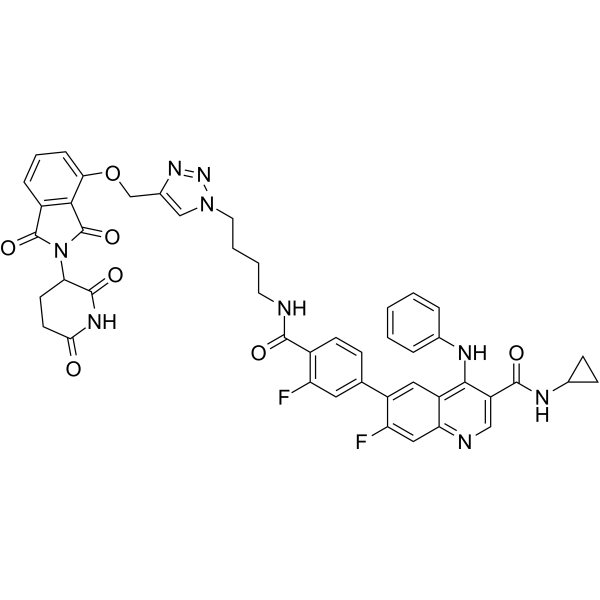
aTAG 4531 (CFT-4531) is a PROTAC-class degrader that induces the degradation of the MTH1/aTAG fusion protein by recruiting cereblon, with a DC50 of 0.28 nM in Jurkat cells. aTAG 4531 inhibits MTH1 enzymatic activity, with a Ki of 1.8 nM. aTAG 4531 rapidly, selectively and reversibly regulates SMART-CAR protein levels, CAR-mediated target cell killing and IL-2 release, and is applicable both in vitro and in vivo. aTAG 4531 can be used in studies of targeted protein degradation, target validation and CAR-T activity regulation.
(Pink: MTH1 ligand (HY-134725); Blue: Cereblon ligand (HY-126457); Black: linker (HY-108374)).
商品は「研究用試薬」です。人や動物の医療用・臨床診断用・食品用の製品ではありません。
研究用途以外に使用した場合、当社は一切の責任を負いかねます。
- 純度 : 99.1%
- CAS 番号: 2412985-00-1
- 分子式: C46H39F2N9O7
- 分子量:867.85
-
保管条件:Powder -20°C, 3 years ; In solvent -80°C, 6 months , -20°C, 1 month

To place orders, for customer services and technical support, please contact: MedChemExpress USA
Tel: 609-228-6898 E-mail: [email protected] [email protected]


-
 生物活性
生物活性
-
化学情報
- 純度とドキュメンテーション
- 参考文献
-
 Help & FAQs




生物活性
製品説明
IC50 & Target
[1]|
MTH1 1.8 nM (Ki) |
MTH1 0.28 nM (DC50) |
体外実験
aTAG 4531 potently inhibits the enzymatic activity of purified human MTH1 aTAG, with a Ki value of 1.8 nM[1].
The degradation of SMART-CAR and MTH1 induced by aTAG 4531 (10 nM; 4 h) in Jurkat T cells is reversible, and protein levels recover to basal levels within 72 h after degradation 剂 elution[1].
Treatment of Jurkat T cells with aTAG 4531 (1-10000 nM; 6 h) induces concentration-dependent degradation of SMART-CAR-HA and MTH1[1].
The degradation of SMART-CAR and MTH1 induced by aTAG 4531 (100 nM; 6 h) in Jurkat T cells is mediated via the CRBN-dependent proteasomal pathway, which is confirmed by rescue experiments using pathway-specific inhibitors and competitors[1].
aTAG 4531 (0.1-1000 nM) regulates CAR-T-mediated target cell killing in a concentration-dependent manner, with the peak inhibitory effect on Raji cell killing and the maximum degradation of SMART-CAR both occurring at 10 nM[1].
MedChemExpress (MCE) has not independently confirmed the accuracy of these methods. They are for reference only.
-
Cell Line:SMART-CAR (HA-tagged CD19 CAR fused to MTH1 aTAG) expressing Jurkat T-cells
-
Concentration:1-10000 nM
-
Incubation Time:6 h
-
Result:Induced concentration-dependent degradation of SMART-CAR-HA and endogenous MTH1.
Caused near-complete degradation observed at 10 nM.
Showed reduced degradation at the highest concentration (10,000 nM) consistent with the hook effect.
-
Cell Line:SMART-CAR (HA-tagged CD19 CAR fused to MTH1 aTAG) expressing Jurkat T-cells
-
Concentration:100 nM; 10 μM Pomalidomide (HY-10984)
-
Incubation Time:6 h (aTAG 4531 incubation); 1 h (Pomalidomide pre-incubation)
-
Result:Induced degradation of SMART-CAR and MTH1 that was completely rescued by pre-treatment with Bortezomib (HY-10227), MLN4924 (HY-10227), Pomalidomide, or MTH1 inhibitor.
Confirmed the degradation is mediated via the CRBN-dependent proteasomal pathway.
-
Cell Line:SMART-CAR (HA-tagged CD19 CAR fused to MTH1 aTAG) expressing Jurkat T-cells
-
Concentration:10 nM
-
Incubation Time:4 h; post-washout analysis up to 72 h
-
Result:Induced complete degradation of SMART-CAR and MTH1 after 4 h of treatment.
Allowed SMART-CAR and MTH1 protein levels to recover to basal levels over 72 h following degrader washout.
Parmacokinetics
体内実験
MedChemExpress (MCE) has not independently confirmed the accuracy of these methods. They are for reference only.
-
Animal Model:NOD SCID (female)[1]
-
Dosage:5 mg/kg
-
Administration:i.v.; single dose
-
Result:Reduced SMART-CAR protein expression to ~20% relative to vehicle-treated controls.
Spared endogenous mouse liver MTH1 from degradation.


化学情報
-
CAS 番号 2412985-00-1
-
性状 Solid
-
分子量 867.85
-
分子式 C46H39F2N9O7
-
Color White to off-white
-
SMILES
O=C(C1=C(F)C=C(C2=CC3=C(NC4=CC=CC=C4)C(C(NC5CC5)=O)=CN=C3C=C2F)C=C1)NCCCCN6N=NC(COC7=CC=CC(C(N8C9C(NC(CC9)=O)=O)=O)=C7C8=O)=C6
-
別名
CFT-4531
-
輸送条件
Room temperature in continental US; may vary elsewhere.
-
保管条件
Powder -20°C 3 years In solvent -80°C 6 months -20°C 1 month


純度とドキュメンテーション
-
データシート (274 KB)
-
SDS (254 KB)
- English - EN (254 KB)
- Français - FR (254 KB)
- Deutsch - DE (254 KB)
- Norwegian - NO (254 KB)
- Español - ES (254 KB)
- Swedish - SV (254 KB)
- Italian - IT (254 KB)
- Korean - KR (254 KB)
- Portuguese - PT (254 KB)
-
取扱説明書 (2659 KB)
参考文献

Calculators
濃度 (開始) × 体積 (開始) = 濃度 (終了) × 体積 (終了)


aTAG 4531 関連分類
HY-163168 関連分類
 Powered by Bioz