



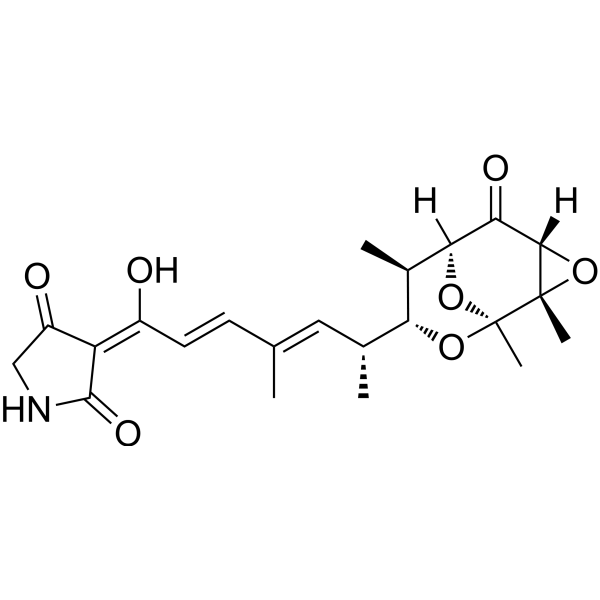
Tirandamycin A
Tirandamycin A, an antibiotic, is a bacterial RNA polymerase inhibitor. Tirandamycin A has antiamoebic and antibacterial properties.
Nur für Forschungszwecke. Wir verkaufen nicht an Patienten.
- CAS. Nr.: 34429-70-4
- Formel: C22H27NO7
- Molecular Weight:417.45
-
Speicherung:
Please store the product under the recommended conditions in the Certificate of Analysis.

To place orders, for customer services and technical support, please contact: MedChemExpress USA
Tel: 609-228-6898 E-mail: [email protected] [email protected]


-
 Biologische Aktivität
-
Chemical Information
- Protokoll
- Reinheit & Dokumentation
- Verweise
-
 Help & FAQs


Alle DNA/RNA Synthesis Isoform-spezifische Produkte anzeigen
MoreAlle Parasite Isoform-spezifische Produkte anzeigen
MoreAlle Antibiotic Isoform-spezifische Produkte anzeigen
More

Biologische Aktivität
Beschreibung
IC50 & Target
|
RNA Polymerase |
Amebae |
In Vitro
A 60 μM treatment with Tirandamycin A results in a slightly stronger inhibition, demonstrating a 84.2% reduction in growth of Entamoeba histolytica HM-1:IMSS and 64.8% reduction in growth by Entamoeba histolytica Col. Tirandamycin A inhibits chain initiation and elongation of bacterial RNA polymerase without acting on mammalian polymerases[1].
MedChemExpress (MCE) has not independently confirmed the accuracy of these methods. They are for reference only. Further protocols information, click here.


Chemical Information
-
CAS. Nr. 34429-70-4
-
Molecular Weight 417.45
-
Formel C22H27NO7
-
SMILES
O=C(/C1=C(O)\C=C\C(C)=C\[C@H]([C@@H]2[C@@H](C)[C@@]3([H])C([C@]4([H])O[C@]4(C)[C@@](O3)(C)O2)=O)C)NCC1=O
-
Structure Classification
-
Initial Source
Streptomyces flaveolus strain Tu 1240
-
Versand
Room temperature in continental US; may vary elsewhere.
-
Speicherung
Please store the product under the recommended conditions in the Certificate of Analysis.

Protokoll
-
Research Protocol for Infectious Diseases
Infectious-disease experiments test how pathogens interact with host barriers, innate immune receptors, inflammatory signaling, pathogen replication, and tissue injury; pattern-recognition receptors such as TLRs, RIG-I-like receptors, NOD-like receptors, and inflammasomes detect microbial molecules and activate NF-κB, interferon, and cytokine responses. The central hypothesis is that infection severity reflects the balance between pathogen burden and host response: protective inflammation restricts pathogen growth, whereas excessive or mislocalized inflammation contributes to tissue damage and disease phenotype. Unresolved questions include which host pathways are protective versus pathogenic, why some infection models fail to translate to human disease, and which combined readouts best predict clinically relevant infection outcomes.


Reinheit & Dokumentation
Verweise
[1]. Avelina Espinosa, et al. Antiamoebic properties of the actinomycete metabolites echinomycin A and tirandamycin A. Parasitol Res. 2012 Dec;111(6):2473-7. [Content Brief]
[2]. H Hagenmaier, et al. Metabiolic products of microorganisms. Tirandamycin B(author's transl). Arch Microbiol. 1976 Aug;109(1-2):65-74. [Content Brief]

Calculators
Konzentration (Stammlösung) × Volumen (Stammlösung) = Konzentration (Ziellösung) × Volumen (Ziellösung)


Tirandamycin A Related Classifications
HY-126406 Related Classifications
 Powered by Bioz