



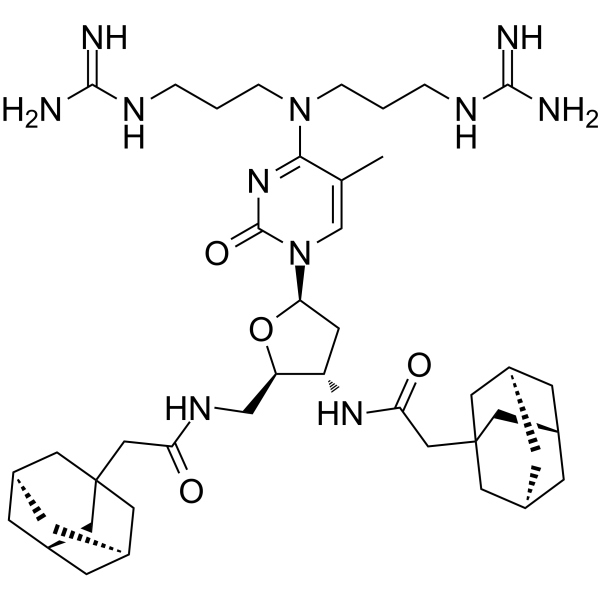
ADG-2e
ADG-2e is a potent antibacterial agent with MICs of 16, 4, 2, and 2 μg/mL for E. coli [KCTC 1682], P. aeruginosa [KCTC 1637], B.subtilis [KCTC 3068], and S. aureus [KCTC 1621], respectively. ADG-2e shows anti-metastatic activity against breast cancer cells.
Nos produits utilisent uniquement pour la recherche. Nous ne vendons pas aux patients.
- CAS No.: 2419951-75-8
- Formule: C42H67N11O4
- Masse moléculaire:790.05
-
Stockage:
Please store the product under the recommended conditions in the Certificate of Analysis.

To place orders, for customer services and technical support, please contact: MedChemExpress USA
Tel: 609-228-6898 E-mail: [email protected] [email protected]


-
 Activité biologique
-
Chemical Information
- Protocole
- Pureté et documentation
- Références
-
 Help & FAQs


Voir tous les produits spécifiques à Isoform Antibiotic
More

Activité biologique
Description
In Vitro
ADG-2e (1-64 μg/mL, 22 hours) exhibits twice the antibacterial activity compared to other antibiotics in methicillin-resistant S. aureus (MRSA) or multidrug-resistant P. aeruginosa (MDRPA) [1]. ADG-2e (0-60 μg/mL, 2 hours) shows only slight hemolysis with increasing concentration[1]. ADG-2e (0-100 μM, 24 hours) does not inhibit the proliferation of MDA-MB-231 cells but has a role in the migration of cancer cells by inserting into the surface of them and affecting cell motility[1]. ADG-2e (0-40 μM, 6 hours) causes actin reorganization to promote its multiple lamellar structures formation[1].
MedChemExpress (MCE) has not independently confirmed the accuracy of these methods. They are for reference only. Further protocols information, click here.
-
Cell Line:Sheep red blood cells (sRBCs)
-
Concentration:0-60 μg/mL
-
Incubation Time:2 hours
-
Result:Showed any hemolysis until 16 μg/mL and showed slight hemolysis at 32 μg/mL.
-
Cell Line:Metastatic breastcancer cell line MDA-MB-231
-
Concentration:0-100 μM
-
Incubation Time:24 hours
-
Result:No significant inhibitory effect on the proliferation of MDA-MB-231 cells.
-
Cell Line:Metastatic breastcancer cell line MDA-MB-231
-
Concentration:0-40 μM
-
Incubation Time:6 hours
-
Result:Showed an increase in actin lamellipodium generation.


Chemical Information
-
CAS No. 2419951-75-8
-
Masse moléculaire 790.05
-
Formule C42H67N11O4
-
SMILES
CC1=CN([C@H]2C[C@H](NC(CC34C[C@@H]5C[C@H](C3)C[C@H](C4)C5)=O)[C@@H](CNC(CC67C[C@@H]8C[C@H](C6)C[C@H](C7)C8)=O)O2)C(N=C1N(CCCNC(N)=N)CCCNC(N)=N)=O
-
Livraison
Room temperature in continental US; may vary elsewhere.
-
Stockage
Please store the product under the recommended conditions in the Certificate of Analysis.

Protocole
-
Research Protocol for Infectious Diseases
Infectious-disease experiments test how pathogens interact with host barriers, innate immune receptors, inflammatory signaling, pathogen replication, and tissue injury; pattern-recognition receptors such as TLRs, RIG-I-like receptors, NOD-like receptors, and inflammasomes detect microbial molecules and activate NF-κB, interferon, and cytokine responses. The central hypothesis is that infection severity reflects the balance between pathogen burden and host response: protective inflammation restricts pathogen growth, whereas excessive or mislocalized inflammation contributes to tissue damage and disease phenotype. Unresolved questions include which host pathways are protective versus pathogenic, why some infection models fail to translate to human disease, and which combined readouts best predict clinically relevant infection outcomes.
-
Breast Cancer Modeling
Breast cancer is a heterogeneous cancer, and it has been distinguished into four subtypes: luminal A, luminal B, HER2-positive and basal-like. Molecular mutations, epigenetic alterations, hormone exposure and immune microenvironment are related to the progression of breast cancer.


Pureté et documentation
Références

Calculators
Concentration (start) × Volume (start) = Concentration (final) × Volume (final)


ADG-2e Related Classifications
HY-147522 Related Classifications
 Powered by Bioz