



Cefetamet
Based on 1 publication(s) in Google Scholar
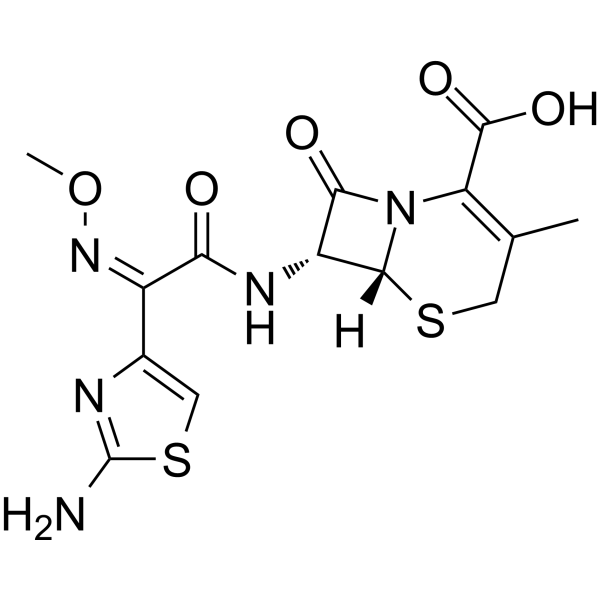
Cefetamet (Ro 15-8074) is a cephalosporin antibiotic and the active metabolite of Cefetamet pivoxil (HY-B1894A). Cefetamet binds to bacterial penicillin-binding protein (PBP) (IC50 for PBP3 in Escherichia coli W3110 is 2.5 μg/mL). Cefetamet has significant activity against Gram-negative bacteria such as Enterobacteriaceae, Neisseria species, and Haemophilus influenzae, as well as Gram-positive bacteria such as Streptococcus. Cefetamet kills and lyses Treponema pallidum. Cefetamet can be used in the research of respiratory tract, urinary tract, ear, nose and throat infections, and syphilis.
Nos produits utilisent uniquement pour la recherche. Nous ne vendons pas aux patients.
- Pureté : 99.06%
- CAS No.: 65052-63-3
- Formule: C14H15N5O5S2
- Masse moléculaire:397.43
-
Stockage:Powder -20°C, 3 years ; In solvent -80°C, 6 months , -20°C, 1 month

To place orders, for customer services and technical support, please contact: MedChemExpress USA
Tel: 609-228-6898 E-mail: [email protected] [email protected]


-
 Activité biologique
-
Chemical Information
-
Solvant et solubilité
- Protocole
- Pureté et documentation
- Références
-
 Help & FAQs


Publications Citing Use of MedChemExpress (MCE) Cefetamet
MoreVoir tous les produits spécifiques à Isoform Antibiotic
More

Activité biologique
Description
IC50 & Target
|
β-lactam |
In Vitro
Cefetamet exhibits high in vitro activity against most members of the Enterobacteriaceae, Haemophilus influenzae, Neisseria spp., and Streptococcus pneumoniae (MIC90 ≤ 2 μg/mL)[2].
Cefetamet shows high in vitro activity against Enterobacteriaceae, Neisseria spp., Vibrio spp., Haemophilus influenzae and streptococci other than enterococci[3].
Cefetamet exhibits poor affinity for the PBPs of Staphylococcus aureus, with IC50s of 90, >100, 52 and >100 μg/mL for PBP 1 to 4[3].
Cefetamet (0.05-0.1 μg/mL; 24 h) kills and lyses Treponema pallidum in vitro[4].
MedChemExpress (MCE) has not independently confirmed the accuracy of these methods. They are for reference only.
In Vivo
MedChemExpress (MCE) has not independently confirmed the accuracy of these methods. They are for reference only.


Chemical Information
-
CAS No. 65052-63-3
-
Appearance Solid
-
Masse moléculaire 397.43
-
Formule C14H15N5O5S2
-
Color White to off-white
-
SMILES
O=C(C(N12)=C(C)CS[C@]2([H])[C@H](NC(/C(C3=CSC(N)=N3)=N\OC)=O)C1=O)O
-
Synonyms
Ro 15-8074; Deacetoxycefotaxime
-
Livraison
Room temperature in continental US; may vary elsewhere.
-
Stockage
Powder -20°C 3 years In solvent -80°C 6 months -20°C 1 month


Publications (1)
-
Journal Impact Factor
-
Most Recent


Solvant et solubilité
In Vitro:
DMSO : 25 mg/mL (62.90 mM; Need ultrasonic; Hygroscopic DMSO has a significant impact on the solubility of product, please use newly opened DMSO)
Please refer to the solubility information to select the appropriate solvent. Once prepared, please aliquot and store the solution to prevent product inactivation from repeated freeze-thaw cycles.
Storage method and period of stock solution: -80°C, 6 months; -20°C, 1 month. When stored at -80°C, please use it within 6 months. When stored at -20°C, please use it within 1 month.
Please refer to the solubility information to select the appropriate solvent. Once prepared, please aliquot and store the solution to prevent product inactivation from repeated freeze-thaw cycles.
Storage method and period of stock solution: -80°C, 6 months; -20°C, 1 month. When stored at -80°C, please use it within 6 months. When stored at -20°C, please use it within 1 month.
Concentration (start) × Volume (start) = Concentration (final) × Volume (final)
In Vivo:
Select the appropriate dissolution method based on your experimental animal and administration route.
- For the following dissolution methods, please ensure to first prepare a clear stock solution using an In Vitro approach and then sequentially add co-solvents:
- To ensure reliable experimental results, the clarified stock solution can be appropriately stored based on storage conditions. As for the working solution for In Vivo experiments, it is recommended to prepare freshly and use it on the same day.
- The percentages shown for the solvents indicate their volumetric ratio in the final prepared solution. If precipitation or phase separation occurs during preparation, heat and/or sonication can be used to aid dissolution.
Add each solvent one by one: 10% DMSO 40% PEG300 5% Tween-80 45% Saline
Solubility: ≥ 2.5 mg/mL (6.29 mM); Clear solution
This protocol yields a clear solution of ≥ 2.5 mg/mL (saturation unknown).
Taking 1 mL working solution as an example, add 100 μL DMSO stock solution (25.0 mg/mL) to 400 μL PEG300, and mix evenly; then add 50 μL Tween-80 and mix evenly; then add 450 μL Saline to adjust the volume to 1 mL.
Preparation of Saline: Dissolve 0.9 g sodium chloride in ddH₂O and dilute to 100 mL to obtain a clear Saline solution.
Add each solvent one by one: 10% DMSO 90% (20% SBE-β-CD in Saline)
Solubility: ≥ 2.5 mg/mL (6.29 mM); Clear solution
This protocol yields a clear solution of ≥ 2.5 mg/mL (saturation unknown).
Taking 1 mL working solution as an example, add 100 μL DMSO stock solution (25.0 mg/mL) to 900 μL 20% SBE-β-CD in Saline, and mix evenly.
Preparation of 20% SBE-β-CD in Saline (4°C, storage for one week): 2 g SBE-β-CD powder is dissolved in 10 mL Saline, completely dissolve until clear.
In Vivo Dissolution Calculator
Please enter the basic information of animal experiments:
-
-
-
-
Recommended: Prepare an additional quantity of animals to account for potential losses during experiments.
Please enter your animal formula composition:
-
%DMSO +
Recommended: Keep the proportion of DMSO in working solution below 2% if your animal is weak.
-
%+
-
+%Tween-80 + +
-
%Saline +
The co-solvents required include: DMSO, . All of co-solvents are available by MedChemExpress (MCE). , Tween 80. All of co-solvents are available by MedChemExpress (MCE).
Working solution concentration: 0.22 mg/mL
Method for preparing stock solution: mg drug dissolved in μL DMSO. Stock solution concentration: mg/mL.
1. Take μL DMSO stock solution;
2. Add μL .
μL , mix evenly;
3. Then add μL Tween 80, mix evenly;
4. Then add μL
Please ensure that the stock solution in the first step is dissolved to a clear state, and add co-solvents in sequence. You can use ultrasonic heating (ultrasonic cleaner, recommended frequency 20-40 kHz), vortexing, etc. to assist dissolution.


Pureté et documentation
-
Fiche technique (281 KB)
-
SDS (394 KB)
- English - EN (394 KB)
- Français - FR (394 KB)
- Deutsch - DE (394 KB)
- Norwegian - NO (394 KB)
- Español - ES (394 KB)
- Swedish - SV (394 KB)
- Italian - IT (394 KB)
- Korean - KR (394 KB)
- Portuguese - PT (394 KB)
-
Instruction de manipulation (2659 KB)
Références
[1]. Wang W, et al. Pharmacokinetics and pharmacodynamics of oral and intravenous cefetamet in dog. Eur J Drug Metab Pharmacokinet. 2015 Dec;40(4):401-7. [Content Brief]
[2]. Wise R, et al. In vitro activity of Ro 15-8074 and Ro 19-5247, two orally administered cephalosporin metabolites. Antimicrob Agents Chemother. 1986 Jun;29(6):1067-72. [Content Brief]
[3]. Angehrn P, et al. In vitro antibacterial properties of cefetamet and in vivo activity of its orally absorbable ester derivative, cefetamet pivoxil. Eur J Clin Microbiol Infect Dis. 1989 Jun;8(6):536-43. [Content Brief]
[4]. Fitzgerald TJ. Effects of cefetamet (Ro 15-8074) on Treponema pallidum and experimental syphilis. Antimicrob Agents Chemother. 1992 Mar;36(3):598-602. [Content Brief]
[5]. Bryson HM, et al. Cefetamet pivoxil. A review of its antibacterial activity, pharmacokinetic properties and therapeutic use. Drugs. 1993;45(4):589-621. [Content Brief]


Complete Stock Solution Preparation Table
Please refer to the solubility information to select the appropriate solvent. Once prepared, please aliquot and store the solution to prevent product inactivation from repeated freeze-thaw cycles.
Storage method and period of stock solution: -80°C, 6 months; -20°C, 1 month. When stored at -80°C, please use it within 6 months. When stored at -20°C, please use it within 1 month.
| Optional Solvent | Concentration Solvent Mass | 1 mg | 5 mg | 10 mg | 25 mg |
|---|---|---|---|---|---|
| DMSO | 1 mM | 2.5162 mL | 12.5808 mL | 25.1617 mL | 62.9042 mL |
| 5 mM | 0.5032 mL | 2.5162 mL | 5.0323 mL | 12.5808 mL | |
| 10 mM | 0.2516 mL | 1.2581 mL | 2.5162 mL | 6.2904 mL | |
| 15 mM | 0.1677 mL | 0.8387 mL | 1.6774 mL | 4.1936 mL | |
| 20 mM | 0.1258 mL | 0.6290 mL | 1.2581 mL | 3.1452 mL | |
| 25 mM | 0.1006 mL | 0.5032 mL | 1.0065 mL | 2.5162 mL | |
| 30 mM | 0.0839 mL | 0.4194 mL | 0.8387 mL | 2.0968 mL | |
| 40 mM | 0.0629 mL | 0.3145 mL | 0.6290 mL | 1.5726 mL | |
| 50 mM | 0.0503 mL | 0.2516 mL | 0.5032 mL | 1.2581 mL | |
| 60 mM | 0.0419 mL | 0.2097 mL | 0.4194 mL | 1.0484 mL |


Cefetamet Related Classifications
HY-A0111 Related Classifications
 Powered by Bioz