



Kaolin

Based on 1 Customer Validation
Kaolin is a family of kaolinitic clays, which is found in the earth's crust. Kaolin alleviates the toxicity of graphene oxide for mammalian cells. Kaolin can be utilized in industrial, cosmetic and medical fields, excipient.
Nos produits utilisent uniquement pour la recherche. Nous ne vendons pas aux patients.
- CAS No.: 1332-58-7
- Formule: Al2Si2O5(OH)4·2H2O
- Masse moléculaire:258.16
-
Stockage:
Store at room temperature 3 years.
In solvent -80°C, 2 years , -20°C, 1 year


To place orders, for customer services and technical support, please contact: MedChemExpress USA
Tel: 609-228-6898 E-mail: [email protected] [email protected]


-
 Activité biologique
-
Chemical Information
- Pureté et documentation
- Références
-
 Help & FAQs


-

HY-D0835A
Hydroxylapatite (<50 nm)Natural Calcium Phosphate -

HY-W051271
Titanium(IV) oxidePhotocatalyst -

HY-W096178B
Silica sand, 1-2mmBiochemical Assay Reagent -
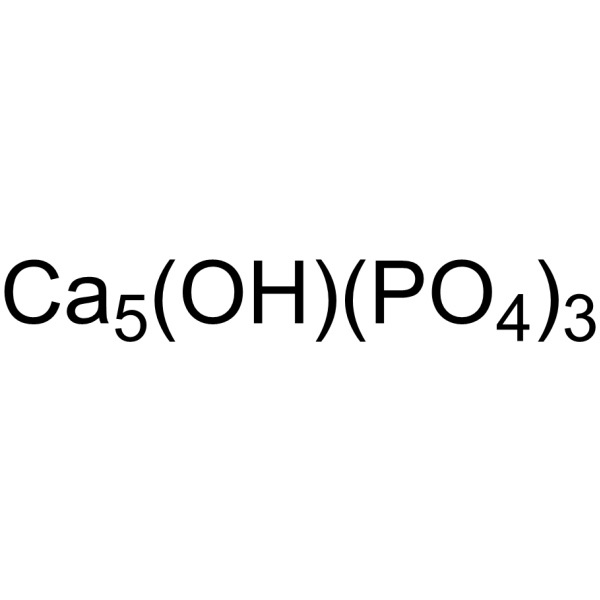
HY-D0835
Hydroxylapatite (25-45 μm)Calcium Phosphate -

HY-W116336B
Zinc oxide, 99.99% metals basisBiochemical Assay Reagents -

HY-W116336D
Zinc oxide, <100 nm particle sizeNitrate Reductase Activator -

HY-Y0498
Aluminum oxideAdjuvant -

HY-Y1219H
Silica gel, high-purity grade, 200-400 meshDesiccant -

HY-W111403
Calcium oxideHeterogeneous Base Catalyst -

HY-Y1213
CarbonPharmaceutical Excipient
Voir tous les produits spécifiques à Isoform TNF Receptor
More

Activité biologique
Description
In Vitro
Kaolin (50, 100 μg/mL, 72 h) combined with graphene oxide (50, 100 μg/mL, 72 h) reduces the toxicity of graphene and decreases the percentage of cells in HCT-116 cells[3].
Kaolin (100 μg/mL, 30-180 min) induces intercellular ROS generation in RAW264 cells[4].
Kaolin (100 μg/mL, 24 h) increases the concentrations of interleukin-1β (IL-1β) and tumor necrosis factor-α (TNF-α) in RAW264 cells[4].
Kaolin (100 μg/mL, 60 min) increases DNA damage in the A549 cells co-cultured with RAW264 cells[4].
MedChemExpress (MCE) has not independently confirmed the accuracy of these methods. They are for reference only.
In Vivo
Kaolin (5.0/0.1 mg/mL in 0.15 M NaCl, intratracheal inoculation, lasting for 24 h-210 days) incites acute inflammatory reaction at early periods and increases in the fibroblastic activity in the focal areas in mice[5].
MedChemExpress (MCE) has not independently confirmed the accuracy of these methods. They are for reference only.
-
Animal Model:ICR mice[4]
-
Dosage:0.05 and 0.2 mg
-
Administration:intratracheal instillation, lasting for 3 h
-
Result:Significantly induced DNA damage in the lungs of the mice.


Chemical Information
-
CAS No. 1332-58-7
-
Appearance Solid
-
Masse moléculaire 258.16
-
Formule Al2Si2O5(OH)4·2H2O
-
Color White to off-white
-
SMILES
[Kaolin]
-
Livraison
Room temperature in continental US; may vary elsewhere.
-
Stockage
Store at room temperature 3 years
In solvent -80°C 2 years -20°C 1 year


Pureté et documentation
-
Fiche technique (272 KB)
-
SDS (421 KB)
- English - EN (421 KB)
- Français - FR (421 KB)
- Deutsch - DE (421 KB)
- Norwegian - NO (421 KB)
- Español - ES (421 KB)
- Swedish - SV (421 KB)
- Italian - IT (421 KB)
- Korean - KR (421 KB)
- Portuguese - PT (421 KB)
-
Instruction de manipulation (2659 KB)
Références
[1]. Elder DP, et al. Pharmaceutical excipients - quality, regulatory and biopharmaceutical considerations. Eur J Pharm Sci. 2016 May 25;87:88-99. [Content Brief]
[3]. Rozhina E, et al. Kaolin alleviates the toxicity of graphene oxide for mammalian cells. Medchemcomm. 2019 Jun 10;10(8):1457-1464. [Content Brief]
[4]. Kato T, et al. Effect of physicochemical character differences on the genotoxic potency of kaolin. Genes Environ. 2017 May 1;39:12. [Content Brief]
[5]. Sahu AP, Shanker R, Zaidi SH. Pulmonary response to kaolin, mica and talc in mice. Exp Pathol (Jena). 1978;16(1-6):276-82. [Content Brief]

Calculators
Concentration (start) × Volume (start) = Concentration (final) × Volume (final)


Kaolin Related Classifications
HY-W115786 Related Classifications
 Powered by Bioz
Keywords
- Kaolin
- 1332-58-7
- Environmental Pollutants
- TNF Receptor
- Reactive Oxygen Species (ROS)
- Biochemical Assay Reagents
- Interleukin Related
- pharmaceutical excipient
- pharmaceutical auxiliarie
- pharmaceutical ingredients
- inactive ingredients
- stability
- solubility
- processability
- absorption
- distribution
- metabolism
- and elimination (ADME)
- Inhibitor
- inhibitor
- inhibit