



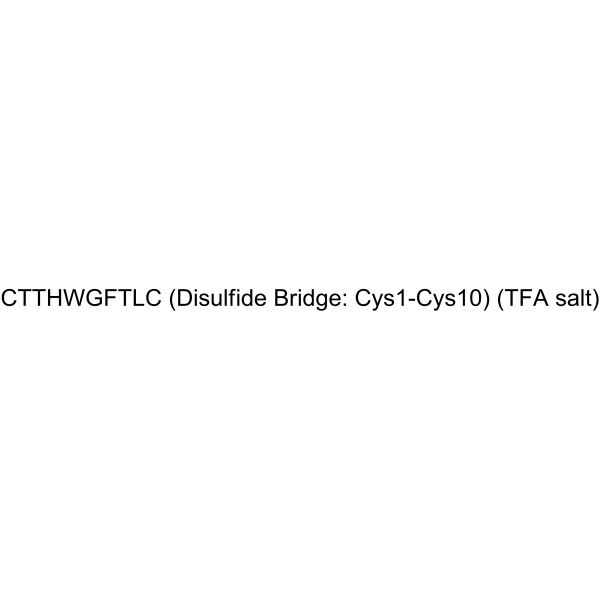
CTTHWGFTLC, CYCLIC TFA

Based on 1 Customer Validation
CTTHWGFTLC, CYCLIC TFA is a cyclic peptide inhibitor for matrix metalloproteinases MMP-2 and MMP-9. The IC50 value for MMP-9 is ~8 μM.
Nur für Forschungszwecke. Wir verkaufen nicht an Patienten.
- Reinheit : 98.52%
- Formel: C54H72F3N13O16S2
- Molecular Weight:1280.35
-
Speicherung:
Sealed storage, away from moisture and light, under nitrogen.
Powder -80°C, 2 years , -20°C, 1 year* In solvent : -80°C, 6 months; -20°C, 1 month (sealed storage, away from moisture and light, under nitrogen)

To place orders, for customer services and technical support, please contact: MedChemExpress USA
Tel: 609-228-6898 E-mail: [email protected] [email protected]


-
 Biologische Aktivität
-
Chemical Information
-
Lösungsmittel & Löslichkeit
- Protokoll
- Reinheit & Dokumentation
- Verweise
-
 Help & FAQs




Biologische Aktivität
Beschreibung
IC50 & Target
|
MMP-2 |
MMP-9 |
In Vitro
CTTHWGFTLC, CYCLIC TFA inhibits endothelial and tumor cell migration in vitro[1].
MedChemExpress (MCE) has not independently confirmed the accuracy of these methods. They are for reference only.
In Vivo
MedChemExpress (MCE) has not independently confirmed the accuracy of these methods. They are for reference only.


Chemical Information
-
Appearance Solid
-
Molecular Weight 1280.35
-
Formel C54H72F3N13O16S2
-
Color White to off-white
-
Sequence
Cys-Thr-Thr-His-Trp-Gly-Phe-Thr-Leu-Cys (Disulfide Bridge: Cys1-Cys10)
-
Sequence Shortening
CTTHWGFTLC (Disulfide Bridge: Cys1-Cys10)
-
Versand
Room temperature in continental US; may vary elsewhere.
-
Speicherung
Sealed storage, away from moisture and light, under nitrogen
Powder -80°C 2 years -20°C 1 year * In solvent : -80°C, 6 months; -20°C, 1 month (sealed storage, away from moisture and light, under nitrogen)


Lösungsmittel & Löslichkeit
In Vitro:
DMSO : ≥ 50 mg/mL (39.05 mM; Hygroscopic DMSO has a significant impact on the solubility of product, please use newly opened DMSO)
* "≥" means soluble, but saturation unknown.
Please refer to the solubility information to select the appropriate solvent. Once prepared, please aliquot and store the solution to prevent product inactivation from repeated freeze-thaw cycles.
Storage method and period of stock solution: -80°C, 6 months; -20°C, 1 month (sealed storage, away from moisture and light, under nitrogen). When stored at -80°C, please use it within 6 months. When stored at -20°C, please use it within 1 month.
Please refer to the solubility information to select the appropriate solvent. Once prepared, please aliquot and store the solution to prevent product inactivation from repeated freeze-thaw cycles.
Storage method and period of stock solution: -80°C, 6 months; -20°C, 1 month (sealed storage, away from moisture and light, under nitrogen). When stored at -80°C, please use it within 6 months. When stored at -20°C, please use it within 1 month.
Konzentration (Stammlösung) × Volumen (Stammlösung) = Konzentration (Ziellösung) × Volumen (Ziellösung)


Reinheit & Dokumentation
-
Data Sheet (268 KB)
-
SDS (252 KB)
- English - EN (252 KB)
- Français - FR (252 KB)
- Deutsch - DE (252 KB)
- Norwegian - NO (252 KB)
- Español - ES (252 KB)
- Swedish - SV (252 KB)
- Italian - IT (252 KB)
- Korean - KR (252 KB)
- Portuguese - PT (252 KB)
-
Handling Instructions (2659 KB)
Verweise


Complete Stock Solution Preparation Table
Please refer to the solubility information to select the appropriate solvent. Once prepared, please aliquot and store the solution to prevent product inactivation from repeated freeze-thaw cycles.
Storage method and period of stock solution: -80°C, 6 months; -20°C, 1 month (sealed storage, away from moisture and light, under nitrogen). When stored at -80°C, please use it within 6 months. When stored at -20°C, please use it within 1 month.
| Optional Solvent | Concentration Solvent Mass | 1 mg | 5 mg | 10 mg | 25 mg |
|---|---|---|---|---|---|
| DMSO | 1 mM | 0.7810 mL | 3.9052 mL | 7.8104 mL | 19.5259 mL |
| 5 mM | 0.1562 mL | 0.7810 mL | 1.5621 mL | 3.9052 mL | |
| 10 mM | 0.0781 mL | 0.3905 mL | 0.7810 mL | 1.9526 mL | |
| 15 mM | 0.0521 mL | 0.2603 mL | 0.5207 mL | 1.3017 mL | |
| 20 mM | 0.0391 mL | 0.1953 mL | 0.3905 mL | 0.9763 mL | |
| 25 mM | 0.0312 mL | 0.1562 mL | 0.3124 mL | 0.7810 mL | |
| 30 mM | 0.0260 mL | 0.1302 mL | 0.2603 mL | 0.6509 mL |


CTTHWGFTLC, CYCLIC TFA Related Classifications
HY-P1789A Related Classifications
 Powered by Bioz