



Defensin HNP-1 human

Based on 1 Customer Validation
Defensin HNP-1 human is a type of human neutrophil peptide (HNPs). Defensin HNP-1 human possesses immunomodulatory functions and can delay the apoptosis of neutrophils. Defensin HNP-1 human inhibits DNA/RNA/protein synthesis and interferes with metabolic pathways, thus exhibiting broad antibacterial activity. Defensin HNP-1 human has direct inactivation effects on HIV, HSV-1, HSV-2, CMV, influenza virus, etc. Defensin HNP-1 human has antileishmanial activity. Defensin HNP-1 human is involved in endothelial cell dysfunction during the early development of atherosclerosis.
For research use only. We do not sell to patients.
- Purity : 98.12%
- CAS No.: 148093-65-6
- Formula: C150H222N44O38S6
- Molecular Weight:3442.03
-
Storage:
Sealed storage, away from moisture.
Powder -80°C, 2 years , -20°C, 1 year* In solvent : -80°C, 6 months; -20°C, 1 month (sealed storage, away from moisture)

To place orders, for customer services and technical support, please contact: MedChemExpress USA
Tel: 609-228-6898 E-mail: [email protected] [email protected]


-
 Biological Activity
-
Chemical Information
-
Solvent & Solubility
- Purity & Documentation
- References
-
 Help & FAQs




Biological Activity
Description
|
Leishmania |
HSV-1 |
HSV-2 |
NLRP3 inflammasome |
In Vitro
Defensin HNP-1 human (0-60 μg/mL, 16 h) exhibits concentration-dependent anti-leishmania protozoan activity, causing necrosis of the pre-flagellate bodies[1].
Defensin HNP-1 human (0-60 μg/mL, 18-24 h) enhances the activity of neutrophils, delays the apoptosis of neutrophils that have not been infected with Leishmania major, and has no effect on the apoptosis of neutrophils that are already infected[1].
Defensin HNP-1 human (20 μg/mL, 18 h) induces neutrophils to produce TNF-α and IL-8, reduces the TGF-β level in the infected group, and significantly decreases the survival rate of parasites in neutrophils[1].
Defensin HNP-1 human upregulates the production of TNF-α and IL-1β in Staphylococcus aureus or monocytes at low concentrations, downregulates the level of IL-10, activates the NLRP3 inflammasome in macrophages induced by LPS (HY-D1056), and promotes the release of IL-1β[3].
MedChemExpress (MCE) has not independently confirmed the accuracy of these methods. They are for reference only.
-
Cell Line:Neutrophils with or without Leishmania major infection
-
Concentration:20 μg/mL
-
Incubation Time:18 h
-
Result:Delayed the apoptosis of uninfected neutrophils and increases the proportion of living cells.
Had no effect on the apoptosis of infected neutrophils.
-
Cell Line:Neutrophils
-
Concentration:20 μg/mL
-
Incubation Time:18 h
-
Result:Promoted the production of pro-inflammatory factor TNF-α and inhibited the immunosuppressive factor TGF-β.
In Vivo
MedChemExpress (MCE) has not independently confirmed the accuracy of these methods. They are for reference only.
-
Animal Model:Atherogenesis model established in ApoE-/- female mice[2]
-
Dosage:10 and 30 μg/mouse
-
Administration:Intravenous injection (i.v.), once every other day for 6 weeks
-
Result:Reduced plasma cholesterol, but also promoted the development of atherosclerotic lesions.


Chemical Information
-
CAS No. 148093-65-6
-
Appearance Solid
-
Molecular Weight 3442.03
-
Formula C150H222N44O38S6
-
Color White to off-white
-
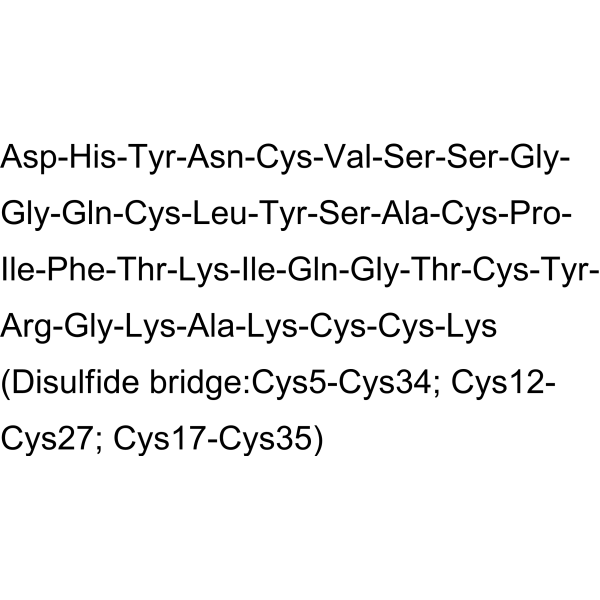
Sequence
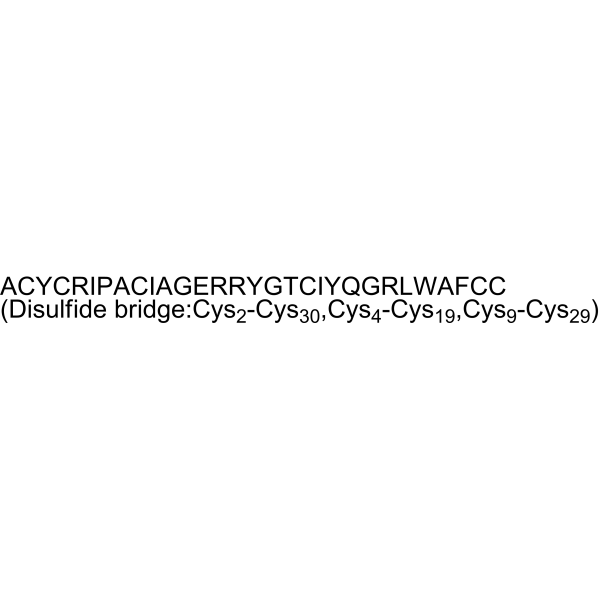
Ala-Cys-Tyr-Cys-Arg-Ile-Pro-Ala-Cys-Ile-Ala-Gly-Glu-Arg-Arg-Tyr-Gly-Thr-Cys-Ile-Tyr-Gln-Gly-Arg-Leu-Trp-Ala-Phe-Cys-Cys (Disulfide bridge:Cys2-Cys30,Cys4-Cys19,Cys9-Cys29)
-
Sequence Shortening
ACYCRIPACIAGERRYGTCIYQGRLWAFCC (Disulfide bridge:Cys2-Cys30,Cys4-Cys19,Cys9-Cys29)
-
Shipping
Room temperature in continental US; may vary elsewhere.
-
Storage
Sealed storage, away from moisture
Powder -80°C 2 years -20°C 1 year * In solvent : -80°C, 6 months; -20°C, 1 month (sealed storage, away from moisture)


Solvent & Solubility
In Vitro
H2O
Peptide Solubility and Storage Guidelines:
1. Calculate the length of the peptide.
2. Calculate the overall charge of the entire peptide according to the following table:
| Contents | Assign value | |
|---|---|---|
| Acidic amino acid | Asp (D), Glu (E), and the C-terminal -COOH. | -1 |
| Basic amino acid | Arg (R), Lys (K), His (H), and the N-terminal -NH2 | +1 |
| Neutral amino acid | Gly (G), Ala (A), Leu (L), Ile (I), Val (V), Cys (C), Met (M), Thr (T), Ser (S), Phe (F), Tyr (Y), Trp (W), Pro (P), Asn (N), Gln (Q) | 0 |
3. Recommended solution:
| Overall charge of peptide | Details |
|---|---|
| Negative (<0) |
1. Try to dissolve the peptide in water first. 2. If water fails, add NH4OH (<50 μL). 3. If the peptide still does not dissolve, add DMSO (50-100 μL) to solubilize the peptide. |
| Positive (>0) |
1. Try to dissolve the peptide in water first. 2. If water fails, try dissolving the peptide in a 10%-30% acetic acid solution. 3. If the peptide still does not dissolve, try dissolving the peptide in a small amount of DMSO. |
| Zero (=0) |
1. Try to dissolve the peptide in organic solvent (acetonitrile, methanol, etc.) first. 2. For very hydrophobic peptides, try dissolving the peptide in a small amount of DMSO, and then dilute the solution with water to the desired concentration. |


Purity & Documentation
-
Data Sheet (266 KB)
-
SDS (252 KB)
- English - EN (252 KB)
- Français - FR (252 KB)
- Deutsch - DE (252 KB)
- Norwegian - NO (252 KB)
- Español - ES (252 KB)
- Swedish - SV (252 KB)
- Italian - IT (252 KB)
- Korean - KR (252 KB)
- Portuguese - PT (252 KB)
-
Handling Instructions (2659 KB)
References
[1]. Dabirian S, et, al. Human neutrophil peptide-1 (HNP-1): a new anti-leishmanial drug candidate. PLoS Negl Trop Dis. 2013 Oct 17;7(10):e2491. [Content Brief]
[2]. Higazi M, et, al. Opposing effects of HNP1 (α-defensin-1) on plasma cholesterol and atherogenesis. PLoS One. 2020 Apr 17;15(4):e0231582. [Content Brief]
[3]. Zhang J, et al. HNP-1: From Structure to Application Thanks to Multifaceted Functions. Microorganisms. 2025 Feb 19;13(2):458. [Content Brief]

Calculators
Concentration (start) × Volume (start) = Concentration (final) × Volume (final)


Defensin HNP-1 human Related Classifications
HY-P2310 Related Classifications
 Powered by Bioz