



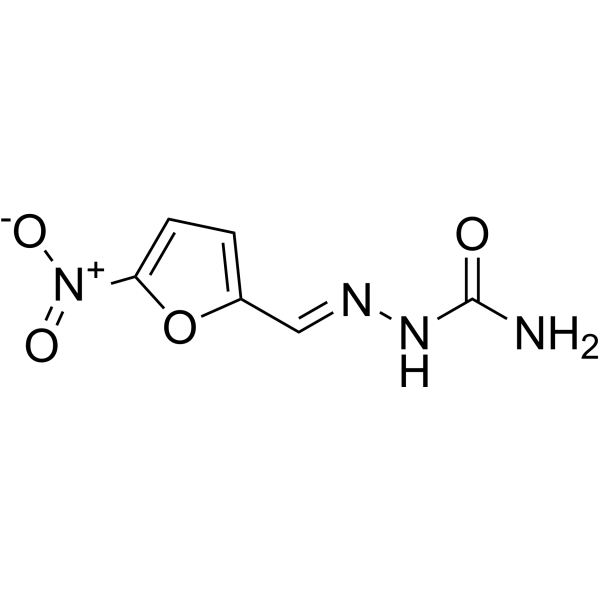
(E)-Nitrofurazone
(E)-Nitrofurazone ((E)-Nitrofural) is a topical broad-spectrum antibacterial agent effective against both Gram-negative and Gram-positive bacteria. (E)-Nitrofurazone also possesses antiprotozoal and antiparasitic activities. (E)-Nitrofurazone is commonly used in the research of superficial wounds, burns, skin infections, pyoderma, infectious skin diseases, trypanosomiasis, and acute bacillary dysentery.
For research use only. We do not sell to patients.
- Purity : 98.83%
- CAS No.: 112574-44-4
- Formula: C6H6N4O4
- Molecular Weight:198.14
-
Storage:Powder -20°C, 3 years , 4°C, 2 years ; In solvent -80°C, 6 months , -20°C, 1 month

To place orders, for customer services and technical support, please contact: MedChemExpress USA
Tel: 609-228-6898 E-mail: [email protected] [email protected]


-
 Biological Activity
-
Chemical Information
-
Solvent & Solubility
- Protocols
- Purity & Documentation
- References
-
 Help & FAQs


All Parasite Isoforms
More

Biological Activity
Description
Cellular Effect
|
Cell Line

|
Type | Value | Description | References |
|---|---|---|---|---|
| THP-1 | IC50 |
>100 μM
Compound: NFZ
|
Cytotoxicity against human THP-1 cells assessed as inhibition of cell growth incubated for 48 hrs by resazurin dye based assay
Cytotoxicity against human THP-1 cells assessed as inhibition of cell growth incubated for 48 hrs by resazurin dye based assay
|
[PMID: 36516584] |
| THP-1 | IC50 |
>100 μM
Compound: NFZ
|
Cytotoxicity against human THP-1 cells assessed as inhibition of cell growth incubated for 72 hrs by resazurin staining based analysis
Cytotoxicity against human THP-1 cells assessed as inhibition of cell growth incubated for 72 hrs by resazurin staining based analysis
|
[PMID: 37859713] |
| V79 | IC50 |
270 μM
Compound: Nitrofurazone
|
Differential hypoxic cytotoxicity towards chinese hamster cells (V79) using MTT assay under anaerobic conditions
Differential hypoxic cytotoxicity towards chinese hamster cells (V79) using MTT assay under anaerobic conditions
|
10.1016/0960-894X(95)00352-T |
| V79 | IC50 |
740 μM
Compound: Nitrofurazone
|
Differential hypoxic cytotoxicity towards chinese hamster cells (V79) using MTT assay under aerobic conditions
Differential hypoxic cytotoxicity towards chinese hamster cells (V79) using MTT assay under aerobic conditions
|
10.1016/0960-894X(95)00352-T |
| Vero | IC50 |
>100 μM
Compound: NFZ
|
Cytotoxicity against African green monkey Vero cells assessed as inhibition of cell growth incubated for 48 hrs by resazurin dye based assay
Cytotoxicity against African green monkey Vero cells assessed as inhibition of cell growth incubated for 48 hrs by resazurin dye based assay
|
[PMID: 36516584] |
| Vero | IC50 |
>100 μM
Compound: NFZ
|
Cytotoxicity against African green monkey Vero cells assessed as inhibition of cell growth incubated for 48 hrs by resazurin staining based analysis
Cytotoxicity against African green monkey Vero cells assessed as inhibition of cell growth incubated for 48 hrs by resazurin staining based analysis
|
[PMID: 37859713] |


Chemical Information
-
CAS No. 112574-44-4
-
Appearance Solid
-
Molecular Weight 198.14
-
Formula C6H6N4O4
-
Color Light yellow to yellow
-
SMILES
O=[N+](C1=CC=C(/C=N/NC(N)=O)O1)[O-]
-
Synonyms
(E)-Nitrofural
-
Shipping
Room temperature in continental US; may vary elsewhere.
-
Storage
Powder -20°C 3 years 4°C 2 years In solvent -80°C 6 months -20°C 1 month


Solvent & Solubility
In Vitro:
DMSO : 6.25 mg/mL (31.54 mM; Need ultrasonic; Hygroscopic DMSO has a significant impact on the solubility of product, please use newly opened DMSO)
Please refer to the solubility information to select the appropriate solvent. Once prepared, please aliquot and store the solution to prevent product inactivation from repeated freeze-thaw cycles.
Storage method and period of stock solution: -80°C, 6 months; -20°C, 1 month. When stored at -80°C, please use it within 6 months. When stored at -20°C, please use it within 1 month.
Please refer to the solubility information to select the appropriate solvent. Once prepared, please aliquot and store the solution to prevent product inactivation from repeated freeze-thaw cycles.
Storage method and period of stock solution: -80°C, 6 months; -20°C, 1 month. When stored at -80°C, please use it within 6 months. When stored at -20°C, please use it within 1 month.
Concentration (start) × Volume (start) = Concentration (final) × Volume (final)

Protocols
-
Research Protocol for Infectious Diseases
Infectious-disease experiments test how pathogens interact with host barriers, innate immune receptors, inflammatory signaling, pathogen replication, and tissue injury; pattern-recognition receptors such as TLRs, RIG-I-like receptors, NOD-like receptors, and inflammasomes detect microbial molecules and activate NF-κB, interferon, and cytokine responses. The central hypothesis is that infection severity reflects the balance between pathogen burden and host response: protective inflammation restricts pathogen growth, whereas excessive or mislocalized inflammation contributes to tissue damage and disease phenotype. Unresolved questions include which host pathways are protective versus pathogenic, why some infection models fail to translate to human disease, and which combined readouts best predict clinically relevant infection outcomes.
-
Gram Staining of Tissue Sections
Gram staining of tissue sections is a histochemical technique used to differentiate Gram-positive and Gram-negative bacteria within histological specimens based on differences in bacterial cell wall structure and dye retention, adapted from classical bacteriological Gram staining into tissue-compatible “histological Gram stain” variants. In tissue applications, modifications of the Brown-Hopps and Brown-Brenn methods are commonly used to improve differentiation of microorganisms embedded within host connective tissue and to reduce overstaining or loss of Gram-negative signal, which are known limitations of earlier approaches. The principle relies on crystal violet-iodine complex retention in Gram-positive organisms and subsequent decolorization and counterstaining steps that allow contrast visualization of Gram-negative organisms against tissue background.


Purity & Documentation
-
Data Sheet (270 KB)
-
SDS (394 KB)
- English - EN (394 KB)
- Français - FR (394 KB)
- Deutsch - DE (394 KB)
- Norwegian - NO (394 KB)
- Español - ES (394 KB)
- Swedish - SV (394 KB)
- Italian - IT (394 KB)
- Korean - KR (394 KB)
- Portuguese - PT (394 KB)
-
Handling Instructions (2659 KB)
References


Complete Stock Solution Preparation Table
Please refer to the solubility information to select the appropriate solvent. Once prepared, please aliquot and store the solution to prevent product inactivation from repeated freeze-thaw cycles.
Storage method and period of stock solution: -80°C, 6 months; -20°C, 1 month. When stored at -80°C, please use it within 6 months. When stored at -20°C, please use it within 1 month.
| Optional Solvent | Concentration Solvent Mass | 1 mg | 5 mg | 10 mg | 25 mg |
|---|---|---|---|---|---|
| DMSO | 1 mM | 5.0469 mL | 25.2347 mL | 50.4694 mL | 126.1734 mL |
| 5 mM | 1.0094 mL | 5.0469 mL | 10.0939 mL | 25.2347 mL | |
| 10 mM | 0.5047 mL | 2.5235 mL | 5.0469 mL | 12.6173 mL | |
| 15 mM | 0.3365 mL | 1.6823 mL | 3.3646 mL | 8.4116 mL | |
| 20 mM | 0.2523 mL | 1.2617 mL | 2.5235 mL | 6.3087 mL | |
| 25 mM | 0.2019 mL | 1.0094 mL | 2.0188 mL | 5.0469 mL | |
| 30 mM | 0.1682 mL | 0.8412 mL | 1.6823 mL | 4.2058 mL |


(E)-Nitrofurazone Related Classifications
HY-B0226A Related Classifications
 Powered by Bioz