



PD 168568
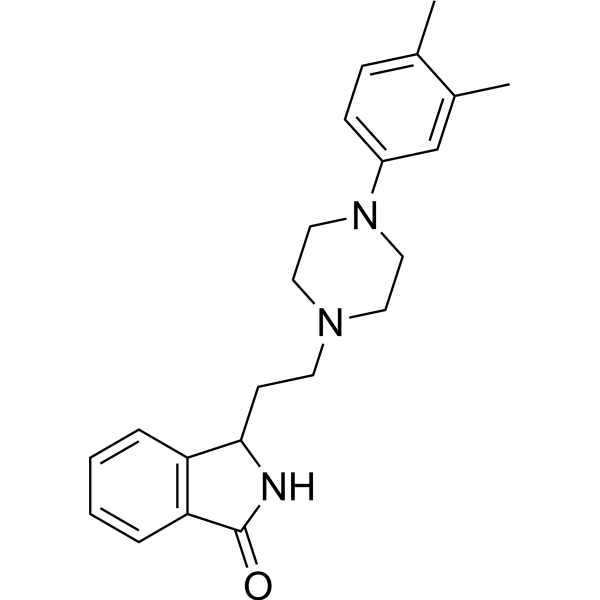
PD 168568 is a orally active and potent dopamine receptor D4 (DRD4) antagonist. PD 168568 contains an isoindolinone and is selective for the D4 receptor versus D2 and D3, with Ki values of 8.8, 1842, and 2682 nM, respectively. PD 168568 can be used for glioblastoma (GBM) research.
Para uso exclusivo en investigación. No vendemos a pacientes.
- No. CAS: 210688-56-5
- Fòrmula: C22H27N3O
- Peso molecular:349.47
-
Almacenamiento:Powder -20°C, 3 years ; In solvent -80°C, 6 months , -20°C, 1 month

To place orders, for customer services and technical support, please contact: MedChemExpress USA
Tel: 609-228-6898 E-mail: [email protected] [email protected]
Other In-stock Forms of PD 168568


-
 Actividad biológica
-
Chemical Information
- Pureza y Documentación
- Referencias
-
 Help & FAQs




Actividad biológica
Descripciòn
IC50 & Target
|
D4 Receptor 8.8 nM (Ki) |
D2 Receptor 1842 nM (Ki) |
D3 Receptor 2682 nM (Ki) |
In Vitro
PD 168568 shows selectivity inhibition toward glioblastoma neural stem cells (GNS), with IC50 of 25-50 µM[1].
MedChemExpress (MCE) has not independently confirmed the accuracy of these methods. They are for reference only.
In Vivo
MedChemExpress (MCE) has not independently confirmed the accuracy of these methods. They are for reference only.
-
Animal Model:Rat[1]
-
Dosage:3 mg/kg
-
Administration:Oral administration
-
Result:Inhibited amphetamine (0.5 mg/kg, i.p.) stimulated locomotor activity.


Chemical Information
-
No. CAS 210688-56-5
-
Appearance Solid
-
Peso molecular 349.47
-
Fòrmula C22H27N3O
-
Color White to off-white
-
SMILES
O=C1NC(CCN2CCN(C3=CC=C(C)C(C)=C3)CC2)C4=C1C=CC=C4
-
Envío
Room temperature in continental US; may vary elsewhere.
-
Almacenamiento
Powder -20°C 3 years In solvent -80°C 6 months -20°C 1 month


Pureza y Documentación


Referencias
[1]. Dolma S, et al. Inhibition of Dopamine Receptor D4 Impedes Autophagic Flux, Proliferation, and Survival of Glioblastoma Stem Cells. Cancer Cell. 2016 Jun 13;29(6):859-873. [Content Brief]
[2]. Lindsley CW, et al. Return of D4 Dopamine Receptor Antagonists in Drug Discovery. J Med Chem. 2017 Sep 14;60(17):7233-7243. [Content Brief]
[3]. Belliotti TR, et al. Isoindolinone enantiomers having affinity for the dopamine D4 receptor. Bioorg Med Chem Lett. 1998 Jun 16;8(12):1499-502. [Content Brief]

Calculators
Concentration (start) × Volume (start) = Concentration (final) × Volume (final)


PD 168568 Related Classifications
HY-103407 Related Classifications
 Powered by Bioz