



Semapimod
Based on 5 publication(s) in Google Scholar
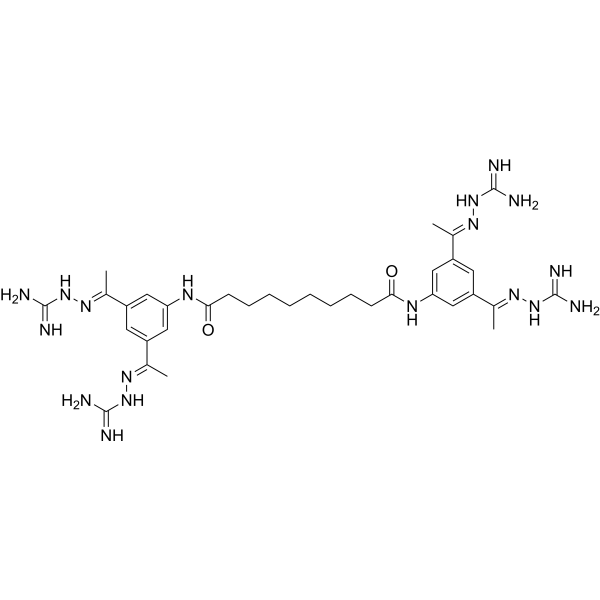
Semapimod, an inhibitor of proinflammatory cytokine production, can inhibit TNF-α, IL-1β, and IL-6. Semapimod inhibits TLR4 signaling (IC50≈0.3 μM). Semapimod inhibits p38 MAPK and nitric oxide production in macrophages. Semapimod has potential in a variety of inflammatory and autoimmune disorders.
Para uso exclusivo en investigación. No vendemos a pacientes.
- No. CAS: 352513-83-8
- Fòrmula: C34H52N18O2
- Peso molecular:744.90
-
Almacenamiento:
Please store the product under the recommended conditions in the Certificate of Analysis.

To place orders, for customer services and technical support, please contact: MedChemExpress USA
Tel: 609-228-6898 E-mail: [email protected] [email protected]


-
 Actividad biológica
-
Chemical Information
- Protocolo
- Pureza y Documentación
- Referencias
-
 Help & FAQs


Publications Citing Use of MedChemExpress (MCE) Semapimod
MoreVer todos los productos específicos de isoformas TNF Receptor
More

Actividad biológica
Descripciòn
IC50 & Target
|
CD40 |
IL-1β |
IL-6 |
p38 MAPK |
In Vitro
Semapimod leads to a significant decrease of p38-MAPK phosphorylation in macrophages, proinflammatory gene expression of macrophage inflammatory protein-1alpha, interleukin-6, monocyte chemoattractant protein-1, and intercellular adhesion molecule-1, and neutrophil infiltration. Semapimod completely abrogated nitric oxide production within the tunica muscularis[2].
Semapimod desensitizes TLR signaling via its effect on the TLR chaperone gp96. Semapimod tetrahydrochloride inhibits ATP-binding and ATPase activities of gp96 in vitro (IC50≈0.2-0.4 μM). Semapimod desensitizes TLR signaling via its effect on the TLR chaperone gp96[3].
Semapimod (0-500 nM) inhibits microglia-stimulated GL261 invasion[4].
Semapimod (0-10 µM) dose not affect serum-stimulated glioblastoma cell invasion, even at 10 µM, underlining the selectivity of semapimod for cells from the monocytic lineage[4].
Semapimod (200 nM) does not affect microglia-stimulated glioblastoma cell proliferation[4].
MedChemExpress (MCE) has not independently confirmed the accuracy of these methods. They are for reference only.
In Vivo
Semapimod restores AM-induced akt phosphorylation and cGMP production in OZ rats[1].
Semapimod (6 mg/kg/day, Intracranially for 1 week) inhibits glioblastoma cell invasion in vivo[4].
Semapimod (intracranially administered, 2 weeks) semapimos strongly increases the survival of GL261 tumor-bearing animals in combination with radiation, but has no significant benefit in the absence of radiation[4].
MedChemExpress (MCE) has not independently confirmed the accuracy of these methods. They are for reference only.
-
Animal Model:Male OZ rats[1]
-
Dosage:5 mg/kg
-
Administration:I.p; daily for 2 weeks
-
Result:Restored endothelium-dependent vasorelaxation in OZ rats.
-
Animal Model:C57Bl/6 mice (GL261 cells were orthotopically implanted)[4]
-
Dosage:6 mg/kg/day
-
Administration:Intracranially for 1 week, delivered via an osmotic pump
-
Result:Inhibited tumor cell invasion by more than 75%.
Ensayo clínico
| NCT Number | Sponsor | Condition | Start Date |
Phase

|
|---|---|---|---|---|
| NCT01329991 | Plexxikon| | 2011-05 | PHASE1 |


Chemical Information
-
No. CAS 352513-83-8
-
Peso molecular 744.90
-
Fòrmula C34H52N18O2
-
SMILES
O=C(NC1=CC(/C(C)=N/NC(N)=N)=CC(/C(C)=N/NC(N)=N)=C1)CCCCCCCCC(NC2=CC(/C(C)=N/NC(N)=N)=CC(/C(C)=N/NC(N)=N)=C2)=O
-
Synonyms
CNI-1493 free base; CPSI-2364
-
Envío
Room temperature in continental US; may vary elsewhere.
-
Almacenamiento
Please store the product under the recommended conditions in the Certificate of Analysis.


Publications (5)


Pureza y Documentación
Referencias
[1]. Nishimatsu H, et al. Blockade of endogenous proinflammatory cytokines ameliorates endothelial dysfunction in obese Zucker rats. Hypertens Res. 2008;31(4):737‐743. [Content Brief]
[2]. Wehner S, Set al. Inhibition of p38 mitogen-activated protein kinase pathway as prophylaxis of postoperative ileus in mice. Gastroenterology. 2009;136(2):619‐629. [Content Brief]
[3]. Wang J, et al. Experimental Anti-Inflammatory Drug Semapimod Inhibits TLR Signaling by Targeting the TLR Chaperone gp96. J Immunol. 2016;196(12):5130‐5137. [Content Brief]
[4]. Miller IS, et al. Semapimod sensitizes glioblastoma tumors to ionizing radiation by targeting microglia. PLoS One. 2014 May 9;9(5):e95885. [Content Brief]

Calculators
Concentration (start) × Volume (start) = Concentration (final) × Volume (final)


Semapimod Related Classifications
HY-15509 Related Classifications
 Powered by Bioz