



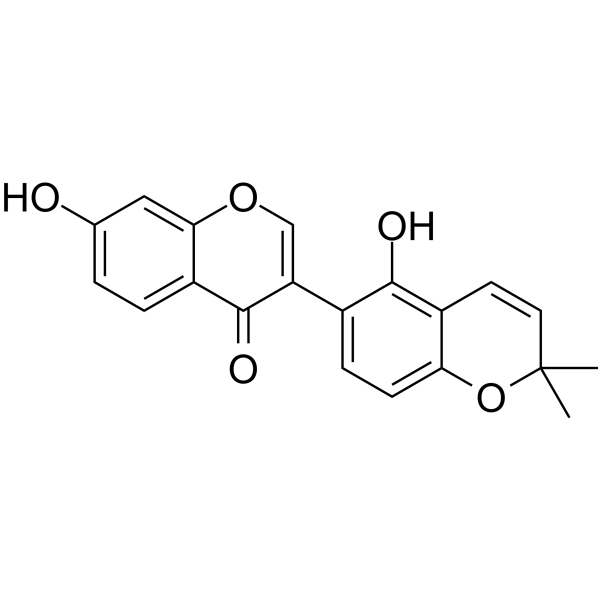
Glabrone
Based on 1 publication(s) in Google Scholar
Glabrone is an isoflavone found in Glycyrrhiza glabra roots. Glabrone exhibits significant PPAR-γ ligand binding activity. Glabrone is a specific UGT1A9 probe substrate, and its metabolites can block influenza virus release by inhibiting neuraminidase (NA). Glabrone can be used to screen for herb-drug interactions and for anti-influenza virus activity.
Nur für Forschungszwecke. Wir verkaufen nicht an Patienten.
- Reinheit : 99.08%
- CAS. Nr.: 60008-02-8
- Formel: C20H16O5
- Molecular Weight:336.34
-
Speicherung:
4°C, sealed storage, away from moisture and light
* In solvent : -80°C, 6 months; -20°C, 1 month (sealed storage, away from moisture and light)

To place orders, for customer services and technical support, please contact: MedChemExpress USA
Tel: 609-228-6898 E-mail: [email protected] [email protected]


-
 Biologische Aktivität
-
Chemical Information
-
Lösungsmittel & Löslichkeit
- Reinheit & Dokumentation
- Verweise
-
 Help & FAQs


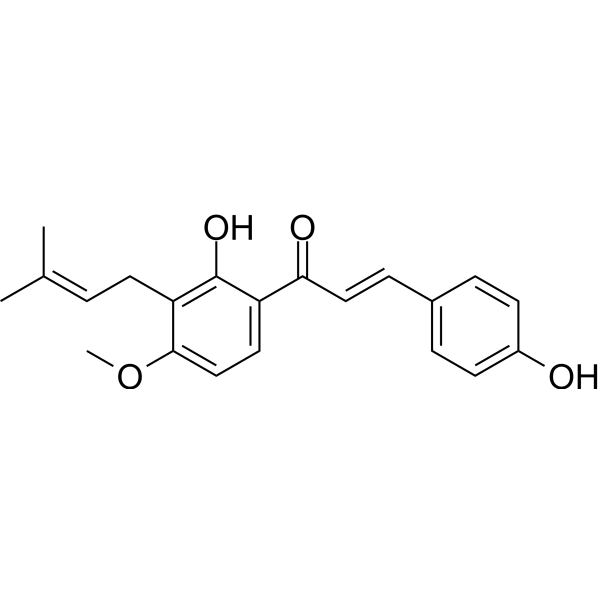
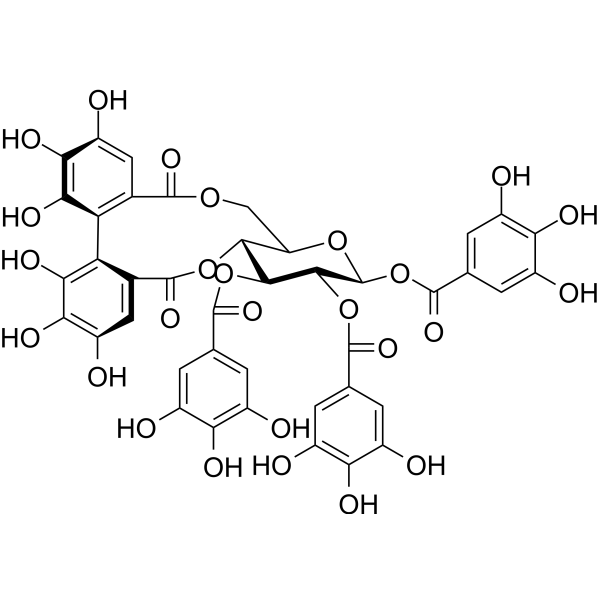
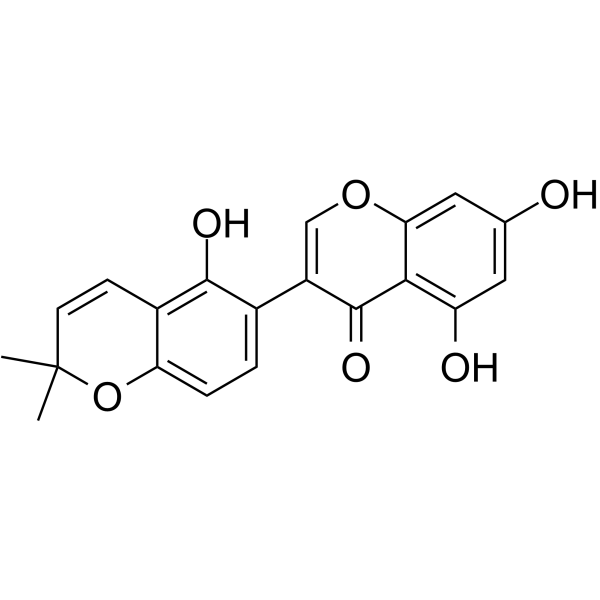
Publications Citing Use of MedChemExpress (MCE) Glabrone
More

Biologische Aktivität
Beschreibung
IC50 & Target
[2]|
PPAR-γ |
Cellular Effect
|
Cell Line

|
Type | Value | Description | References |
|---|---|---|---|---|
| MDCK | CC50 |
90.8 μM
Compound: 5
|
Cytotoxicity against MDCK cells after 72 hrs
Cytotoxicity against MDCK cells after 72 hrs
|
[PMID: 24313801] |
| MDCK | IC50 |
34.7 μM
Compound: 5
|
Antiviral activity against Influenza A virus J/8178/09 infected in MDCK cells assessed as inhibition of virus-induced cytopathic effect after 48 hrs
Antiviral activity against Influenza A virus J/8178/09 infected in MDCK cells assessed as inhibition of virus-induced cytopathic effect after 48 hrs
|
[PMID: 24313801] |
In Vitro
Glabrone (0.1-100 μM) inhibits the Oseltamivir (HY-13317)-susceptible viral NA of influenza virus PR/8/34 at concentrations lower than 10 μM[1].
Glabrone (0-50 μM, 48 h) significantly inhibits the cytopathic effect (CPE) of J/8178/09 (H1N1), and showed moderate inhibitory activity against HK/68 (H3N2) in Madin Darby canine kidney (MDCK) cells[1].
Glabrone exhibits Vmax and Km values of 362.6 nmol/min/mg protein and 17.2 μM for human liver microsomes (HLMs), and 382.3 nmol/min/mg protein and 16.6 μM for recombinant human UGT1A9, respectively[3].
MedChemExpress (MCE) has not independently confirmed the accuracy of these methods. They are for reference only.


Chemical Information
-
CAS. Nr. 60008-02-8
-
Appearance Solid
-
Molecular Weight 336.34
-
Formel C20H16O5
-
Color Off-white to light yellow
-
SMILES
O=C1C(C2=CC=C3C(C=CC(C)(C)O3)=C2O)=COC4=CC(O)=CC=C14
-
Structure Classification
-
Versand
Room temperature in continental US; may vary elsewhere.
-
Speicherung
4°C, sealed storage, away from moisture and light
* In solvent : -80°C, 6 months; -20°C, 1 month (sealed storage, away from moisture and light)


Publications (1)
-
Journal Impact Factor
-
Most Recent
-
Biomed Pharmacother
Multi-target mechanisms of glabrone in ulcerative colitis: Synergistic restoration of mucosal barrier and inhibition of inflammation through SRC/HSP90 Co-modulation. [Abstract]2026 Jan:194:118951. PMID: 41496348


Lösungsmittel & Löslichkeit
In Vitro:
DMSO : 25 mg/mL (74.33 mM; Need ultrasonic; Hygroscopic DMSO has a significant impact on the solubility of product, please use newly opened DMSO)
Please refer to the solubility information to select the appropriate solvent. Once prepared, please aliquot and store the solution to prevent product inactivation from repeated freeze-thaw cycles.
Storage method and period of stock solution: -80°C, 6 months; -20°C, 1 month (sealed storage, away from moisture and light). When stored at -80°C, please use it within 6 months. When stored at -20°C, please use it within 1 month.
Please refer to the solubility information to select the appropriate solvent. Once prepared, please aliquot and store the solution to prevent product inactivation from repeated freeze-thaw cycles.
Storage method and period of stock solution: -80°C, 6 months; -20°C, 1 month (sealed storage, away from moisture and light). When stored at -80°C, please use it within 6 months. When stored at -20°C, please use it within 1 month.
Konzentration (Stammlösung) × Volumen (Stammlösung) = Konzentration (Ziellösung) × Volumen (Ziellösung)
In Vivo:
Select the appropriate dissolution method based on your experimental animal and administration route.
- For the following dissolution methods, please ensure to first prepare a clear stock solution using an In Vitro approach and then sequentially add co-solvents:
- To ensure reliable experimental results, the clarified stock solution can be appropriately stored based on storage conditions. As for the working solution for In Vivo experiments, it is recommended to prepare freshly and use it on the same day.
- The percentages shown for the solvents indicate their volumetric ratio in the final prepared solution. If precipitation or phase separation occurs during preparation, heat and/or sonication can be used to aid dissolution.
Add each solvent one by one: 10% DMSO 40% PEG300 5% Tween-80 45% Saline
Solubility: ≥ 0.5 mg/mL (1.49 mM); Clear solution
This protocol yields a clear solution of ≥ 0.5 mg/mL (saturation unknown).
Taking 1 mL working solution as an example, add 100 μL DMSO stock solution (5.0 mg/mL) to 400 μL PEG300, and mix evenly; then add 50 μL Tween-80 and mix evenly; then add 450 μL Saline to adjust the volume to 1 mL.
Preparation of Saline: Dissolve 0.9 g sodium chloride in ddH₂O and dilute to 100 mL to obtain a clear Saline solution.
In Vivo Dissolution Calculator
Please enter the basic information of animal experiments:
-
-
-
-
Recommended: Prepare an additional quantity of animals to account for potential losses during experiments.
Please enter your animal formula composition:
-
%DMSO +
Recommended: Keep the proportion of DMSO in working solution below 2% if your animal is weak.
-
%+
-
+%Tween-80 + +
-
%Saline +
The co-solvents required include: DMSO, . All of co-solvents are available by MedChemExpress (MCE). , Tween 80. All of co-solvents are available by MedChemExpress (MCE).
Working solution concentration: 0.22 mg/mL
Method for preparing stock solution: mg drug dissolved in μL DMSO. Stock solution concentration: mg/mL. * In solvent : -80°C, 6 months; -20°C, 1 month (sealed storage, away from moisture and light)
1. Take μL DMSO stock solution;
2. Add μL .
μL , mix evenly;
3. Then add μL Tween 80, mix evenly;
4. Then add μL
Please ensure that the stock solution in the first step is dissolved to a clear state, and add co-solvents in sequence. You can use ultrasonic heating (ultrasonic cleaner, recommended frequency 20-40 kHz), vortexing, etc. to assist dissolution.


Reinheit & Dokumentation
-
Data Sheet (274 KB)
-
SDS (252 KB)
- English - EN (252 KB)
- Français - FR (252 KB)
- Deutsch - DE (252 KB)
- Norwegian - NO (252 KB)
- Español - ES (252 KB)
- Swedish - SV (252 KB)
- Italian - IT (252 KB)
- Korean - KR (252 KB)
- Portuguese - PT (252 KB)
-
Handling Instructions (2659 KB)
Verweise
[1]. Grienke U, et al. Computer-guided approach to access the anti-influenza activity of licorice constituents. J Nat Prod. 2014 Mar 28;77(3):563-70. [Content Brief]
[2]. Kuroda M, et al. Phenolics from Glycyrrhiza glabra roots and their PPAR-gamma ligand-binding activity. Bioorg Med Chem. 2010 Jan 15;18(2):962-70. [Content Brief]
[3]. Kuang Y, et al. Glabrone as a specific UGT1A9 probe substrate and its application in discovering the inhibitor glycycoumarin. Eur J Pharm Sci. 2021 Jun 1;161:105786. [Content Brief]


Complete Stock Solution Preparation Table
Please refer to the solubility information to select the appropriate solvent. Once prepared, please aliquot and store the solution to prevent product inactivation from repeated freeze-thaw cycles.
Storage method and period of stock solution: -80°C, 6 months; -20°C, 1 month (sealed storage, away from moisture and light). When stored at -80°C, please use it within 6 months. When stored at -20°C, please use it within 1 month.
| Optional Solvent | Concentration Solvent Mass | 1 mg | 5 mg | 10 mg | 25 mg |
|---|---|---|---|---|---|
| DMSO | 1 mM | 2.9732 mL | 14.8659 mL | 29.7318 mL | 74.3295 mL |
| 5 mM | 0.5946 mL | 2.9732 mL | 5.9464 mL | 14.8659 mL | |
| 10 mM | 0.2973 mL | 1.4866 mL | 2.9732 mL | 7.4330 mL | |
| 15 mM | 0.1982 mL | 0.9911 mL | 1.9821 mL | 4.9553 mL | |
| 20 mM | 0.1487 mL | 0.7433 mL | 1.4866 mL | 3.7165 mL | |
| 25 mM | 0.1189 mL | 0.5946 mL | 1.1893 mL | 2.9732 mL | |
| 30 mM | 0.0991 mL | 0.4955 mL | 0.9911 mL | 2.4777 mL | |
| 40 mM | 0.0743 mL | 0.3716 mL | 0.7433 mL | 1.8582 mL | |
| 50 mM | 0.0595 mL | 0.2973 mL | 0.5946 mL | 1.4866 mL | |
| 60 mM | 0.0496 mL | 0.2478 mL | 0.4955 mL | 1.2388 mL |


Glabrone Related Classifications
HY-N4194 Related Classifications
 Powered by Bioz