



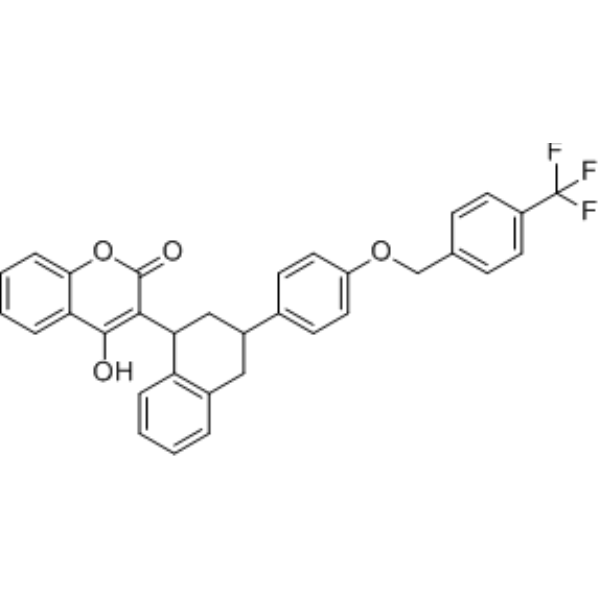
Flocoumafen

Based on 1 Customer Validation
Flocoumafen (WL 108366) is an orally active vitamin K epoxide reductase inhibitor and a multi-target ligand, which includes prostaglandin F synthase, serum albumin, glucocorticoid receptor 2, and MMP-9. Flocoumafen is a second-generation anticoagulant rodenticide (ARs) with a half-life of 177.4 hours and has deadly anticoagulant effects.
For research use only. We do not sell to patients.
- Purity : 99.35%
- CAS No.: 90035-08-8
- Formula: C33H25F3O4
- Molecular Weight:542.54
-
Storage:Powder -20°C, 3 years , 4°C, 2 years ; In solvent -80°C, 6 months , -20°C, 1 month

To place orders, for customer services and technical support, please contact: MedChemExpress USA
Tel: 609-228-6898 E-mail: [email protected] [email protected]


-
 Biological Activity
-
Chemical Information
-
Solvent & Solubility
- Protocols
- Purity & Documentation
- References
-
 Help & FAQs




Biological Activity
Description
IC50 & Target
|
MMP-9 |
Glucocorticoid Receptor 2 |
In Vitro
Flocoumafen best compound is prostaglandin F synthase and serum albumin (binding affinity ≥ 14.0 kcal/mol), followed by glucocorticoid receptor 2, matrix metalloproteinase-9, nuclear receptor ROR-alpha, and activin receptor type-1, with a binding affinity of ≥ 13.5 kcal/mol[1].
MedChemExpress (MCE) has not independently confirmed the accuracy of these methods. They are for reference only. Further protocols information, click here.
In Vivo
MedChemExpress (MCE) has not independently confirmed the accuracy of these methods. They are for reference only.
-
Animal Model:Male Fischer rats[3]
-
Dosage:0.02 and 0.1 mg/kg; once a week; for 14 weeks
-
Administration:Oral
-
Result:Caused noticeable cell accumulation in the liver, with residuals increasing as the dose rises at low doses, while at high doses, it stabilized after a while. The lethal anticoagulant effected only occurs when the binding sites were saturated.
Showed about 30% of the cumulative dosage disappeared from the feces within 3 days after each administration at low doses,for high doses, this value ranges from 18% after the first dose to 59% after the tenth dose, and anticoagulant toxicity appeared after six weeks.


Chemical Information
-
CAS No. 90035-08-8
-
Appearance Solid
-
Molecular Weight 542.54
-
Formula C33H25F3O4
-
Color White to off-white
-
SMILES
O=C1C(C2CC(C3=CC=C(OCC4=CC=C(C(F)(F)F)C=C4)C=C3)CC5=C2C=CC=C5)=C(O)C6=CC=CC=C6O1
-
Synonyms
WL 108366
-
Shipping
Room temperature in continental US; may vary elsewhere.
-
Storage
Powder -20°C 3 years 4°C 2 years In solvent -80°C 6 months -20°C 1 month


Solvent & Solubility
In Vitro:
DMSO : 100 mg/mL (184.32 mM; Need ultrasonic; Hygroscopic DMSO has a significant impact on the solubility of product, please use newly opened DMSO)
Please refer to the solubility information to select the appropriate solvent. Once prepared, please aliquot and store the solution to prevent product inactivation from repeated freeze-thaw cycles.
Storage method and period of stock solution: -80°C, 6 months; -20°C, 1 month. When stored at -80°C, please use it within 6 months. When stored at -20°C, please use it within 1 month.
Please refer to the solubility information to select the appropriate solvent. Once prepared, please aliquot and store the solution to prevent product inactivation from repeated freeze-thaw cycles.
Storage method and period of stock solution: -80°C, 6 months; -20°C, 1 month. When stored at -80°C, please use it within 6 months. When stored at -20°C, please use it within 1 month.
Concentration (start) × Volume (start) = Concentration (final) × Volume (final)
In Vivo:
Select the appropriate dissolution method based on your experimental animal and administration route.
- For the following dissolution methods, please ensure to first prepare a clear stock solution using an In Vitro approach and then sequentially add co-solvents:
- To ensure reliable experimental results, the clarified stock solution can be appropriately stored based on storage conditions. As for the working solution for In Vivo experiments, it is recommended to prepare freshly and use it on the same day.
- The percentages shown for the solvents indicate their volumetric ratio in the final prepared solution. If precipitation or phase separation occurs during preparation, heat and/or sonication can be used to aid dissolution.
In Vivo Dissolution Calculator
Please enter the basic information of animal experiments:
-
-
-
-
Recommended: Prepare an additional quantity of animals to account for potential losses during experiments.
Please enter your animal formula composition:
-
%DMSO +
Recommended: Keep the proportion of DMSO in working solution below 2% if your animal is weak.
-
%+
-
+%Tween-80 + +
-
%Saline +
The co-solvents required include: DMSO, . All of co-solvents are available by MedChemExpress (MCE). , Tween 80. All of co-solvents are available by MedChemExpress (MCE).
Working solution concentration: 0.22 mg/mL
Method for preparing stock solution: mg drug dissolved in μL DMSO. Stock solution concentration: mg/mL.
1. Take μL DMSO stock solution;
2. Add μL .
μL , mix evenly;
3. Then add μL Tween 80, mix evenly;
4. Then add μL
Please ensure that the stock solution in the first step is dissolved to a clear state, and add co-solvents in sequence. You can use ultrasonic heating (ultrasonic cleaner, recommended frequency 20-40 kHz), vortexing, etc. to assist dissolution.

Protocols
-
Mitochondrial membrane-potential fluorescent assay
Mitochondrial membrane potential fluorescent assays estimate ΔΨm in living cells using lipophilic cationic dyes such as TMRM, TMRE, rhodamine 123, and JC-1, which accumulate in mitochondria according to membrane polarization; loss of signal after FCCP or CCCP treatment is interpreted as mitochondrial depolarization. TMRM/TMRE and rhodamine 123 are commonly used for semi-quantitative live-cell microscopy or flow cytometry, while JC-1 can report a shift from red aggregate fluorescence to green monomer fluorescence during depolarization; interpretation requires controls because dye concentration, quenching mode, cell type, dye efflux, and mitochondrial mass can affect fluorescence independently of ΔΨm.
-
Research Protocol for Endocrine Diseases
Endocrine diseases often arise from disrupted hormone production, hormone signaling, or target-tissue responsiveness; for diabetes-focused endocrine disease models, insulin signaling regulates glucose uptake, hepatic glucose output, lipid metabolism, and β-cell compensation. Type 2 diabetes develops through interacting defects in insulin resistance, β-cell dysfunction, adipose inflammation, hepatic glucose overproduction, altered incretin signaling, and ectopic lipid metabolism. A major unresolved question is whether endocrine dysfunction is driven primarily by target-tissue insulin resistance, intrinsic β-cell failure, immune/inflammatory stress, or combined multi-organ failure that differs by disease stage.
-
Mitochondrial membrane-potential and mitochondrial mass staining
Mitochondrial membrane potential staining measures the electrochemical polarization across the mitochondrial inner membrane in live cells using lipophilic cationic fluorescent probes; early rhodamine-based work showed that selective mitochondrial dye accumulation is lost when the mitochondrial transmembrane potential is dissipated. JC-1 reports mitochondrial polarization by shifting from green monomer fluorescence to red J-aggregate fluorescence as dye concentration increases within energized mitochondria; therefore, the red/green fluorescence ratio is used as a relative readout of mitochondrial membrane potential. TMRE or TMRM staining provides a single-channel relative readout because these cationic rhodamine esters accumulate in polarized mitochondria, and lower fluorescence indicates reduced mitochondrial polarization when acquisition and dye-loading conditions are controlled. Mitochondrial mass staining is commonly performed with MitoTracker Green FM or related MitoTracker dyes as
-
Protocol for Pharmacokinetic Study
Pharmacokinetic studies quantify how an organism handles a drug over time through absorption, distribution, metabolism, and excretion, and the core experimental readout is the concentration-time profile of parent drug and, when relevant, metabolites in biological matrices such as plasma, whole blood, urine, bile, or tissue. Pharmacokinetic analysis links dose, route, exposure, clearance, half-life, distribution, bioavailability, and systemic exposure to drug efficacy and toxicity hypotheses rather than measuring a signaling pathway directly. The literature links pharmacokinetics to drug-development phenotypes by showing that drug metabolism and pharmacokinetics influence compound progression, exposure-response interpretation, safety margins, dosing strategy, and failure risk during discovery and development. DMPK science contributes to compound optimization by integrating physicochemical properties, in vitro metabolism, transporter behavior, in vivo exposure, and pharmacodynamic contex


Purity & Documentation
-
Data Sheet (273 KB)
-
SDS (789 KB)
- English - EN (789 KB)
- Français - FR (789 KB)
- Deutsch - DE (789 KB)
- Norwegian - NO (789 KB)
- Español - ES (789 KB)
- Swedish - SV (789 KB)
- Italian - IT (789 KB)
- Korean - KR (789 KB)
- Portuguese - PT (789 KB)
-
Handling Instructions (2659 KB)
References
[1]. Nadia Coronado-Posada, et al. In Silico Analysis to Identify Molecular Targets for Chemicals of Concern: The Case Study of Flocoumafen, an Anticoagulant Pesticide. Environ Toxicol Chem. 2021 Jul;40(7):2034-2043. [Content Brief]
[3]. Huckle KR, et al. Elimination and accumulation of the rodenticide flocoumafen in rats following repeated oral administration. Xenobiotica. 1988 Dec;18(12):1465-79. [Content Brief]


Complete Stock Solution Preparation Table
Please refer to the solubility information to select the appropriate solvent. Once prepared, please aliquot and store the solution to prevent product inactivation from repeated freeze-thaw cycles.
Storage method and period of stock solution: -80°C, 6 months; -20°C, 1 month. When stored at -80°C, please use it within 6 months. When stored at -20°C, please use it within 1 month.
| Optional Solvent | Concentration Solvent Mass | 1 mg | 5 mg | 10 mg | 25 mg |
|---|---|---|---|---|---|
| DMSO | 1 mM | 1.8432 mL | 9.2159 mL | 18.4318 mL | 46.0796 mL |
| 5 mM | 0.3686 mL | 1.8432 mL | 3.6864 mL | 9.2159 mL | |
| 10 mM | 0.1843 mL | 0.9216 mL | 1.8432 mL | 4.6080 mL | |
| 15 mM | 0.1229 mL | 0.6144 mL | 1.2288 mL | 3.0720 mL | |
| 20 mM | 0.0922 mL | 0.4608 mL | 0.9216 mL | 2.3040 mL | |
| 25 mM | 0.0737 mL | 0.3686 mL | 0.7373 mL | 1.8432 mL | |
| 30 mM | 0.0614 mL | 0.3072 mL | 0.6144 mL | 1.5360 mL | |
| 40 mM | 0.0461 mL | 0.2304 mL | 0.4608 mL | 1.1520 mL | |
| 50 mM | 0.0369 mL | 0.1843 mL | 0.3686 mL | 0.9216 mL | |
| 60 mM | 0.0307 mL | 0.1536 mL | 0.3072 mL | 0.7680 mL | |
| 80 mM | 0.0230 mL | 0.1152 mL | 0.2304 mL | 0.5760 mL | |
| 100 mM | 0.0184 mL | 0.0922 mL | 0.1843 mL | 0.4608 mL |


Flocoumafen Related Classifications
HY-111186 Related Classifications
 Powered by Bioz